
The best educational book lists for 2026 come from four sources worth bookmarking right now: School Reading List, Books for Topics (home of the National Year of Reading picks), Bank Street College's Best Children's Books, and the Association for Library Service to Children (ALSC) summer lists. Each one is vetted, not crowdsourced, which matters more than you'd think.
Short on time? Start here:
- Picture book: The Fabled Stables style adventure titles topping Bank Street's 2026 list for read-aloud warmth and visual storytelling.
- Middle-grade: Anything from ALSC's grades 3–5 summer roster, built for independent reading stamina.
- Educator resource: ReadingList's State of K-12 Reading 2026 for Lexile-mapped curriculum planning.
Bank Street's panel reviewed over 600 titles published in 2025 alone before naming its 2026 selections, screening for literary quality, emotional resonance, and representation. That's the kind of scrutiny a random "best books" roundup rarely gets.
Key Takeaways
A reliable 2026 reading list combines panel-vetted sources like Bank Street and ALSC with grade-banded picks matched to reading level and content suitability, then gets revisited every term.
| Point | Details |
|---|---|
| Bookmark four core sources | Follow School Reading List, Books for Topics, Bank Street College, and ALSC for vetted 2026 picks. |
| Match Lexile to content check | Reading level and content appropriateness are separate checks; verify both before assigning a book. |
| Refresh lists each term | Swap underperforming titles and add student nominations at each term break, not just annually. |
| Mix formats deliberately | Use print, audiobooks, and e-readers by purpose, not as a reward hierarchy. |
| Involve parents monthly | Send short, themed excerpts with one-line reasons instead of a full title dump. |
Table of Contents
- Educational Book Lists 2026: Which Sources to Trust
- Best Book Picks by Age and Stage (Reception Through KS5)
- Themed Book Lists for STEM, Inclusion, Wellbeing, and History
- Professional Reading for Teachers and School Leaders in 2026
- What Separates a Well-Vetted List From Noise
- Updating Your Book List as the School Year Changes
- Matching Books to Reading Level and Content Appropriateness
- Getting Parents and Caregivers Involved in Home Reading
- Using Audiobooks and Digital Formats Alongside Print
- Ready to Add a Few More Titles to Your List?
- Educational Book Lists 2026: What Actually Matters
- Sources
Educational Book Lists 2026: Which Sources to Trust
Not every list deserves a bookmark. Some are built by committees who read the books. Others are auto-generated from bestseller data. Here's who actually does the work.
- School Reading List aggregates grade-banded recommendations for children and teens, organized for UK classroom planning and parental browsing, with themes and age filters that make it a fast reference during term planning.
- Books for Topics — anchors its National Year of Reading picks to curriculum topics, so a Year 4 teacher covering the Romans can pull five matched titles in minutes.
- Bank Street College — runs a review panel of librarians, educators, and child development specialists who read every submitted title before it earns a spot on the annual list.
- ALSC's 2026 summer reading lists split into birth to preK, K–2, grades 3–5, and grades 6–8 bands, designed specifically for library programs and family reading over the break.
Use School Reading List and Books for Topics for weekly curriculum planning. Save Bank Street for library acquisitions and gift guides. Pull ALSC's lists every June for summer reading kits.
Best Book Picks by Age and Stage (Reception Through KS5)
Reading level matters as much as subject matter. ReadingList's 2026 data shows Lexile ranges climbing steadily from early grades through high school, and mismatched books are the single most common reason a reluctant reader stays reluctant.
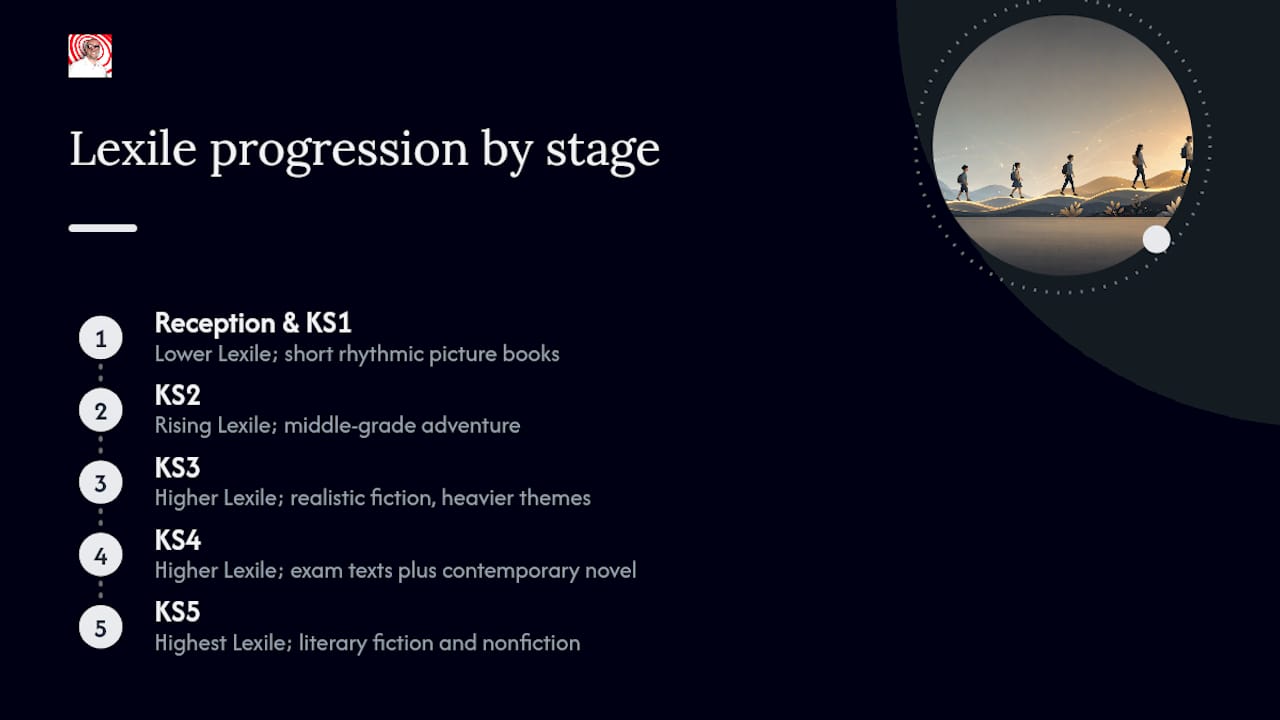
Reception and KS1: Short, rhythmic picture books with repeated phrases work best for decoding practice. Use them for daily read-alouds and point out rhyming patterns as an informal phonics check. Our early readers guide breaks down what to look for at this stage.
KS2: Middle-grade adventure and mystery titles from ALSC's grades 3–5 band build reading stamina. Assign a chapter a night and follow with a two-minute retell exercise. This is also when kids start choosing their own books, so a reading habits checklist helps parents spot when a child is coasting versus genuinely engaged.
KS3: Realistic fiction and light dystopian titles suit this stage's appetite for moral complexity. Use small-group discussion circles rather than solo book reports. Watch for content shifts, since KS3 titles start introducing heavier themes than KS2 readers are used to.
KS4: Exam-linked texts still dominate, but pair them with a contemporary novel on a similar theme for contrast essays. This keeps required reading from feeling like the only reading.
KS5: Literary fiction and nonfiction from Bank Street's older-reader picks work well for independent study and university preparation. Encourage annotation and cross-referencing between assigned texts and personal choice reading.
At every stage, check a title's suitability before assigning it class-wide. A book that reads as edgy at KS3 might be exactly right at KS4 and completely wrong two years earlier.
Themed Book Lists for STEM, Inclusion, Wellbeing, and History
Curriculum themes need their own shortlists, not a single generic "good books" pile.
- STEM: Nonfiction explainers on space, engineering, and coding paired with a hands-on experiment tie a chapter to a real activity the same week.
- Diversity and inclusion: Stories centering underrepresented voices work best when followed by a class discussion connecting a character's experience to a current event. Our piece on why diversity in kids' books matters covers selection criteria in more depth.
- Mental health and wellbeing: Gentle fiction dealing with anxiety or friendship conflict opens well with a "how would you handle this" journal prompt rather than a formal essay.
- History and social studies: Historical fiction tied to a specific era pairs naturally with a primary-source comparison activity, letting students spot where the novel took creative license.
Pro Tip: When building a themed list for a mixed-ability class, apply Universal Design for Learning from the start rather than retrofitting easier options later. The Handbook of Universal Design for Learning makes the case that inclusive selection built in from day one beats a bolted-on "easy version" every time.
Professional Reading for Teachers and School Leaders in 2026
Your own reading list matters too. These picks focus on practice you can apply, not theory that sits on a shelf.
- A science-of-reading title from Edutopia's 2026 roundup sharpens phonics instruction for early-grade teachers.
- A UDL-focused text helps you plan lessons that work for mixed-ability classrooms without separate tracks.
- An assessment-focused book from the Eduettu 2026 list reframes formative feedback as an ongoing conversation, not a grade.
- A leadership title from Engineerica's leadership roundup anchors decisions about curriculum change and staff buy-in.
One practical strategy: choose one book to sharpen your individual craft and one to build a shared vocabulary across your team, then bring both into your next PLC meeting. Recent coverage of teacher professional reading habits found that small, sustainable changes, like adopting one new discussion routine, stick better than an overhaul of your entire reading program.
What Separates a Well-Vetted List From Noise
Anyone can publish a "best books of 2026" post. Few back it with real review criteria. Before trusting a list, check for these signals:
- Does it name a review panel, or just a single blogger's opinion?
- Does it cite reading-level data, like Lexile scores, rather than vague age ranges?
- Does it cross-reference curriculum standards, the way ReadingList's dataset does?
- Does it address representation deliberately, the way Bank Street's panel does, rather than as an afterthought?
A panel-reviewed list, where multiple librarians and educators independently score submissions, catches blind spots a single curator misses. A crowd-sourced bestseller list just reflects whoever bought the most copies that month, which says more about marketing budgets than classroom fit.
Updating Your Book List as the School Year Changes
A reading list built in September rarely fits the class you have by March. Reading levels shift, interests change, and what worked as a September icebreaker can feel stale by spring term.
Revisit your list at each term break, not just once a year. Swap in titles based on what actually got read versus what sat untouched. If a themed unit on the Victorians landed flat, don't just adjust the unit. Check whether the paired book was the problem.
Build in a mid-year check where students nominate a book they loved that isn't on your official list. Some of the strongest additions to a KS2 or KS3 reading list come from a student's own recommendation, not a curated source. Cross-reference their pick against a source like Books for Topics to confirm it still supports your curriculum goals before making it official.
Track which books consistently underperform, meaning kids avoid them or rush through without engagement, and retire them. A list that never changes isn't a strength. It's a sign nobody's checking whether the books still work for the students in front of you.
Matching Books to Reading Level and Content Appropriateness
Reading difficulty and content appropriateness are two different checks, and conflating them is where most misassigned books go wrong. A book can sit at the perfect Lexile score for a student and still contain content that isn't right for their age or your specific classroom.
Check reading difficulty first using Lexile ranges or a grade-band guide like the one in ReadingList's 2026 report, which maps how ranges climb from elementary through high school. A student reading two grade levels ahead in decoding skill isn't automatically ready for a book aimed at that older age group emotionally.
Then check content separately. Read a plot summary and, ideally, the first and last chapters yourself before assigning a book class-wide. Look for themes around violence, loss, or mature relationships that might need parental notice or a content warning, even in a book that's otherwise a strong reading-level match.
For older readers exploring suspense or thriller genres, content appropriateness deserves particular attention since pacing and tension can outrun a student's reading level even when vocabulary doesn't. Our guide to suspense and young readers walks through how to judge whether a suspenseful title suits a specific age group.
When in doubt, offer a choice between two titles at a similar reading level with different content intensity, and let the student or parent pick.
Getting Parents and Caregivers Involved in Home Reading
A school's book list only works as well as the reading that happens off school grounds. Parents need more than a title dump at parents' evening to actually use a list at home.
Send home a short, themed excerpt from your curated list each month rather than the full roster at once. A shorter list gets read; a forty-title spreadsheet gets ignored. Include a one-line reason for each pick, the same format used throughout this article, so a busy parent can scan it in under a minute.
Frame requests around a shared activity, not just "read more." Suggest a specific bedtime read-aloud pairing, or a car-ride audiobook for the drive to weekend sports. Our parent's guide to reading benefits breaks down exactly why ten minutes of shared reading a night moves the needle more than an hour of solo screen-free reading time imposed as a rule.
Some of the best engagement comes from letting a caregiver share what they're reading too. A quick "what I'm reading this week" note home, matched to a caregiver's own book, builds the kind of two-way conversation that a static list never will.
Using Audiobooks and Digital Formats Alongside Print
Print books aren't the only format worth putting on a 2026 reading list, and treating audio or digital as a lesser substitute undersells what they actually do well.
Audiobooks build listening comprehension and vocabulary exposure at a pace often ahead of a struggling reader's decoding speed, which means a student can access grade-level content and themes before their independent reading catches up. Pair a physical copy with its audiobook for a struggling reader, letting them follow along visually while listening, a technique that strengthens word recognition without the frustration of sounding out every line alone.

E-readers with adjustable font size and built-in dictionaries remove friction for readers who find dense print pages overwhelming. For a classroom with mixed devices, a digital format also solves the practical problem of stocking multiple physical copies of the same title.
Don't treat audio and digital as reward-only options for kids who "can't" read print. Use them as legitimate format choices tied to purpose: audiobooks for car rides and multitasking, e-readers for travel, print for the deep, distraction-free sessions that build sustained attention. A well-rounded 2026 reading list offers all three and lets the reading goal, not the format snobbery, decide which one fits a given moment.
Ready to Add a Few More Titles to Your List?
A good reading list always has room for one more book that surprises a reluctant reader into finishing it. If you're building out your Reception or KS1 shelf, browse the children's book collection at Markwatsonbooks for illustrated titles built around exactly the kind of read-aloud warmth Bank Street's panel rewards. For KS4 and KS5 students ready for something with real narrative tension, and where content suitability has been checked against your class, the full book catalog covers thriller and suspense titles worth a look once you've confirmed the fit.
If you're compiling a broader family reading roundup for a newsletter or blog, Wild Foodz's family travel and lifestyle content occasionally features seasonal reading picks worth cross-referencing for a parent audience planning school breaks.
Educational Book Lists 2026: What Actually Matters
The conventional wisdom treats a reading list as a static document you build once a year and hand out. That's backward. The most useful list is the one you're willing to argue with, term by term, based on what your actual students respond to.
What's overrated is chasing the newest release the moment it's published. Bank Street's panel takes time to review titles for a reason, and a book that just came out hasn't had a chance to prove it holds up to a second reading or a classroom discussion. What's underrated is the boring discipline of checking Lexile data against your actual class roster instead of trusting an age range printed on the back cover.
If you take one thing from this, prioritize the mismatch problem first. A brilliant book assigned two reading levels off does more damage to a reluctant reader's confidence than a mediocre book that fits. Get the fit right, then worry about finding the perfect title.
Sources
Diversity and inclusion themes get most of the attention, but global perspective is a separate skill worth building deliberately. A student can read plenty of inclusive titles set entirely in their own country and still never encounter a story told from outside a Western viewpoint.
Look for translated fiction, not just stories about other cultures written by domestic authors. A novel translated from another language carries sentence rhythms and storytelling conventions that differ from what students are used to, and that friction is educational in itself.
Pair a historical fiction unit with a nonfiction text from the region being studied, written by an author from that region when possible. Rotate read-aloud selections so at least one title per term is set outside the UK or the US, in a country students haven't studied before.
For classroom discussion, ask students to compare a story's family structure, school system, or community norms to their own rather than just its plot. That comparison builds the kind of perspective-taking that a single "diverse books" unit can't cover on its own. Global perspective isn't a theme you check off. It's a habit you build across the whole year, one book at a time.
- Bank Street College — The Best Children’s Books of the Year (2026 edition)
- State of K-12 Reading Lists 2026 | ReadingList
- 2026 Summer Reading Lists | Association for Library Service to Children
- Education Books You Shouldn't Miss | Edutopia