
The most reliable, repeatable story inspiration sources are personal memory, news archives, visual art, music, dreams, objects, and curated prompt pools. According to Writer's Digest, these categories work because they are always available, always changing, and always personal enough to produce a distinctive voice. You don't wait for lightning. You build a system.
Two prompts you can run right now:
- "What if" prompt: What if your neighbor has been living under a false identity for twenty years, and today a stranger knocks on their door? Set a timer for 10 minutes and write the scene from the stranger's point of view.
- "Object out of place" prompt: A child's shoe sits on the center of a highway at 3 AM. Who left it there, and why is the other shoe missing? Write the first 150 words.
After you run either prompt, drop your raw idea into an idea bank entry: one line describing the premise, one line capturing the feeling it gave you. That file becomes your creative fuel for months.
Key Takeaways
The most reliable story inspiration sources are the ones you can return to every single day without running dry: memory, news, objects, images, music, dreams, and prompt pools.
| Point | Details |
|---|---|
| Use multiple source categories | Rotate between memory, news, objects, music, and prompts to keep your range wide and your ideas fresh. |
| Run timed exercises daily | A 10–15 minute timed prompt session produces more usable seeds than an hour of unfocused free writing. |
| Build an idea bank | File every seed with a source tag and a one-line emotional note; review monthly and flag the ideas that still feel alive. |
| Apply the "What if" technique | One "What if" question per day, based on something you actually noticed, builds thirty seeds in a month. |
| Markwatsonbooks as study material | The horror and children's collections model how small, strange details escalate into full narrative tension. |
Table of Contents
- 2. Headlines and weird news archives hold ready-made story seeds
- 3. Historical records and primary documents give your story unusual texture
- 4. Visual art and photographs unlock nonverbal story prompts
- 5. A misplaced object can crack open an entire story
- 6. Music and soundscapes set mood, pacing, and character voice
- 7. Dreams and the subconscious give you images logic can't invent
- 8. Prompt pools and communities like Writer's Digest and Reddit r/writing accelerate idea generation
- 9. Constraints and form experiments force your best ideas out
- 10. Ready-to-use exercises and prompt templates you can run right now
- 11. Turning idea-finding into a daily habit that actually sticks
- 12. How to pick the right source for your next writing session
- The honest truth about where ideas actually come from
- Mark Watson's books as study material and practice fuel
- Sources
2. Headlines and weird news archives hold ready-made story seeds
Real life is stranger and more dramatic than most invented plots. Writer's Digest confirms that news archives and weird-news feeds are among the most dependable sources for unusual, true-to-life story seeds. The key is knowing where to look and how to adapt quickly.
Where to search:
- Newspaper archives (ProQuest Historical Newspapers, Chronicling America at the Library of Congress)
- "Weird News" sections at major outlets and aggregators
- Human-interest columns in regional papers
- Reddit's r/TrueOffMyChest and r/UnresolvedMysteries for contemporary oddities
Search tactic: Use a keyword plus a date range plus a location. Try "abandoned child + 1920s + rural Ohio" or "unexplained fire + 1970s + Louisiana." The specificity surfaces stories that have never been fictionalized.
Three headline-to-logline examples:
- Headline: "Man found living in airport for 18 years." Story seed: A man with no country chooses the terminal as home. Logline: When authorities finally locate his family, he refuses to leave.
- Headline: "Town votes to ban all mirrors." Story seed: A superstition becomes law. Logline: A newcomer discovers what the town is really afraid of seeing.
- Headline: "Letters found in a wall during renovation, dated 1943." Story seed: Someone hid correspondence they couldn't send. Logline: A contractor reads them and realizes the sender is still alive.
Pro Tip: Fictionalize responsibly. Change identifying details, combine two separate incidents into one, and never exploit a living victim's trauma for plot. The goal is the emotional truth of the situation, not a retelling of someone's worst day.
3. Historical records and primary documents give your story unusual texture
Archives are a horror writer's and literary novelist's best-kept secret. Court records, ship manifests, local histories, personal letters, and census documents contain contradictions, gaps, and marginal notes that no fiction writer would dare invent. Those gaps are your story.
Kinds of primary sources worth exploring:
- Newspaper archives (Library of Congress's Chronicling America is free)
- Probate and court records (often digitized at county genealogy sites)
- Ship passenger manifests (Ancestry.com and FamilySearch)
- Personal letters and diaries (university special collections, many digitized)
- Local history pamphlets (often held at public libraries and state historical societies)
Rapid archival search template: Pick a time period + a place + one surprising-sounding keyword. Search "1890s + Mississippi + asylum" or "1940s + Chicago + unclaimed body." Scan for contradictions: a wealthy man listed as a vagrant, a woman with no listed occupation who owned property. Look for marginal notes in scanned documents. Those anomalies are the story.
Sample logline from an archival oddity: A ship manifest from 1887 lists a passenger under two different names on the same voyage. Logline: A historian tracing her great-grandmother's immigration discovers the woman arrived as two different people, and only one of them survived the crossing.
4. Visual art and photographs unlock nonverbal story prompts
Images bypass the verbal brain and land directly in mood and instinct. That's exactly why the Art Institute of Chicago's creative writing prompts use artworks as story starters. A painting's composition, the direction a figure is looking, the color of a shadow — each detail suggests motive, stakes, and atmosphere before a single word is written. As Medium's writing theory guide notes, visual art helps writers break verbal ruts and find unexpected character motivations.
Three image-based exercises:
- Round-robin from an artwork: Find a painting with at least three figures. Assign each figure a secret. Write the scene from the perspective of the figure no one is looking at.
- Photograph vantage scene: Find a historical photograph. Write a scene from the point of view of the photographer. What did they choose not to capture, and why?
- Object-character fusion: Pick a single artifact from a museum collection. Write a character who has owned this object for forty years. What does it cost them to give it up?
Recommended online collections to browse:
- The Art Institute of Chicago's online collection (artic.edu)
- The Metropolitan Museum of Art's open-access image library (metmuseum.org)
- The Library of Congress Prints and Photographs Online Catalog (loc.gov)
- The Smithsonian Open Access collection (si.edu)
5. A misplaced object can crack open an entire story
Concrete objects anchor scenes in physical reality and suggest backstory without explanation. A wedding ring in a storm drain. A child's drawing in an abandoned office. A gun in a kitchen drawer. Each one implies a history, a relationship, and a conflict the reader immediately wants to understand.
Prompt templates:
- Object in the wrong place: A [object] appears in [location where it has no business being]. Who put it there, and what does it cost the person who finds it?
- Place detail to secret: The [specific detail] in this room has been there for [time period]. The person who put it there is the only one who knows what it means.
10-minute timed exercise:
- List 20 ordinary objects as fast as you can. Don't edit.
- Circle the one that feels most out of place on that list.
- Write a scene where that object changes a relationship between two people. Give yourself exactly 10 minutes.
Real-life observation consistently surfaces these sensory-rich details. A walk through a neighborhood, a slow look around a waiting room, a glance at what someone left behind on a park bench — these are all live object prompts waiting to be captured.
6. Music and soundscapes set mood, pacing, and character voice

Music tells you how a scene feels before you know what happens in it. A minor-key string quartet suggests dread and restraint. A driving synth pulse suggests urgency and paranoia. Experienced writers use curated mood playlists as a pre-writing ritual to enter a genre-appropriate headspace and maintain tone across sessions, according to Writer's Digest.
Playlist-prompt exercise: Choose a mood playlist. Map it to three story beats:
- Opening track: What is the world before everything changes? Write one paragraph.
- Middle track: The complication arrives. What does it sound like in this scene?
- Final track: The payoff or the collapse. Write the last line of the chapter.
Soundtrack moods to try:
- Ambient drone (Brian Eno's Music for Airports) for quiet dread and isolation
- Spaghetti Western scores for moral ambiguity and wide-open stakes
- Post-rock instrumentals (Explosions in the Sky) for grief and momentum
- Lo-fi jazz for urban noir and unreliable narrators
Pro Tip: Use instrumental tracks when drafting. Lyrics compete with your prose and pull your word choices toward the song's language. Save lyrical tracks for the brainstorm phase, when you want emotional color without committing to specific words.
7. Dreams and the subconscious give you images logic can't invent
Dream logic is the enemy of cliché. The images that surface in sleep don't follow narrative convention, which is exactly what makes them useful. A door that opens onto another door. A person you love who speaks in a stranger's voice. These images carry emotional charge without explanation, and that charge is the raw material of horror and literary fiction alike.
Simple dream-journal template:
- Timestamp: Date and approximate time of capture
- Sensory detail: One image, one sound, one physical sensation
- First emotion: The feeling before you analyzed it
- One-line interpretation: What does this remind you of in waking life?
Translation questions to turn dream elements into story:
- Who is the figure in the dream, and what do they want from you?
- What is the cost of following the dream's internal logic to its conclusion?
- What would a character have to believe about the world for this image to make sense?
Mini example: Dream image: a flooded library where the books are still dry. First emotion: relief mixed with wrongness. Translation: A librarian discovers that the flood that destroyed her town left only her building untouched. The reason why is the story.
Treating idea generation as a habit rather than waiting for inspiration means keeping the dream journal on your nightstand, not on your phone across the room. Capture within two minutes of waking, or the image dissolves.
8. Prompt pools and communities like Writer's Digest and Reddit r/writing accelerate idea generation
Prompt resources are not a crutch. They are a sparring partner. The goal is never to write the prompt as given but to use it as a pressure point that forces an unexpected choice. Writer's Digest's creative writing prompts offer varied types including object-based, color-focused, and misheard-lyric prompts that push writers past their default instincts. For horror-focused writers, Final Draft's 101 horror story prompts and No Film School's horror writing prompts provide a deep reservoir of genre-specific starter concepts.
Named resources to use repeatedly:
- Writer's Digest prompt pages (writersdigest.com) for varied, genre-spanning prompts
- Reddit r/writing and r/WritingPrompts for community-generated ideas and immediate feedback
- The Poetry Foundation (poetryfoundation.org) for image-dense, compressed language prompts
- Final Draft and No Film School for horror story inspiration and screenwriting-adjacent concepts
Three techniques for adapting raw prompts into original angles:
- Genre flip: Take a horror prompt and write it as a children's story. Take a romance prompt and write it as a thriller. The collision produces something neither genre would generate alone.
- Raise the stakes: Whatever the prompt suggests, double the cost of failure. If the character loses a job, make it the last job in the city. Constraint sharpens everything.
- Change the POV: The prompt gives you a protagonist. Write it from the antagonist's perspective, or from the perspective of someone who witnesses the event but has no power to change it.
Pro Tip: When using community prompt threads, write your version before reading other responses. Reading first narrows your imagination to the range of what others have already done. Your instinct, however strange, is the version worth writing.
9. Constraints and form experiments force your best ideas out
A blank page is the enemy of originality. Constraints are the solution. When you remove options, the creative brain stops browsing and starts solving, and the solutions it finds are almost always more surprising than anything generated by free association. Writer's Digest notes that form experiments and constraints function as creative problem-solving prompts that force unexpected choices.
Three repeatable constraint exercises:
- Word-count limit: Write a complete story in exactly 100 words. Every word must earn its place. The discipline of cutting reveals what the story is actually about.
- Forced point of view: Write a scene from the perspective of an inanimate object that cannot speak, move, or intervene. A chair at a dinner table. A key in a lock. The constraint forces you to find drama in observation.
- Forbidden letter: Write a scene without using the letter "e." The workarounds you find will produce word choices you would never have made otherwise, and some of them will be better than your defaults.
30-minute micro-challenge: Pick one constraint from the list above. Set a timer. Write without stopping. When the timer ends, read what you produced and circle the single most surprising sentence. That sentence is your next story seed. Iterate the constraint weekly, rotating through the three types.
10. Ready-to-use exercises and prompt templates you can run right now
These five exercises are designed for immediate use. Each one has a time limit and a clear output so you know when you're done.
-
Headline-to-logline (10 minutes): Find one real news headline. Write a one-sentence logline that fictionalizes the event. Change the names, the location, and one key detail. File the logline in your idea bank.
-
Object-out-of-place scene (15 minutes): Choose one object from your immediate environment that feels slightly wrong or out of context. Write a 150-word scene where a character discovers it. The scene must end on an unanswered question.
-
Dream translation (10 minutes): Use the dream-journal template from Section 7. If you have no recent dream, use this image: a staircase that leads to a room that shouldn't exist in the building's floor plan. Answer the three translation questions and write a one-paragraph premise.
-
Music-to-three-beats (20 minutes): Pick one instrumental track. Write three paragraphs: the world before the conflict, the moment of rupture, and the final image. The track plays through all three.
-
Constraint micro-novel (30 minutes): Write a story in exactly 250 words using the forbidden-letter constraint. The story must have a beginning, a complication, and an ending. File the result as a seed, not a finished piece.
Fillable prompt template (copy and reuse):
Timing and iteration: Run one exercise per writing session, rotating through the five over a week. File every result in an idea bank folder labeled by source type (memory, news, object, music, dream). Review the bank monthly and flag any seed that still feels electric. Those are your next projects.
11. Turning idea-finding into a daily habit that actually sticks
Idea generation is a habit, not a lightning strike. Writers who maintain daily routines build a continuous pipeline of concepts rather than waiting for inspiration to arrive. The structure below converts that principle into a repeatable workflow.
Routine templates:
- Daily 15-minute idea slot: Every morning, open your idea bank and add one entry. It can be a headline, a dream fragment, an object you noticed, or a "What if" question. One entry. No editing.
- Weekly deep-dive session (60 minutes): Pick one source category (archives, visual art, music, prompts). Go deep for an hour. Produce at least three loglines. File them.
- Monthly idea-bank triage: Review all entries. Flag the three that still feel alive. Expand each flagged entry to 50 words.
Example workflow with file structure:
- One-line idea: "A lighthouse keeper who has been dead for six months keeps filing weather reports."
- 50-word seed: Expand the premise: who receives the reports, what do they contain, and what does the keeper want?
- 250-word scene: Write the moment the living character realizes the reports are accurate.
The character development workflow at Markwatsonbooks maps directly onto this file structure, showing how to convert a one-line seed into a layered character profile before you write a single scene.
Pro Tip: The habit only works if the friction is near zero. Keep your idea bank in one place, always open, always the same format. A note on your phone, a physical index card, a dedicated doc — pick one and never switch. The format matters less than the consistency.
12. How to pick the right source for your next writing session
Not every source fits every session. The choice depends on your time, your intent, and how recently you've used that source. Here's a decision checklist to run before you start.
Decision checklist:
- Time available: Under 15 minutes? Use an object prompt or a headline. Over 30 minutes? Use archives, visual art, or a deep music session.
- Intent: Hunting for tone and mood? Use music or visual art. Hunting for plot? Use headlines and archives. Hunting for character? Use memory and objects.
- Freshness test: Have you used this source in the last three sessions? If yes, rotate to a different category. Repetition narrows your range.
- Risk check: Does the source involve a real person or a recent traumatic event? Apply the ethics pro tip from Section 2 before proceeding.
30-minute quick-harvest session template:
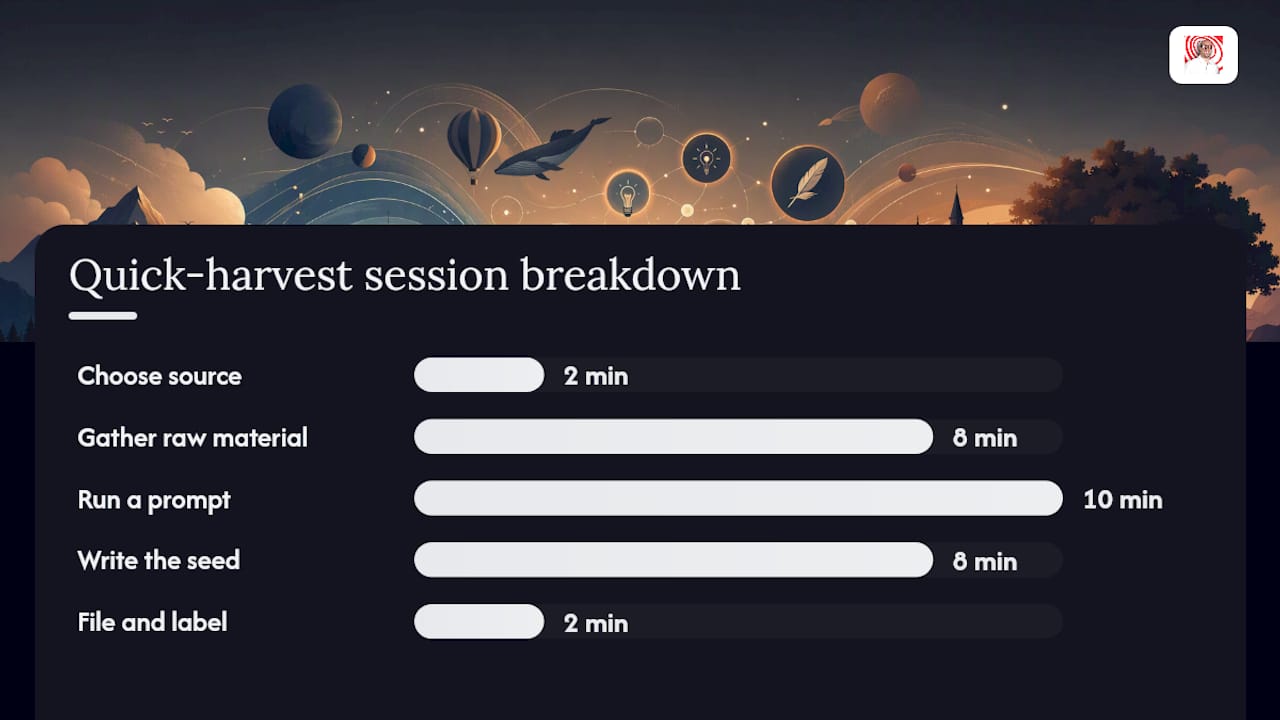
| Step | Action | Time |
|---|---|---|
| 1. Choose source | Pick one category from the checklist above | 2 min |
| 2. Gather raw material | Scan headlines, browse images, or play a track | 8 min |
| 3. Run a prompt | Apply the fillable template from Section 10 | 10 min |
| 4. Write the seed | One paragraph, no editing | 8 min |
| 5. File and label | Drop into idea bank with source tag | 2 min |
Recommended toolset: A timer (phone or dedicated app), a notes app with folder structure (Notion, Apple Notes, or a physical notebook), and a camera for photographing objects and scenes on the go.
Red flags for an unproductive session:
- You've spent more than 10 minutes choosing a source without starting.
- You're reading other writers' responses to prompts before writing your own.
- You're researching the historical context of a headline instead of writing the logline.
- You feel the need to finish the idea before filing it. File the fragment. Completion is for drafts, not seeds.
The honest truth about where ideas actually come from
Most writers I know describe inspiration as something that happens to them. A dream, a headline, a song that won't leave. What they're describing is the output of a system they've built without realizing it. The dream journal they keep. The habit of reading strange news. The playlist they put on before they write. The ideas feel like gifts because the system is invisible.
The single most underrated shift a writer can make is treating idea-finding as craft, not temperament. You don't have to be the kind of person inspiration visits. You build the conditions where it shows up reliably, and then you show up too.
One habit worth starting today: at the end of every writing session, write one "What if" question based on something you noticed that day. Not a polished premise. Just a question. A neighbor's car parked at an odd angle. A child who wouldn't look at a particular door. A phone that rang twice and stopped. One question, filed, dated. Do that for thirty days and you'll have thirty seeds, at least three of which will feel genuinely electric.
The art of storytelling isn't about waiting for the right idea. It's about building the habit that makes the right idea findable.
Mark Watson's books as study material and practice fuel
If you want to see these techniques in action across multiple genres, the books at Markwatsonbooks are built from exactly the sources this article covers: unsettling objects, dream logic, weird true events, and the kind of "What if" questions that refuse to stay quiet.

The horror collections are particularly useful for writers practicing genre-specific prompts. Each story models how a single strange detail, a misplaced object, a wrong sound, a face that doesn't match a name, escalates into full narrative tension. Read one story before a writing session and use it as a tone anchor for your own prompt work. The children's books serve a different purpose: they show how image-based and object-driven storytelling works at its most compressed, which makes them excellent models for the 100-word constraint exercise.
Browse the full catalog at Mark Watson Books and pick one title that matches the source category you're working with this week.
Sources
These resources are organized by category so you can go directly to the one that fits your current session.
News and archives
- 6 Sources of Story Inspiration You Can Use Again and Again
- 101 Terrifying Horror Story Prompts | Final Draft
- Writing Prompts | The Art Institute of Chicago
- 12 Sources for Generating Ideas for Stories | Medium
- The 6 best sources of inspiration | WriteYourNovel
Museums and visual collections
Prompt hubs
Habit and idea-generation guides
Markwatsonbooks resources