
TL;DR:
- Middle grade fiction is written for readers aged 8 to 12, featuring protagonists aged 10 to 13 in stories of 25,000 to 50,000 words. The genre emphasizes themes like identity, friendship, and adventure while excluding graphic violence, profanity, and sexual content to ensure emotional safety. It differs from young adult fiction by focusing on external events and immediate worlds rather than internal identity struggles.
Middle grade fiction is defined as a literary genre written for readers aged 8–12, featuring protagonists typically between 10 and 13 years old. Books in this category run 25,000 to 50,000 words and sit between early chapter books and young adult literature. The genre has its own clear identity, its own content rules, and its own emotional logic. If you are a parent, teacher, or young reader trying to figure out what makes a book "middle grade," this guide gives you the full picture, from defining characteristics to standout authors and practical selection tips.
What is middle grade fiction and how is it defined?
Middle grade fiction is a publishing category, not just an informal label. The industry defines it by three factors: the reader's age, the protagonist's age, and the book's word count. Readers are typically 8–12 years old. Protagonists are usually 10–13. Word counts fall in the 25,000 to 50,000 range, though some fantasy titles stretch longer.
The genre sits in a specific developmental window. Children at this stage are leaving the simple world of picture books and early readers behind, but they are not yet ready for the emotional weight of young adult fiction. Middle grade fiction meets them exactly where they are: curious, energetic, and starting to ask bigger questions about who they are.
Publishers like Penguin and Scholastic use these standards to classify and market books. That means when you see a book labeled "middle grade," it has been intentionally crafted for this age group, not just shelved there by accident.
What are the main characteristics and themes of middle grade fiction?
Middle grade fiction has a distinct set of hallmarks that separate it from every other age category. These are not arbitrary rules. They reflect what children aged 8–12 actually need from stories.
Core thematic focus areas:
- Identity and belonging. Characters wrestle with fitting in at school, making and losing friends, and figuring out who they are.
- Family dynamics. Conflict with parents, siblings, or guardians drives many plots. The home is a central stage.
- First experiences. First crushes, first failures, and first real responsibilities appear frequently. Romance stays mild, never sexual.
- Adventure and discovery. Many middle grade stories send protagonists on quests, mysteries, or journeys that test their courage.
- Friendship. Loyalty, betrayal, and reconciliation among peers are recurring emotional engines.
Content restrictions are firm. Graphic violence, profanity, and sexual content are strictly off-limits. This is not censorship. It is intentional design for a specific developmental stage.
The tone in middle grade fiction stays optimistic. Even when a story addresses loss, illness, or injustice, it resolves with hope. Middle grade literature builds safe emotional spaces with hopeful endings to foster resilience in young readers. That emotional safety is part of what makes the genre so powerful for children navigating real-world challenges.
Protagonists in middle grade stories react to external events more than they reflect internally. A character might lose a best friend, discover a secret, or face a bully. The story moves through action and consequence, not extended introspection. This keeps pacing brisk and plots engaging for readers who are still building their attention stamina.
Pro Tip: Look for books where the protagonist solves problems using their own resourcefulness. That sense of agency is a hallmark of well-crafted middle grade fiction, and it models real problem-solving skills for young readers.
You can learn more about how children's book themes like identity and friendship show up across age categories.
How does middle grade fiction differ from young adult literature?
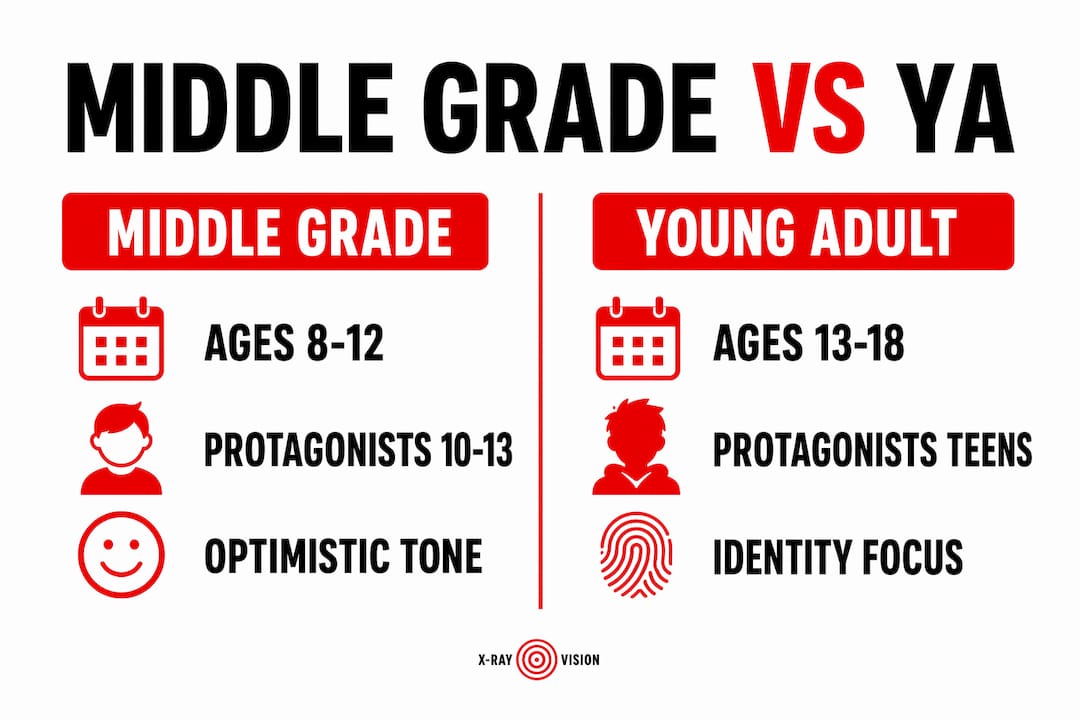
The line between middle grade and young adult (YA) fiction confuses many parents and teachers. The differences are real and meaningful.
| Feature | Middle grade | Young adult |
|---|---|---|
| Target reader age | 8–12 | 13–18 |
| Protagonist age | 10–13 | 14–18 |
| Typical word count | 25,000–50,000 | 50,000–90,000+ |
| Romance | Mild crushes only | Relationships, emotional complexity |
| Violence and content | No graphic content | Mature themes allowed |
| Narrative focus | External events, immediate world | Internal identity, broader society |
| Tone | Optimistic, hopeful | Can be dark, ambiguous |
The most important distinction is not age. It is agency versus identity. Middle grade protagonists struggle to maintain control over their immediate environment, their family, friends, and school life. YA protagonists grapple with who they are becoming and where they fit in the wider world.
Middle grade protagonists react to external events rather than engaging in deep internal reflection. YA fiction, by contrast, spends far more time inside a character's head, exploring doubt, desire, and moral complexity. That difference in interiority is what makes YA feel heavier and more emotionally demanding.
A common misconception is that a book with a 14-year-old protagonist automatically becomes YA. Protagonist age matters, but thematic content and emotional complexity matter more. Age categories serve as guidelines, and thematic content often determines classification more accurately than protagonist age alone.
Pro Tip: If you are unsure whether a book is middle grade or YA, read the first chapter and ask: is the protagonist reacting to their immediate world, or questioning their entire identity? The answer usually tells you everything.
For a deeper look at how YA content differs, the guide on young adult horror breaks down those distinctions clearly.
How should parents and teachers select middle grade books?
Choosing the right middle grade book for a child is both an art and a practical skill. These steps make the process straightforward.
-
Apply the read-up rule. The read-up principle holds that middle grade readers prefer protagonists slightly older than themselves. A 9-year-old often connects best with a 11-year-old protagonist. Use this when matching books to readers.
-
Check thematic fit, not just age rating. A book labeled "ages 8–12" still varies widely in emotional weight. A story about parental divorce hits differently than one about a dragon quest. Know the child's current emotional world before selecting.
-
Prioritize protagonist agency. Books where the main character actively solves problems build confidence and critical thinking. Avoid stories where the protagonist is purely passive.
-
Seek diversity in characters and settings. Modern middle grade fiction includes protagonists from a wide range of cultural backgrounds, family structures, and abilities. Diverse representation helps all children see themselves in stories and builds empathy in those who don't.
-
Vary the genre. Middle grade spans realistic fiction, fantasy, mystery, adventure, historical fiction, and humor. A child who claims to "hate reading" often just hasn't found their genre yet. Try graphic novels, epistolary formats, or adventure-heavy plots.
-
Use trusted recommendation lists. The American Library Association's Newbery Medal, the Coretta Scott King Award, and the Pura Belpré Award all recognize outstanding middle grade titles. These lists are curated by professionals who read widely in the genre.
-
Match reading ability to interest level. A strong reader aged 9 may handle a 400-page fantasy novel. A reluctant reader aged 12 may thrive with a shorter, faster-paced adventure. Reading level and interest level are not the same thing.
Who are popular middle grade authors and what are some notable examples?
The middle grade genre has produced some of the most beloved books in children's literature. These authors and titles define what the genre does best.
- J.K. Rowling (Harry Potter and the Sorcerer's Stone): The first three books in the series are classic middle grade, featuring a young protagonist navigating school, friendship, and identity in a magical world.
- Roald Dahl (Matilda, Charlie and the Chocolate Factory): Dahl's work exemplifies the genre's mix of humor, heart, and child-centered agency. His protagonists consistently outwit adults.
- Rick Riordan (Percy Jackson and the Olympians): Riordan's series brought mythology to a new generation. The books are fast-paced, funny, and grounded in a protagonist who fights to protect his immediate world.
- Madeleine L'Engle (A Wrinkle in Time): A landmark in science fiction for young readers, featuring a protagonist who is awkward, brilliant, and deeply relatable.
- C.S. Lewis (The Chronicles of Narnia): A defining series in children's fantasy. The Chronicles of Narnia remains one of the most widely read middle grade series in history, blending adventure with moral themes.
- Sharon Creech (Walk Two Moons, Holes): Creech writes realistic fiction with emotional depth, exploring family, grief, and identity without ever losing the optimistic middle grade tone.
- Jeff Kinney (Diary of a Wimpy Kid): The series uses a diary-comic format to capture the social anxiety of middle school with humor and honesty.
These authors share a key quality: they write for children, not at them. Their stories respect the emotional scale of a child's world without condescending or oversimplifying.
The children's publishing industry continues to expand middle grade offerings, with growing emphasis on diverse voices and contemporary settings that reflect the real lives of today's young readers.
Key Takeaways
Middle grade fiction is defined by its reader age (8–12), protagonist age (10–13), optimistic tone, and strict content guidelines that prioritize emotional safety over thematic complexity.
| Point | Details |
|---|---|
| Core definition | Middle grade targets readers aged 8–12 with protagonists aged 10–13 and word counts of 25,000–50,000. |
| Content boundaries | Graphic violence, profanity, and sexual content are excluded; romance stays at mild crushes only. |
| Middle grade vs. YA | Middle grade focuses on external agency and immediate world; YA explores internal identity and broader society. |
| Selection strategy | Use the read-up rule, check thematic fit, and vary genres to match each child's emotional and reading level. |
| Genre scope | Middle grade spans fantasy, realistic fiction, mystery, adventure, and humor, with authors like Roald Dahl and Rick Riordan defining its range. |
Why middle grade fiction deserves more respect than it gets
Adults often underestimate middle grade fiction. I've seen it dismissed as "simple" or "lightweight" by readers who forget what it felt like to be ten years old. That's the core mistake.
Adults miss the child's emotional scale when they engage with middle grade fiction. A lost friendship at age 10 carries the same emotional weight as a major adult crisis. When a middle grade protagonist loses their best friend or feels invisible at school, that is not a small problem. For that child, it is everything.
What I find most compelling about the genre is how it builds lifetime reading habits. A child who falls in love with Percy Jackson or Matilda at age 9 becomes a reader for life. The genre's optimistic tone is not naivety. It is a deliberate choice to give children the emotional tools to face difficulty without being crushed by it.
The pitfall I see most often is adults confusing "simple" with "easy to write." Middle grade fiction is genuinely hard to craft well. You have to hold a child's perspective authentically, keep pacing tight, and deliver emotional truth without the shortcuts that adult fiction allows. The best middle grade authors are not writing down to their audience. They are writing up to it.
If you want children to become readers, put the right middle grade book in their hands at the right moment. The genre does the rest.
— Mark
Middle grade reads worth exploring at Markwatsonbooks
Markwatsonbooks carries a curated selection of children's books and genre fiction for readers of all ages, including titles that sit right in the middle grade sweet spot.

Whether you are a parent searching for your child's next favorite story or a teacher building a classroom library, the children's book collection at Markwatsonbooks offers a range of titles worth exploring. For older middle grade readers who are ready for something with more edge, the full books catalog includes genre options that grow with young readers as their tastes develop. Browse by age, genre, or mood and find the story that clicks.
FAQ
What age is middle grade fiction for?
Middle grade fiction targets readers aged 8–12, with protagonists typically aged 10–13. The read-up rule means most books feature characters slightly older than the intended reader.
How long is a typical middle grade book?
Most middle grade novels run between 25,000 and 50,000 words. Fantasy titles in the genre sometimes exceed that range, but the standard sits firmly within those boundaries.
What topics are off-limits in middle grade fiction?
Graphic violence, profanity, and sexual content are excluded from middle grade fiction. Romance is limited to mild, non-sexual crushes, keeping content appropriate for the 8–12 age group.
What is the difference between middle grade and young adult fiction?
Middle grade focuses on protagonists maintaining agency over their immediate world, while young adult fiction explores identity, broader society, and more mature emotional themes. YA also allows darker content and more complex romance.
Can a middle grade book have an older protagonist?
Yes. Thematic content and emotional complexity matter more than protagonist age alone. Some classics with protagonists older than 13 remain fully appropriate and accessible for middle grade readers based on their themes and tone.