

TL;DR:
- The Cthulhu Mythos emphasizes cosmic indifference and humanity's smallness in the universe.
- It evolved through collaborations, debates, and reinterpretations influenced by Lovecraft and others.
- Its lasting impact lies in evoking existential dread by leaving questions unanswered.
If you think the Cthulhu Mythos is just a collection of tentacled sea monsters and crumbling New England villages, you're missing the real terror. The Lovecraftian horror tradition is something far stranger and more unsettling: a vision of a universe that simply does not care about us. Born from H.P. Lovecraft's fiction and expanded by generations of writers, artists, and game designers, the Mythos has shaped modern horror in ways most fans never fully realize. This guide covers the origin, the core principles, the key contributors, the explosive cultural influence, and the heated debates that keep this century-old mythology alive and vital today.
Table of Contents
- What is the Cthulhu Mythos?
- From Lovecraft to Derleth: Building the Mythos
- How the Cthulhu Mythos changed modern horror
- Interpretations and debates: Purists, players, and pop culture
- Why the Cthulhu Mythos endures: Beyond tentacles and terror
- Continue your journey into cosmic horror
- Frequently asked questions
Key Takeaways
| Point | Details |
|---|---|
| Cosmic horror origins | The Cthulhu Mythos redefined horror by focusing on the vast, indifferent universe and humanity’s fragility. |
| Collaborative storytelling | Multiple authors have shaped, debated, and reinterpreted the Mythos, making it a living literary world. |
| Enduring pop culture influence | From movies to games, the Mythos inspires creators to this day with its psychological dread and madness themes. |
| Debate fuels evolution | Ongoing debates among purists, adaptors, and fans keep the Mythos alive and relevant. |
What is the Cthulhu Mythos?
The Cthulhu Mythos is not a single book, a trilogy, or even one author's vision. It's a loosely connected shared fictional universe, built from stories, letters, and creative collaboration that span more than a hundred years. Think of it as a vast, dark ocean. Different writers drop their anchors at different depths, but they all share the same cold water beneath them.
At its heart, the Mythos is built on cosmicism: the idea that humanity is not the center of the universe, is not special, and is not protected by any benevolent god. The Lovecraftian horror tradition stresses cosmicism, humanity's insignificance, and forbidden knowledge leading to madness. Characters in these stories don't fight evil and win. They stumble onto truths too large for the human mind to hold, and they shatter.
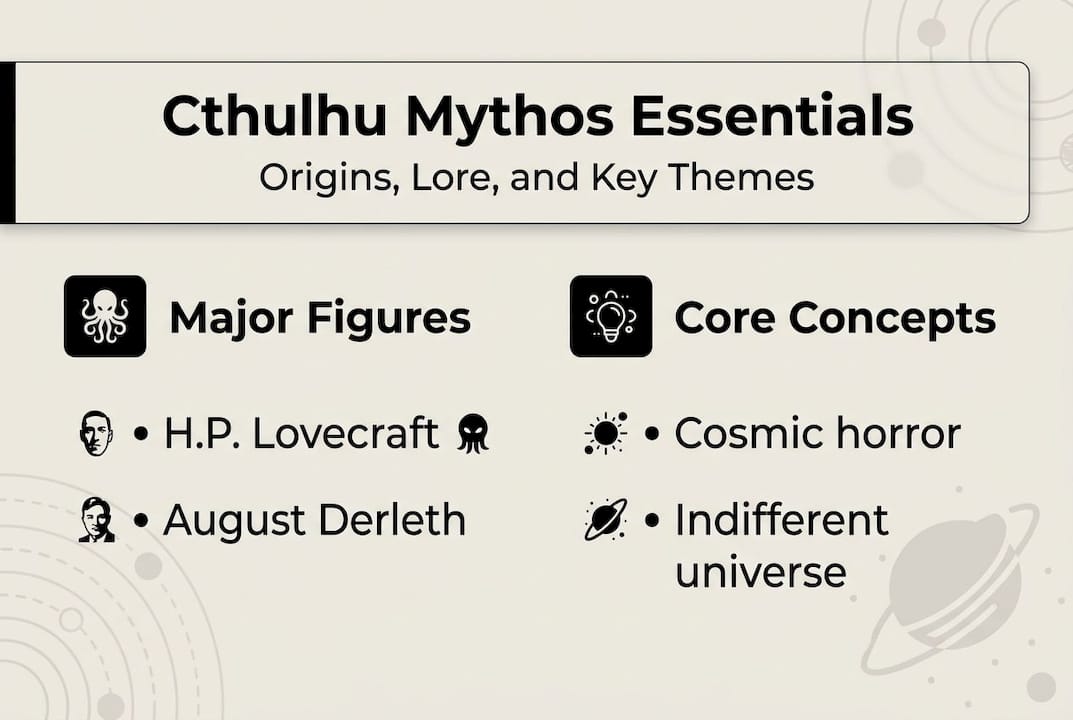
| Lovecraftian concept | What it means |
|---|---|
| Cosmicism | Humanity is tiny and irrelevant in the cosmos |
| Forbidden knowledge | Some truths destroy the mind that finds them |
| Cosmic indifference | The universe has no interest in human survival |
| Unreliable narrator | The protagonist often doubts their own sanity |
| Eldritch entities | Beings so alien they cannot be fully described |
The defining features that make the Mythos unlike any other horror tradition include:
- Mood over monsters: Dread, disorientation, and a sense of the vast unknown drive the stories
- Shared mythology: Gods, tomes, and locations (like R'lyeh and the Necronomicon) appear across unrelated works
- Psychological focus: Mental collapse is often the true climax, not physical danger
- Open-ended lore: Nothing is fully explained, and that ambiguity is the point
- Collaborative expansion: Any writer can contribute to the Mythos
Explore modern horror fiction and you'll find the Mythos fingerprints everywhere, from oppressive atmosphere to unknowable antagonists.
Pro Tip: Not all Mythos stories even feature Cthulhu. The Great Dreamer is more of a symbol. It's the mood of cosmic dread that defines the tradition, not any single creature.
From Lovecraft to Derleth: Building the Mythos
H.P. Lovecraft never sat down and said, "I'm going to build a mythology." It happened organically. He wrote stories, shared ideas in letters with other writers like Clark Ashton Smith and Robert E. Howard, and encouraged them to borrow his invented gods, places, and tomes. A creative ecosystem formed almost by accident.
Then Lovecraft died in 1937, and August Derleth stepped in. Derleth was devoted to preserving Lovecraft's legacy, but he had his own ideas. He expanded the Mythos post-Lovecraft with a good-vs-evil dualism that Lovecraft himself never intended, introducing the idea that the Great Old Ones were imprisoned by "Elder Gods" acting as forces of good.
| Aspect | Lovecraft's vision | Derleth's additions |
|---|---|---|
| Moral framework | No good or evil; pure indifference | Good (Elder Gods) vs. Evil (Great Old Ones) |
| Humanity's role | Irrelevant and insignificant | Capable of resistance and moral agency |
| Tone | Existential despair | More traditional horror conflict |
| Theological influence | Atheistic and nihilistic | Influenced by Christian cosmology |
Major contributors who shaped the post-Lovecraftian Mythos:
- August Derleth — Systemized and published much of the Mythos through Arkham House
- Clark Ashton Smith — Added rich, dark fantasy elements and exotic settings
- Robert Bloch — Brought psychological depth, later famous for Psycho
- Ramsey Campbell — Relocated the Mythos to Britain with striking originality
- Brian Lumley — Created the Titus Crow series, expanding the universe dramatically
"The debate over Derleth's changes isn't just academic. It cuts to the core of what the Mythos is supposed to do to readers. Lovecraft wanted you to feel helpless. Derleth wanted you to feel that resistance was possible. Those are fundamentally different kinds of horror."
This is exactly what makes the horror literature evolution tied to the Mythos so fascinating. You can trace philosophical battles through fiction. And if you want to see how these ideas play out in vivid modern storytelling, Return to Innsmouth brings those competing visions into sharp, gripping focus.
How the Cthulhu Mythos changed modern horror
The Mythos didn't just influence horror. It rewired how storytellers think about fear itself. Before Lovecraft, horror largely relied on a monster you could see, a villain you could name, and a resolution where good triumphed. The Mythos demolished that structure.
The works influenced by the Cthulhu Mythos span hundreds of films, novels, games, and comics. Consider In the Mouth of Madness (1994), John Carpenter's love letter to Lovecraftian dread. Or the video game Bloodborne, which buries its players in a world of cosmic horror so thick you can feel the weight of it. The tabletop RPG Call of Cthulhu introduced "Sanity" as a game mechanic in 1981, and that single innovation changed how designers think about psychological horror in interactive storytelling.
Key features that keep creators returning to the Mythos:
- The enemy cannot be punched, negotiated with, or destroyed
- Knowledge itself becomes a weapon that wounds the seeker
- Settings feel ancient, decayed, and haunted by forces older than time
- The horror scales infinitely, there's always something larger and more unknowable
- Ambiguity invites personal interpretation, making each adaptation fresh
For horror fans, the Lovecraftian tradition excels at evoking dread via incomprehensibility rather than gore. That's the shift. Visual horror shocks you for a moment. Existential horror follows you home.
Pro Tip: The most terrifying scene in any Mythos story is rarely the monster reveal. It's the moment the protagonist realizes the monster doesn't even know they exist. That's where the real dread lives.
Understanding horror books' impact helps explain why Mythos fiction resonates so deeply. And if you're curious about how horror affects readers on a psychological level, the Mythos is a masterclass in controlled, purposeful terror. Even the horror movies guide shows how Lovecraftian influence crept into cinema's DNA.
Interpretations and debates: Purists, players, and pop culture
Here's where the fun really starts. The Cthulhu Mythos isn't a locked canon with a single correct reading. It's a living argument, and fans love it that way.
Purists, Derlethians, and RPG adapters each stake out radically different territory. Purists adhere to Lovecraft's atheistic cosmic indifference, Derlethians accept the added moral order, and RPG systems systematize the Mythos for playability and narrative structure.
The three main schools of Mythos interpretation:
- Purists: Cosmic indifference is sacred. No heroes, no hope, no resolution. The universe wins.
- Derlethians: The addition of a moral struggle gives the stories dramatic stakes and spiritual resonance.
- Game Adaptors: The Mythos is a toolkit. Sanity mechanics, Great Old Ones as boss fights, Investigators as protagonists. Playability matters more than philosophical purity.
"Not all stories labeled 'Cthulhu Mythos' follow Lovecraft's vision, and that's where it gets genuinely controversial. If you strip away cosmic indifference, are you still telling a Mythos story? Or just a monster story with Lovecraftian window dressing?"
Different media adapt or distort these core themes in fascinating ways. Anime like Haiyore! Nyaruko-san turns Mythos entities into romantic comedy characters. Comics like Locke & Key borrow the aesthetic without the nihilism. Each version sparks the same debate: how faithful must you be to the source?
These arguments keep the Mythos relevant. They force creators and fans to revisit the core questions: What is horror? What does it mean to be small? A personal visit to the Cthulhu museum in Dunwich, Massachusetts reveals just how seriously fans take these distinctions, with entire exhibits dedicated to the Purist vs. Derlethian divide. And if you want to understand how these debates shape actual storytelling craft, crafting horror stories breaks it down brilliantly.
Why the Cthulhu Mythos endures: Beyond tentacles and terror
Here's my honest take after years of reading, writing, and living inside these stories. The Mythos endures because it tells the truth about something we all feel but rarely say out loud: the universe is enormous, indifferent, and none of us really knows what's waiting at the edges of what we understand.
That's not just horror. That's honesty.
Modern fans aren't just drawn to Cthulhu because the creature looks cool on a t-shirt. They're drawn to a fictional space that refuses to provide easy answers. In a world of algorithmic comfort and instant resolution, there's something deeply compelling about a story that ends with "and nobody was saved."
Creators who explore horror fiction collections built on Mythos foundations understand this intuitively. The best Mythos stories don't explain the monster. They explain you, your smallness, your hunger to understand, and your fragility when understanding finally arrives.
Pro Tip: The best horror is often what's left unexplained. The Mythos has proven that for a century. When you leave questions unanswered, the reader's imagination does the heaviest, most personal lifting.
That's the real staying power. It's not tentacles. It's the terrifying, electric possibility that we are not alone, and whatever is out there doesn't care.
Continue your journey into cosmic horror
If this guide has stirred something in you, that unsettling tension, that pull toward the unknown, then you're already thinking like a Mythos reader. The next step is easy.

Mark Watson Books offers a curated selection of horror fiction that captures exactly this kind of cosmic dread. From atmospheric short fiction to full-length novels built on Lovecraftian foundations, there's a story waiting to pull you under. Start with Cthulhu Mythos stories that bridge Lovecraft's original vision with bold modern voices. Don't wait for the stars to align. Dive in now and discover your next favorite horror read.
Frequently asked questions
What is the main idea behind the Cthulhu Mythos?
The Mythos centers on humanity's insignificance in an uncaring universe, where cosmicism and insignificance define the core worldview and forbidden knowledge often leads directly to madness.
Who expanded the Cthulhu Mythos after Lovecraft?
August Derleth notably expanded the Mythos, introducing good-vs-evil dualism that many fans still consider a controversial departure from Lovecraft's original intent.
How has the Mythos influenced modern media?
It has inspired hundreds of works across film, literature, video games, comics, and tabletop RPGs, making it one of the most pervasive forces in modern horror.
What is the controversy between purists and Derlethians?
Purists favor Lovecraft's atheistic cosmic indifference while Derlethians accept later moral additions, creating an ongoing debate about what the Mythos is truly meant to express.
Do you have to read Lovecraft to understand the Mythos?
No; many creators expand the Mythos in exciting directions, but reading Lovecraft first gives you the strongest possible foundation for understanding its core ideas and emotional power.
Recommended
- Return to Innsmouth and Other Cthulhu Mythos Stories: Modern Visions of Cosmic Horror from the Worlds of H. P. Lovecraft | Mark Watson Books
- History of horror literature: From folklore to fiction
- Creepypasta: Origins: Terrifying Tales Featuring Creepypasta Favorites | Mark Watson Books
- Horror movies guide: Genre, classics & literary roots
- Role of Mythology in Goth Art – Why It Matters – GothMarket