
What is dystopian horror, and what makes it its own subgenre?
Dystopian horror is an oppressive, fear-driven subgenre where society itself becomes the monster. Unlike standard horror, which targets individual survival, or general dystopian fiction, which critiques political systems from a distance, dystopian horror fuses both into something far more suffocating. The societal atmosphere acts as the antagonist, turning bureaucratic policies and authoritarian control into sources of visceral, bodily dread.
What separates it from its neighbors on the genre shelf? A few defining characteristics:
- Loss of individuality: Characters are stripped of identity, reduced to numbers, roles, or disposable parts of a larger machine.
- Authoritarian control: Governments, corporations, or ideological systems dominate every aspect of life, leaving no safe space.
- Pervasive dread: The horror is not a single monster or event. It is the air everyone breathes.
- Body and psychological threats: Physical mutilation, forced transformation, and psychological breakdown are common tools of oppression.
- Societal annihilation: Surviving characters are often permanently broken. There is no triumphant escape, only endurance or collapse.
- The illusion of order: The oppressive system frequently presents itself as utopian, making the horror even more disorienting.
General dystopian fiction asks, "How did society get here?" Dystopian horror asks, "What does it feel like to be trapped inside it?" That shift from analysis to visceral experience is the subgenre's defining move. The institutionalized power becomes as inescapable as a supernatural monster, and administrative policy becomes a source of bodily terror.
Recurring themes that give dystopian horror its unsettling tension
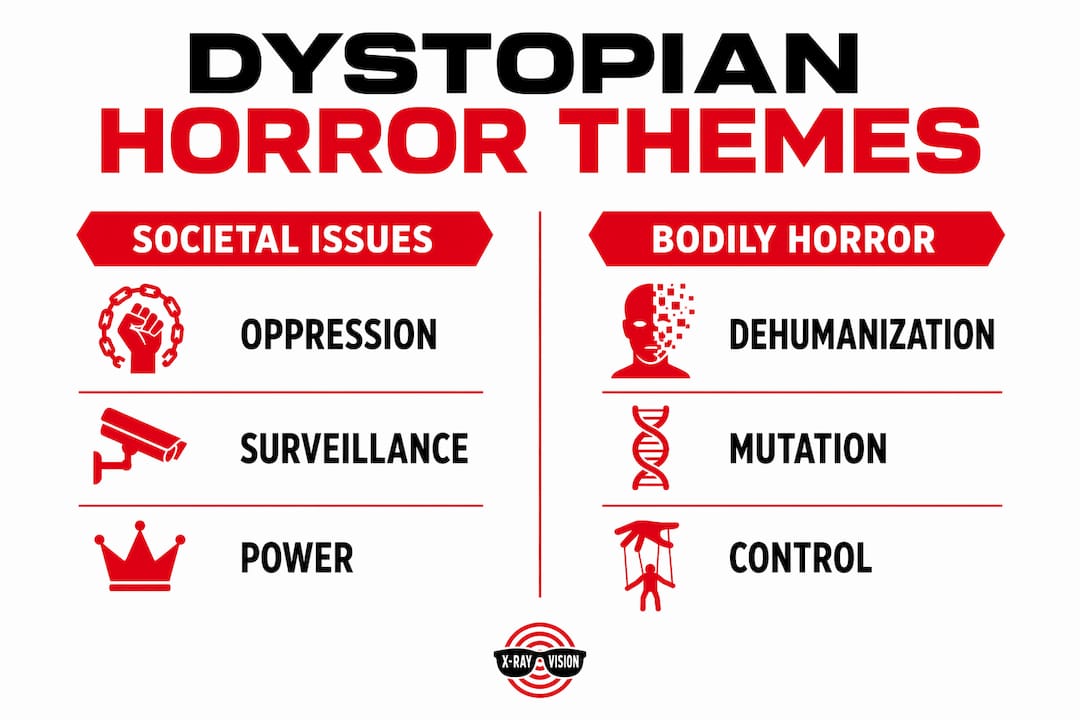
The thematic DNA of dystopian horror draws from a well-documented set of motifs. Literary scholars identify nine signature elements across the genre: totalitarian control, loss of individuality, censorship, propaganda, environmental degradation, resource scarcity, social inequality, fear, and the illusion of a perfect society. In dystopian horror, these elements do not just build a bleak backdrop. They generate genuine terror.
Here is how those themes function as horror tools:
- Totalitarianism: The state's reach is total, making resistance feel suicidal. Fear of the system replaces fear of the dark.
- Propaganda and censorship: Truth becomes a weapon. Characters who discover reality risk everything, and readers feel that vertigo alongside them.
- Environmental decay: Poisoned landscapes and dying ecosystems create a slow, creeping dread that no single villain could produce.
- Social inequality: The gap between the ruling class and the disposable underclass generates resentment, desperation, and violence.
- Loss of agency: Perhaps the most purely horrifying element. When characters cannot choose, cannot resist, and cannot escape, the reader feels the walls close in.
These themes work together to build what analysts describe as "societal horror," a collective powerlessness that hits differently than personal terror. You are not afraid for one character. You are afraid for everyone.
Pro Tip: When reading or watching dystopian horror, pay attention to how the world treats the human body. Forced transformation, medical experimentation, and physical punishment are the genre's most direct way of making political oppression feel real and immediate.
Notable dystopian horror films and why they still matter
Dystopian horror found its visual language early and has never stopped evolving. The films below represent the subgenre's range, from body horror to time-fractured political nightmares.
| Film | Year | Core Themes | Standout Feature |
|---|---|---|---|
| Metropolis | 1927 | Class hierarchy, industrial alienation, loss of individuality | Fritz Lang's Expressionist visuals; widely regarded as the seminal dystopian film |
| Brazil | 1985 | Bureaucratic control, surveillance, psychological collapse | Terry Gilliam turns paperwork into pure horror |
| Videodrome | 1983 | Media as body horror, corporate control, reality dissolution | David Cronenberg's visceral fusion of flesh and technology |
| 12 Monkeys | 1995 | Pandemic, time loops, institutional power, collective doom | Terry Gilliam again; the horror is that no one can stop what is coming |
| The Matrix | — | Technological surveillance, simulated reality, loss of agency | The Wachowskis made corporate dystopia feel like a nightmare you cannot wake from |
| Children of Men | 2006 | Human extinction, state violence, reproductive oppression | Alfonso Cuarón's unbroken long takes make the horror feel documentary-real |
| Annihilation | — | Environmental mutation, bodily transformation, psychological disintegration | Alex Garland weaponizes the natural world against the human body |
Two films deserve closer attention.
Videodrome (1983) is one of the purest expressions of dystopian horror ever put on screen. David Cronenberg's film imagines a television signal that literally rewrites the human body, turning flesh into a medium for corporate and political control. The horror is not a monster. It is the idea that the systems you consume are consuming you back. Cronenberg's genius was making media addiction visceral, years before the internet made that metaphor literal.
12 Monkeys (1995) operates on a different kind of dread. Terry Gilliam builds a world where a pandemic has already destroyed civilization, and the protagonist's attempts to prevent it may be the very cause of it. The horror is systemic and temporal. Institutions fail, time loops trap, and the individual is powerless against the machinery of fate. Gilliam had already explored bureaucratic horror in Brazil, but 12 Monkeys adds the weight of inevitability. The social meaning embedded in these film moments is what keeps them culturally alive decades after release.
Why do these films matter? Because they use horror's emotional toolkit, dread, disgust, shock, to make political critique feel personal. You do not just understand the argument. You feel it in your chest.
Essential dystopian horror literature you should read
The written form of this subgenre has produced some of the most enduring cautionary fiction in the English language. These works go beyond political allegory into genuine psychological and bodily horror.
- George Orwell's Nineteen Eighty-Four (1949): The foundational text. Room 101 is not just a torture chamber. It is a machine for destroying the self. Orwell understood that the most terrifying oppression is the kind that makes you betray your own mind.
- Margaret Atwood's The Handmaid's Tale (1985): Reproductive rights as horror. Atwood's Gilead is a theocratic state where women's bodies are state property, and the horror is how plausibly it could happen. Atwood's characters, as one scholar notes, are "forced to grapple with complex moral dilemmas in her post-apocalyptic settings."
- Aldous Huxley's Brave New World (1932): A dystopia built on pleasure rather than pain, which makes it more insidious. The horror is that no one is suffering visibly. Everyone is just... empty.
- Ray Bradbury's Fahrenheit 451 (1953): Book burning as cultural genocide. Bradbury's firemen do not just destroy knowledge. They destroy the capacity for empathy, and the horror is how eagerly society cooperates.
- Shirley Jackson's The Lottery (1948): A short story that delivers more dread per page than most novels. A community's ritual violence is presented with such mundane normalcy that the ending lands like a physical blow.
- Cormac McCarthy's The Road (2006): Post-apocalyptic horror stripped to its bones. Two people moving through a dead world, with no system left to oppress them, only the horror of what humans become without one.
- Philip K. Dick's Do Androids Dream of Electric Sheep? (1968): The horror of not knowing what is human. Dick's androids are not the threat. The dehumanizing system that creates them is.
Literature explores these themes differently than film. Without a director's visual grammar, the reader's imagination fills the gaps, often with something more personally terrifying than any special effect. The literary devices that make horror last on the page are different from those that work on screen, and dystopian horror literature exploits that gap brilliantly.
How dystopian horror differs from general dystopia and standard horror
The distinction is sharper than it might seem. General dystopian fiction, think Orwell's political essays or Ursula K. Le Guin's sociological thought experiments, prioritizes systemic analysis. It asks how power corrupts and how societies collapse. Standard horror prioritizes primal fear: the monster, the killer, the unknown thing in the dark. Dystopian horror does something neither genre does alone.
Key differences:
- The antagonist: In standard horror, it is a creature or a killer. In general dystopia, it is a political system. In dystopian horror, the system becomes the creature. Bureaucratic oppression is rendered viscerally terrifying, as inescapable as any supernatural force.
- The stakes: Horror threatens the individual. Dystopia threatens the collective. Dystopian horror threatens both simultaneously, which is why it hits harder.
- The body: Standard horror uses the body as a site of attack. Dystopian horror uses the body as a site of political control, forced transformation, reproductive coercion, medical experimentation.
- Resolution: Horror usually offers a resolution, the monster dies, the survivor escapes. Dystopian horror rarely does. The system persists. Characters may survive, but they are changed, broken, or complicit.
The political dimension is not decorative. Experimental research published in Perspectives on Politics found that exposure to dystopian narratives produces an 8 percentage point increase in willingness to justify violent protest, compared to exposure to real-world news or no media at all. Crucially, this effect was not produced by violent media alone. It required the political narrative context. That finding separates dystopian horror from action movies or slasher films. The genre does not just frighten. It reshapes how audiences think about power and resistance.
Dystopian horror's political narratives influence audiences differently than general horror or dystopia precisely because they fuse systemic critique with visceral, bodily fear, making abstract oppression feel personally threatening.
How did dystopian horror evolve as a genre?
The roots run deeper than most readers expect. Thomas More coined "utopia" in 1516, and the dystopian imagination followed almost immediately as its dark mirror. By the 19th century, writers like Mary Shelley (Frankenstein, 1818) were already fusing bodily horror with warnings about unchecked scientific and social power. Shelley's creature is not just a monster. He is a product of a system that creates life and then abandons it.
The 20th century accelerated everything. The two World Wars, the rise of fascism, and the Cold War gave dystopian horror its sharpest political edges. Orwell wrote Nineteen Eighty-Four in 1948, the year before he died, drawing directly on his experience of totalitarianism in Spain and his observations of Stalinist Russia. Huxley's Brave New World arrived in 1932, shaped by anxieties about mass production and behavioral conditioning.
Cinematic dystopia emerged almost simultaneously with these literary developments. Fritz Lang's Metropolis (1927) is widely regarded as the seminal dystopian film, combining Expressionist aesthetics with social commentary on class hierarchy and industrial alienation. The 1980s brought cyberpunk, with Blade Runner (1982) establishing the visual and thematic vocabulary of corporate dystopia. The 1990s and 2000s pushed the horror elements further, with films like 12 Monkeys and Children of Men making systemic collapse feel immediate and personal.
The genre's history of horror literature shows a consistent pattern: each era's dystopian horror reflects that era's specific anxieties. The Cold War produced surveillance states. The 1980s produced corporate body horror. The 2000s produced pandemic and environmental collapse. The pattern has not broken.
Where does dystopian horror show up beyond films and books?
The subgenre's reach extends well past the page and the screen. Video games like Cyberpunk 2077 and Half-Life 2 build fully playable dystopian horror worlds, where the player inhabits the oppression rather than observing it. The interactivity adds a layer of complicity that passive media cannot replicate. You are not watching someone navigate a surveillance state. You are navigating it yourself.
Television has become one of the genre's most powerful vehicles. Series formats allow dystopian horror to develop its world-building over dozens of hours, making the oppressive system feel lived-in and inescapable in ways a two-hour film rarely achieves. The slow accumulation of detail is its own kind of horror.
Graphic novels and comics have contributed significantly. Alan Moore's V for Vendetta uses the visual grammar of comics to make fascist Britain feel both stylized and terrifyingly real. The medium's combination of image and text creates a reading experience that is simultaneously literary and cinematic.
Online horror, including the Creepypasta tradition, has developed its own strain of dystopian dread, imagining digital systems, surveillance networks, and algorithmic control as sources of horror. Stories now have a second life online that amplifies their reach and allows dystopian horror narratives to evolve through community retelling. The genre adapts to every new medium because its core fear, that the systems humans build will eventually consume them, is permanently relevant.
The genre's adaptability to contemporary societal fears like climate change, artificial intelligence, and reproductive policy keeps it fresh across generations. Each new anxiety finds its dystopian horror expression within years of emerging.
What storytelling structures does dystopian horror rely on?
Dystopian horror has developed a recognizable narrative toolkit, though the best works subvert it in interesting ways.
The most common structure is the revelation arc: a protagonist who initially accepts the oppressive system gradually discovers its true horror. Think Winston Smith in Nineteen Eighty-Four, or the narrator of The Handmaid's Tale. The reader experiences the world's horror through the character's dawning awareness, which mirrors the reader's own process of understanding.
A second structure is the descent narrative, where a character who begins outside or above the system is pulled into it. This structure is particularly effective for horror because it removes the safety of observer status. You watch someone like you become trapped.
The narrative framework of dystopian horror often juxtaposes high-level political systems with intimate, bodily horror to deliver cautionary tales on the erosion of freedom. The political is made personal through the body: what the system does to flesh, to reproduction, to sensory experience.
Dystopian horror also tends to resist satisfying resolutions. The genre's complexity makes clean endings feel dishonest. Instead, narratives often deliver revelations or partial societal shifts, acknowledging that systems as entrenched as these do not fall easily. This structural ambiguity is itself a horror technique. The reader leaves unsettled, uncertain whether resistance is possible.
Pro Tip: Notice how dystopian horror uses unreliable narrators. When the protagonist cannot trust their own memories or perceptions, the reader shares that disorientation, which makes the oppressive system feel even more total.
What psychological and societal impacts does dystopian horror portray?
The psychological damage in dystopian horror is not incidental. It is the point. Characters in these narratives experience trauma, paranoia, dissociation, and moral collapse as direct products of the systems that oppress them. Philip Ridley's plays The Pitchfork Disney (1991) and Mercury Fur (2005) showcase how "trauma is not an individual suffering but instead a societal breakdown," with characters suffering amnesia, paranoia, and homicidal tendencies as symptoms of collective collapse.
Dystopian horror portrays surveillance as a psychological weapon. When characters know they are always watched, they begin to police themselves, internalizing the oppressor's gaze. This self-surveillance is one of the genre's most chilling insights: the system does not need to be everywhere if it has convinced you to be its own enforcer.
The societal impacts are equally specific. Dystopian horror consistently depicts the destruction of family structures, the elimination of private language, and the weaponization of intimacy. In Nineteen Eighty-Four, love itself becomes a tool of the state. In The Handmaid's Tale, reproduction is state property. These are not abstract political points. They are horror scenarios that target the most personal aspects of human experience.
The genre also explores how oppressive systems produce complicity. Characters are not simply victims. They participate, enforce, and sometimes embrace their own oppression. That moral complexity is what gives dystopian horror its lasting psychological weight. You finish these stories asking not just "how did they let this happen?" but "would I have done differently?"
How does dystopian horror vary across cultures and regions?
American dystopian horror tends to focus on corporate power, surveillance capitalism, and the erosion of individual rights. Films like The Matrix and RoboCop imagine futures where corporations have replaced governments as the primary oppressive force. This reflects a specifically American anxiety about private power unchecked by democratic institutions.
British dystopian horror leans toward bureaucratic suffocation and class rigidity. Terry Gilliam's Brazil is the clearest example: a world where the horror is not a villain but a filing system. Alan Moore's V for Vendetta imagines fascism as a specifically British failure, rooted in fear and complicity rather than foreign invasion.
Japanese dystopian horror, particularly in manga and anime, often explores the horror of conformity and the erasure of the individual within collective social structures. Works like Akira (1988) fuse body horror with political collapse in ways that reflect Japan's specific post-Hiroshima anxieties about technology, mutation, and national identity.
Latin American dystopian horror frequently draws on the lived experience of authoritarian regimes, making its political horror less speculative and more documentary. The genre there tends to be rawer, less filtered through science fiction metaphor, because the dystopia being described is closer to recent historical memory.
These regional variations reveal something important about the subgenre's core mechanism. Dystopian horror works by taking a society's specific, real fears and amplifying them to their logical extreme. The horror elements in dystopia are always culturally specific, even when the themes feel universal. What terrifies an American audience may not terrify a Japanese one, and vice versa, because the oppressive systems they fear are shaped by different histories.
Explore dystopian horror with Markwatsonbooks

If this overview has you hungry for more, Markwatsonbooks has you covered. The horror collection brings together titles that push into the darkest corners of the genre, from psychological dread to visceral body horror. For readers drawn to the internet horror tradition, the Creepypasta anthologies offer a modern strain of dystopian unease, where digital systems and collective storytelling produce their own brand of societal dread. Browse the full catalog at Markwatsonbooks and find your next unsettling read.
Key Takeaways
Dystopian horror is the subgenre where political oppression becomes visceral, bodily terror, and its political narratives produce measurably different audience effects than standard horror or general dystopian fiction.
| Point | Details |
|---|---|
| Societal atmosphere as antagonist | Dystopian horror makes the system itself the monster, not a single villain or creature. |
| Eight-point political impact | Exposure to dystopian narratives produces an 8 percentage point increase in willingness to justify violent protest, per experimental research. |
| Nine signature motifs | Scholars identify totalitarianism, censorship, propaganda, environmental decay, resource scarcity, social inequality, fear, loss of individuality, and the illusion of utopia as core elements. |
| Body horror as political critique | Physical transformation, reproductive coercion, and psychological breakdown are the genre's tools for making abstract oppression feel personal. |
| Cultural adaptability | The genre evolves to reflect each era's specific fears, from Cold War surveillance to AI and climate anxiety, keeping it permanently relevant. |