

Digital folklore is an emergent cultural system produced by user practices, platform architecture, and algorithmic validation. It runs on the same engine that powered campfire stories and chain letters, but now the retelling happens in comment sections, edit histories, and remix culture. The pattern holds across every case worth studying: repetition locks a form in place, variation lets it mutate, and social validation (likes, shares, upvotes) decides what survives.
TL;DR:
- Digital folklore relies heavily on social validation, with stories that receive replies or shares becoming more likely to be recognized and remembered.
- Early reply activity, not just initial posting, marks the true origin of a legend's spread within online communities.
- Platforms shape which stories survive by rewarding quick engagement with specific formats like short videos, serialized threads, or closed-group humor.
- Cross-cultural diffusion of digital folklore happens mainly through partial translation and reinterpretation, often with visual evidence bypassing language barriers.
- Researchers should archive multimodal sources and ethically handle stories involving real individuals, especially when stories cross cultural and platform borders.
Table of Contents
- What Is Digital Folklore, Exactly?
- Where Internet Folklore Culture Came From
- How Legends Get Built, Proven, and Spread
- The Cases Every Researcher Should Know
- Why Platforms Decide Which Stories Survive
- What Serialized Horror Communities Teach Researchers
- Research Gaps and Ethical Ground Rules
- How Digital Folklore Crosses Borders and Cultures
- Selected Resources for Further Research
- An Editorial Take on Theory Versus Practice
- Sources
What Is Digital Folklore, Exactly?
Scholars define digital folklore as an emergent cultural system generated through the interaction of users, platforms, and computational logics. That phrase does a lot of work. It means nobody "owns" a piece of internet folklore the way a novelist owns a manuscript. A creepypasta, a meme format, a haunted-cartridge story: each one gets built collectively, tested by an audience, and reshaped by whoever touches it next.
A 2026 theoretical framework describes this process as a vernacular ecology, a self-sustaining environment where user-generated content behaves less like isolated posts and more like organisms competing for attention and reproduction. The three-part model of vernacular ecology, social validation, and platform behavior gives researchers a clean way to break down any viral legend:
- Repetition locks a story into a recognizable shape, whether it's a ritual meme template or a recurring "the game is haunted" narrative beat.
- Variation is the remix layer. Parody accounts, fan edits, and localized retellings keep the form alive by changing just enough to stay interesting.
- Social validation replaces the old gatekeepers. A thread that gets buried under comments and shares functions the same way communal retelling once did around a fire or a workplace break room.
The same theoretical framework treats engagement metrics as a communal recognition system, not just marketing data. A story with zero replies dies quietly. One with thousands of replies becomes canon, whether or not it was ever "true."
Where Internet Folklore Culture Came From
Long before Slenderman haunted a forum, the early web was already generating its own folk traditions. Glitter GIFs, starry tiled backgrounds, "under construction" signs, and the general chaos of a GeoCities page weren't just bad design. They were a shared visual language built by amateurs for other amateurs.
The Digital Folklore Reader treats these artifacts as genuine cultural contributions rather than kitsch to be laughed at. Its editors argue that early homepage builders, forum moderators, and BBS regulars were doing unpaid cultural labor: creating the templates, inside jokes, and etiquette that later digital storytelling would inherit. That reframing matters. It positions the messy personal website of 1999 as an ancestor of the modern meme, not an embarrassing footnote.
A few threads worth tracing from that era:
- Early bulletin board systems (BBS) built reputation economies through sig files, running gags, and shared lore that only made sense to regulars.
- Web ring culture created early hyperlinked communities organized around shared aesthetics rather than algorithmic recommendation.
- "Under construction" GIFs and hit counters became a kind of folk shorthand for "this is a real, lived-in space," predating today's engagement metrics by two decades.
Archived copies preserved through projects like Monoskop let researchers actually see this material today, rather than relying on secondhand description of a web that mostly no longer exists.
How Legends Get Built, Proven, and Spread
A ghost story told around a fire relies on the teller's credibility. A digital legend relies on evidence, or at least the appearance of it. This is where digital folklore departs most sharply from its oral ancestors, and it's the mechanism every researcher needs to understand before analyzing a single case study.
Multimodal authority is the trick. A forum post alone is easy to dismiss. A forum post paired with a screenshot, a video clip, and a corroborating reply from a second account starts to feel like documentation. Legends that combine text, image, and video consistently outlast text-only rumors because each format covers for the weaknesses of the others.
Algorithmic selection then decides which of those multimodal packages actually spreads. Platforms reward specific shapes of content, and dissemination research on social network folk-culture propagation shows that platform architecture, not just story quality, determines what survives long enough to become folklore. Three patterns show up again and again:
- Short, loopable video formats get algorithmically favored because they generate repeat views, which is why TikTok has produced its own fast-mutating legend cycles.
- Serialized forum threads survive because their structure rewards return visits. Each reply extends the "story" and resets the clock on relevance.
- Closed communities like Discord servers develop dense, self-referential in-jokes that rarely reach outsiders but stay remarkably stable inside the group.
Pro Tip: When you're tracing a legend's origin, don't just find the earliest post. Find the earliest post that got a reply. The reply is where social validation starts, and that's the real birth moment of the folklore, not the isolated first mention.
The Cases Every Researcher Should Know
Four examples do most of the heavy lifting when it comes to illustrating how digital folklore actually behaves in the wild.
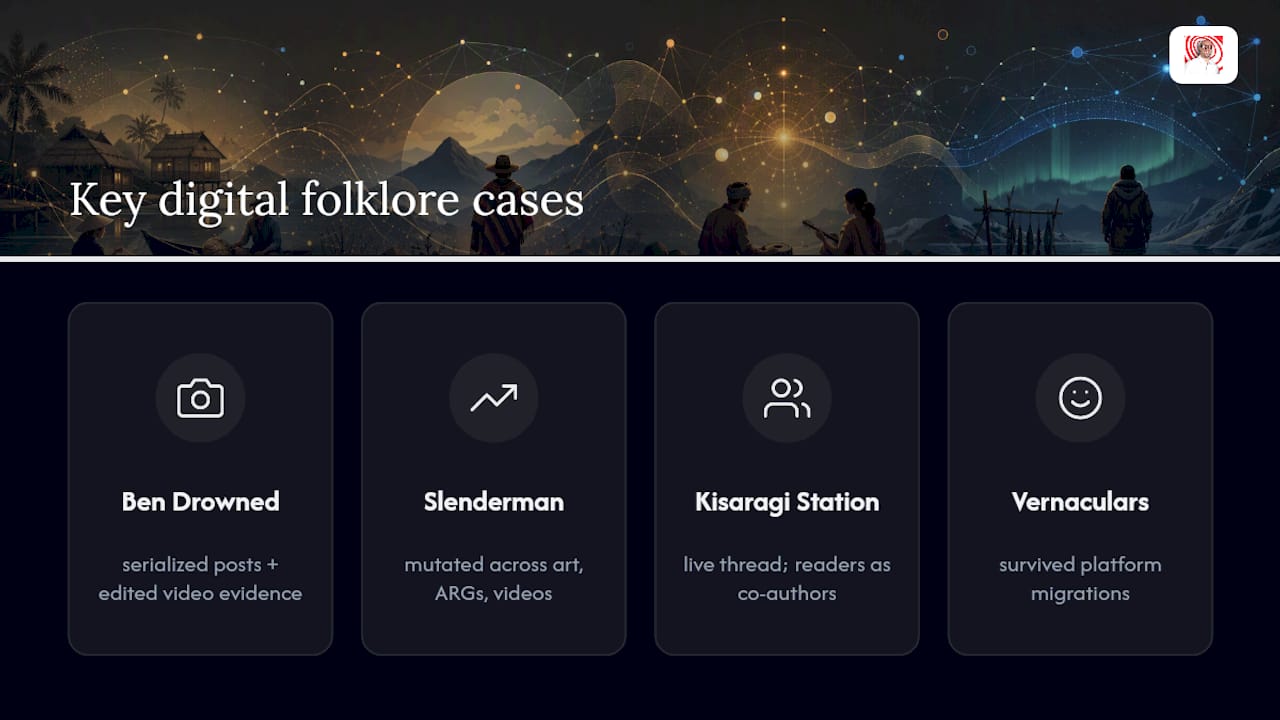
Ben Drowned began on a gaming forum as a first-person account of a haunted Majora's Mask cartridge, but the story's staying power came from its serialized structure. Posts arrived over time, each one paired with edited video "evidence" that appeared to show glitches no ordinary copy of the game produced. That combination, textual claim plus visual proof plus a slow release schedule, is exactly the multimodal authority pattern described above. A BBC Future retrospective documents how the story genuinely frightened children around the world and outlived its original forum by years.
Slenderman shows what happens when digital folklore escapes its origin platform entirely. Born from a 2009 image-editing contest, the character mutated across fan art, ARGs, and video series until it became a horror archetype with no single canonical version, then made international news after being linked to a real-world violent incident involving two minors in 2014. That trajectory, from meme to mainstream anxiety to legal case study, is unusual, but it demonstrates how far digital folklore can travel from its source.
Kisaragi Station began as a single 2004 thread on the Japanese message board 2channel, where a poster claimed to be stranded at a train station that shouldn't exist. The thread's live, participatory structure turned readers into co-authors in real time, since replies kept arriving as if the original poster were still in danger, and the cliffhanger never resolved. It became one of Japan's most recognized netto kaidan (internet ghost stories) and eventually inspired novelty "replica tickets" sold as merchandise.
Everyday vernaculars matter too, and they get less academic attention than the horror cases. LOLcats, glitter text, and other persistent internet visual dialects have survived platform migrations for over two decades, proof that not all digital folklore needs a scary plot to endure.
Why Platforms Decide Which Stories Survive
Folklore has never spread on a level playing field, but digital platforms make the tilt visible and measurable. Algorithmic ranking systems reward whatever generates fast engagement, which structurally favors high-drama, easily summarized legends over quieter, more nuanced variants that take longer to explain.
That has consequences worth naming directly:
- Marginal or minority-community variants of a legend often get buried simply because they don't produce the watch-time or click patterns a recommendation system optimizes for.
- Moderation decisions, including outright deplatforming, push legends into new communities rather than erasing them, which is part of why the same core story resurfaces years later on a different app under a new name.
- Commercial interests eventually catch up to successful folklore. Merchandise, licensed games, and film adaptations pull a once-anonymous communal story into copyright law, which raises real friction over who gets credited or paid for something nobody originally owned.
Archives and edited collections play a stabilizing role here, converting an unstable, platform-dependent story into something a researcher can actually cite years later.
What Serialized Horror Communities Teach Researchers
Watson's work writing creepypasta anthologies sits close to the same participatory dynamics scholars study in digital folklore. Participatory internet horror research describes authenticity in these narratives as something staged and co-produced. Readers verify "evidence," add their own details in comments, and treat the fiction as collaborative rather than fixed. That's precisely how a story like Ben Drowned held its audience.
For anyone trying to trace primary material, three sources consistently outperform casual Google searches: forum archive mirrors, Wayback Machine snapshots of deleted threads, and the original audiovisual files rather than later re-uploads, which often get re-edited without notice. Anthologies matter here too. Curated collections don't just entertain; they freeze a version of a story at a specific point in its evolution, giving academics something stable to cite instead of a moving target. Readers can browse a wide range of that serialized tradition in the creepypasta series collected by Markwatsonbooks.
Research Gaps and Ethical Ground Rules
Most digital folklore scholarship still treats platforms as neutral pipes rather than active co-authors, and that gap deserves more attention. A few open questions researchers keep circling back to: how do legend life cycles differ by platform, how does a story change as it crosses language and cultural borders, and how much of a legend's "spread" is organic versus purely algorithmic?
Ethical handling matters just as much as methodology. Digital folklore frequently involves real people, sometimes named without consent, and a story that started as fiction can produce real harassment or doxxing.
- Archive multimodal sources (text, image, video) together, not separately, since context gets lost when they're split apart.
- Cite ephemeral sources transparently, including the access date, since the original post may vanish within weeks.
- Flag any material involving identifiable minors or private individuals for institutional review before publication.
Pro Tip: If a legend involves a real, identifiable person, treat your citation the way a journalist would treat an unverified source, not the way a folklorist treats a 19th-century ballad.
How Digital Folklore Crosses Borders and Cultures
Kisaragi Station stayed rooted in Japanese message board culture for years before Western horror fans discovered and retranslated it. That lag, and the mutation that followed once new audiences got involved, is typical of how digital folklore actually moves across cultures. It rarely travels as a clean, faithful translation.
Cross-cultural diffusion usually works through partial translation and reinterpretation rather than exact copying. A Japanese netto kaidan becomes an English-language "SCP"-style report. An American meme format gets localized with regional slang and entirely different cultural references while keeping its structural skeleton intact. This is the variation principle operating at a global scale rather than within a single community.
Language barriers slow diffusion but rarely stop it, especially when a story's core "evidence" is visual rather than textual. A haunted video game screenshot needs no translation to unsettle a new audience. Text-heavy legends, by contrast, depend on fan translators who often add their own interpretive flourishes, meaning the version that goes viral in a second language may differ meaningfully from the original.
Globalized platforms accelerate all of this. A story that once took years to migrate between national internet cultures can now cross borders within days on platforms with global reach, though local moderation policies and regional platform bans still create real friction points that shape which version ultimately dominates.
Selected Resources for Further Research
Start with the Digital Folklore Reader for primary theory on early web vernacular, and the Digital Folklore Project archives at Utah State University for year-by-year documented trends. The BBC Future case study grounds Ben Drowned in journalistic detail. For applied examples of serialized horror storytelling, the creepypasta blog roundup covers seven iconic tales worth studying alongside the academic material.
An Editorial Take on Theory Versus Practice
The academic framework gets one thing right that casual internet culture writing usually misses: digital folklore isn't about the content of a story, it's about the process that validates it. Researchers who focus purely on plot analysis, "why is Slenderman scary," miss the more interesting question of why that specific image survived a hundred competing horror concepts posted the same year.
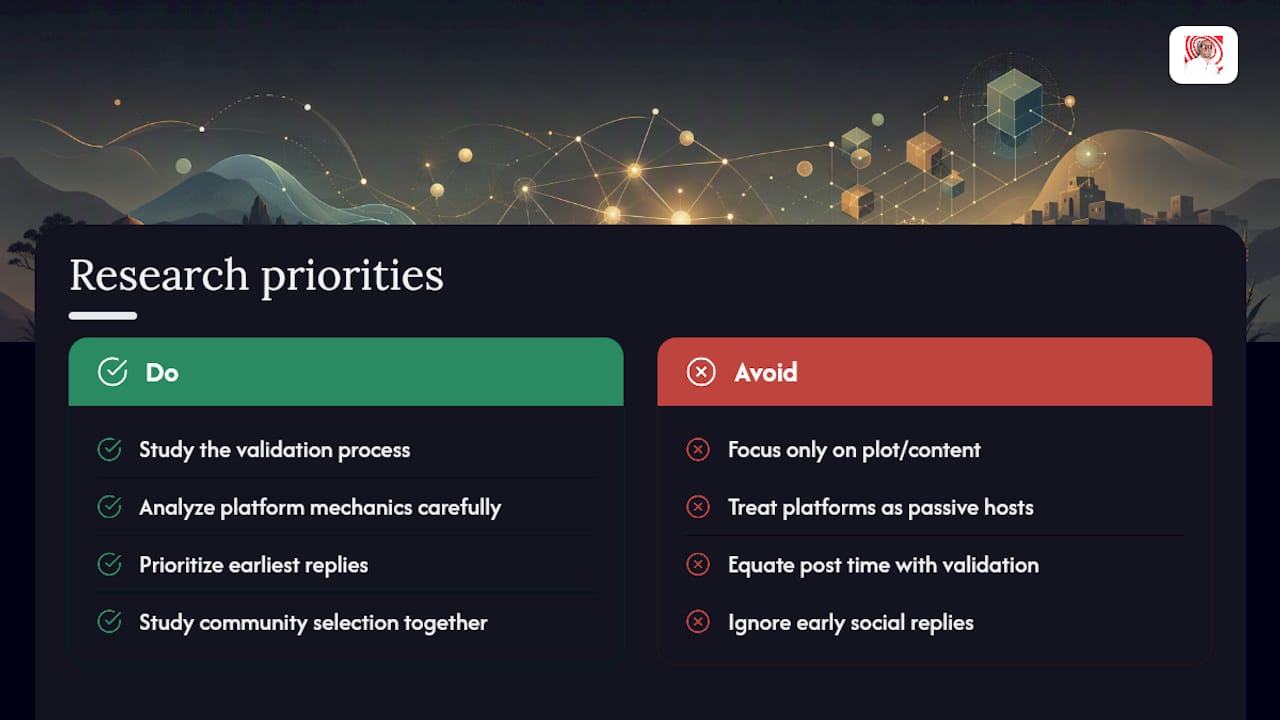
Where conventional advice falls short is in treating platforms as passive hosting. They aren't. A legend that thrives on a slow-scrolling forum thread often dies instantly on a fast-scrolling video feed, not because the story is weaker, but because the format doesn't match what that platform's audience rewards. Anyone studying digital folklore needs to analyze the platform's mechanics as carefully as the narrative itself.
If you're starting this kind of research, prioritize the earliest replies over the earliest post. That's where social validation begins, and it's the moment a private idea becomes shared folklore. Everything scholarly after that point is really the study of a community deciding, together, what deserves to survive. Readers curious how that same participatory instinct plays out in fiction can explore the Creepypasta Omnibus One collection, built on exactly this kind of collaborative horror tradition, or browse the full horror catalog for more.
— Mark
Sources
- From Mouth to Screen: A Theoretical Framework for Digital Folklore as Vernacular Ecology, Social Validation, and Platform Behavior
- DIGITAL FOLKLORE Reader
- From Mouth to Screen: A Theoretical Framework for Digital Folklore as Vernacular Ecology, Social Validation, and Platform Behavior
- Ghost in the machine? How a 'haunted' N64 video game cartridge terrified children around the world
- Digital Folklore Project | Utah State University