

A content warning is a brief, descriptive note that tells you what's waiting inside a book before you open it, and if your story contains intense violence, sexual assault, self-harm, or other heavy material, you should offer one. That's the verdict. No governing body enforces this, and there's no industry-standard requirement for how to do it, but the practice has become an expected courtesy across genre fiction, and horror especially. Content warnings have become an expected courtesy across genre fiction.
Here's how to act on that right now:
- Readers: check the book's front matter, back matter, or the author's website before diving into anything with dark themes.
- Authors: draft a short, specific warning for your front matter and build a fuller list on your own site.
- Everyone: treat a missing warning as a gap to flag, not a green light to assume the book is safe.
Key Takeaways
Content warnings work best when they're specific, non-spoiler, hosted where readers can actually find them, and maintained after publication rather than treated as a one-time task.
| Point | Details |
|---|---|
| No formal standard exists | Content warnings remain a voluntary, practice-driven courtesy, not a legal or industry requirement. |
| Use beta reader feedback | Ask beta and ARC readers directly what scenes unsettled them before finalizing your warning list. |
| Front matter plus website | Keep a short front-matter note and host the full, detailed list on your own author site. |
| Tag at the right level | Use scene-level tagging for anthologies and book-level tagging for single, consistent themes. |
| Update after publication | Revise your hosted warning page whenever new reader feedback or a revised edition calls for it. |
Table of Contents
- What Are Content Warnings in Books, and Who Do They Help?
- How Do You Write an Effective Content Warning?
- Where Should Content Warnings Go in a Book?
- What Are the Most Common Content Warning Categories?
- Where Can Readers Look Up Content Warnings?
- How Mark Handles Content Warnings on His Own Books
- Legal and Ethical Considerations for Content Warnings in Publishing
- Do Content Warnings Need to Change for International Readers?
- What Actually Matters Most in This Debate
- Sources
What Are Content Warnings in Books, and Who Do They Help?
A content warning (sometimes called a trigger warning or content note) is a short flag that a book contains material some readers may find distressing: graphic violence, depictions of abuse, suicidal ideation, and similar themes. The terms get used almost interchangeably, though "content warning" has become the preferred label in publishing circles because it reads as neutral information rather than a clinical diagnosis.
The rationale is consent. A reader who knows what's coming can choose to engage on their own terms, skip a chapter, or set the book aside entirely. That matters most for:
- Survivors of trauma who want to avoid unexpected re-exposure to specific scenarios.
- Parents previewing books for children or teens.
- Educators selecting classroom or library material.
- Any reader who simply prefers to know the emotional weight of a story going in.
Warnings have real limits, though. They can't anticipate every reader's personal history, and a list that tries to cover everything stops being useful. The goal is informed choice, not a guarantee that nothing will land unexpectedly.
How Do You Write an Effective Content Warning?
Good warnings are specific enough to be useful and vague enough to avoid spoiling the plot. Getting that balance right is a craft skill, and it starts before your manuscript is even finished.
- Mine your beta and ARC feedback. Ask readers directly whether any scene made them uncomfortable, and note the intensity and how often it recurs. This single step catches more blind spots than an author rereading their own work ever will.
- Draft using "depictions of" or "descriptions of" language. "Depictions of graphic violence" tells a reader what to expect without revealing who dies or how.
- Match length to genre expectations. A single line works for most novels; a longer list suits anthologies or books touching several sensitive categories at once.
- Decide on granularity. Book-level warnings work for consistent themes throughout; scene-level or chapter-level notes work better for anthologies like Creepypasta collections, where intensity swings wildly from story to story.
- Run an editorial pass before publication. Have an editor or trusted beta reader check the warning list against the final manuscript, since scenes get added or cut during revision and warnings need to keep pace.
Pro Tip: Build a one-question beta reader form asking "Did anything in this book surprise or unsettle you, and where?" You'll get more honest, specific answers than from a general feedback request.
Editors who specialize in this work consistently recommend erring toward specificity over vagueness, since a vague warning like "dark themes" tells a reader almost nothing.
Where Should Content Warnings Go in a Book?
Front matter versus back matter is the first decision, and each has tradeoffs. A warning on the copyright page or right after the title page catches readers before they invest time, but it can also feel like a spoiler-heavy wall of text before chapter one even starts.
- Front matter: best for a short, general note ("This book contains depictions of violence and self-harm") that doesn't give away plot specifics.
- Back matter: works if you'd rather readers experience the story first and reference the warning afterward, though this obviously doesn't help anyone trying to avoid triggering content in the first place.
- Author website page: ideal for the full, detailed list, since it can be updated anytime without touching the printed book.
- QR code in the physical book: links directly to that hosted page, giving print readers the same access ebook readers get through a hyperlink.
The best-practice approach many authors settle on: a brief front-matter line that names the general categories, plus a sentence directing readers to the full list on your website. That way nobody has to hunt, and nobody gets spoiled.
What Are the Most Common Content Warning Categories?
Certain themes come up again and again across genre fiction, and most published lists converge on a similar core set. Here's a working set with example phrasing you can adapt directly:
- Violence: "Contains graphic depictions of violence."
- Sexual assault: "Contains a depiction of sexual assault."
- Self-harm: "Contains references to self-harm."
- Suicide: "Contains discussion of suicidal ideation."
- Child death: "Contains the death of a child."
- Animal cruelty: "Contains a scene of animal cruelty."
- Graphic medical detail: "Contains graphic descriptions of injury and medical trauma."
- Racist language: "Contains racist language reflective of the story's setting."
- Sexual content: "Contains explicit sexual content."
- Addiction: "Contains depictions of substance abuse and addiction."
For single-theme novels, book-level tagging is enough. For anthologies, tag at the story level so one intense entry doesn't force a blanket warning onto the whole collection.
Where Can Readers Look Up Content Warnings?
Reader-run databases like Book Trigger Warnings and the Trigger Warning Database let you search titles by category before buying or borrowing, and they're genuinely useful as a first stop. The catch: entries are community-contributed, which means coverage is inconsistent and accuracy depends entirely on who bothered to submit it.
- Retailer pages and review platforms sometimes surface warnings in reader reviews, though this is unreliable and often buried.
- Community databases fill real gaps but shouldn't be treated as complete or clinically vetted.
- An author's own website remains the most accurate source, since the person who wrote the book is the one maintaining the list.
- If a warning is missing anywhere, most databases and author sites accept reader submissions or corrections, so flag it rather than assuming the omission is intentional.
How Mark Handles Content Warnings on His Own Books
Markwatsonbooks approaches this the way the guidance above recommends: a short front-matter note on each title, paired with a fuller warning list hosted on the site itself. For the Creepypasta anthologies, where story intensity varies enormously from one entry to the next, that means tagging at the story level rather than slapping one blanket warning on the whole book.

Beta readers flag scenes during the draft stage, and the hosted list gets updated after publication if something was missed. That's the real advantage of author-hosted pages over community wikis: accuracy stays current because the author controls it directly, instead of depending on whoever last edited a public entry.
Pro Tip: If you're revising a backlist title, add or update its warning page even after publication. Readers checking a database or your site months later deserve the current version, not what you thought the book needed at launch.
Legal and Ethical Considerations for Content Warnings in Publishing
No law in the United Kingdom or the United States requires a novel to carry a content warning. Fiction isn't regulated the way broadcast content is, where Ofcom enforces specific standards for streaming platforms. Publishing operates almost entirely on voluntary practice, shaped by reader expectation rather than statute.
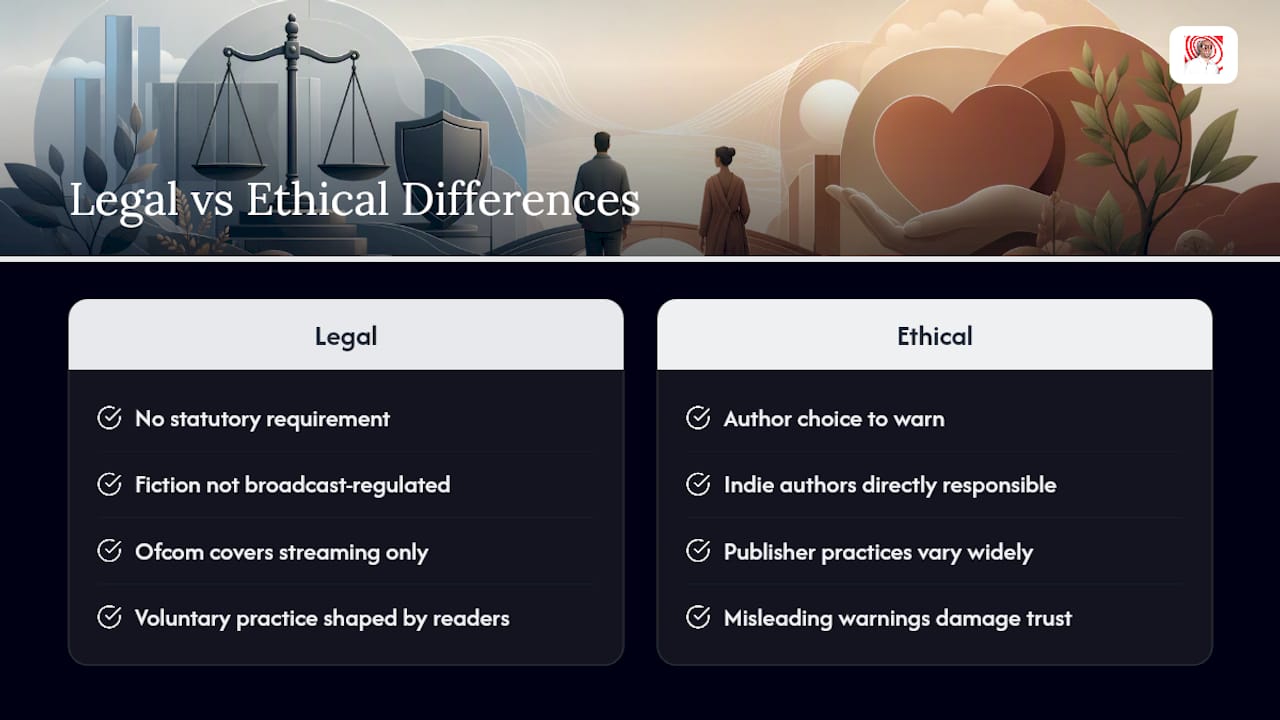
That doesn't make the ethics simple. An author who omits a warning for a graphic depiction of sexual assault or child death isn't breaking a rule, but they're making a choice about whose comfort matters. Independent presses and self-published authors carry this responsibility directly, since there's rarely a sensitivity editor mandated by a large publishing house standing between the manuscript and the reader. Traditional publishers vary widely here too. Some imprints now request warnings as part of the editorial process; many still leave it entirely to the author.
There's also a liability angle worth naming honestly: a warning that misrepresents a book's content, either by overselling intensity for shock value or downplaying something genuinely disturbing, creates a trust problem with readers that can follow an author across their whole catalog. Vague or absent warnings on books marketed toward younger readers raise the ethical stakes further, since age-appropriate framing becomes a parental trust issue, not just a reader-comfort one. The practical standard most professionals land on: warn accurately, warn specifically, and treat the warning as part of the book's promise to the reader, not an afterthought.
Do Content Warnings Need to Change for International Readers?
Cultural context shifts what counts as sensitive material, and a warning list written for one market won't automatically translate. Depictions of alcohol, certain religious themes, or specific historical violence can carry different weight depending on where a reader grew up, and language that reads as mild in one English-speaking market can read as significant elsewhere.

A few adjustments matter if your book reaches readers across the UK, US, Australia, and beyond. Avoid slang or idioms in the warning itself. "Contains graphic violence" translates cleanly; a warning written in heavy colloquial phrasing does not. Be specific about historical or cultural context when a scene depicts real-world events tied to a particular country or group, since a reader unfamiliar with that history needs slightly more framing than one who already recognizes it.
Racist language warnings deserve particular care in international editions. What counts as a slur, and how offensive it reads, varies by region and by a reader's own background. Naming the general category ("contains racist language reflective of the historical setting") without listing specific terms works across markets better than an exhaustive breakdown.
If your book sells through multiple retailers or in translation, keep your hosted warning page as the single source of truth, and update it as you learn what different reader communities flag as missing. That's simpler than trying to write a separate warning list for every market, and it keeps your information consistent no matter where a reader finds your book.
What Actually Matters Most in This Debate
Most advice on this topic treats content warnings as a spoiler problem to solve, and that's the wrong starting point. The real question isn't how to hide a warning well enough that it doesn't ruin a plot twist. It's whether you're willing to update it after the book is already out in the world.
Static warnings printed once in a first edition and never revisited are worse than useless, because they create false confidence. A reader checks the copyright page, sees nothing alarming, and assumes the book is safe. If a scene was added during a later revision, or a beta reader flagged something after launch that never made it into the text, that reader has been misled by omission.
Prioritize the website-hosted list over the front-matter note. The front matter is a pointer, not the destination. Independent presses wrestling with publishing standards generally land on the same conclusion: practice-driven guidance beats rigid rules, because every book's risks are different. Build the habit of revisiting your warning page the way you'd revisit typos in a new print run. It costs almost nothing and it's the single highest-leverage thing an author can do here.
— Mark
Sources
For deeper guidance, see Self-Publishing Advice and McIntyre Editorial. Book Trigger Warnings and the Trigger Warning Database remain solid reader lookup tools despite their gaps.
- Stronger protections for UK audiences under new content and accessibility standards for streaming services — Ofcom (2026)
- When (And How) To Use Content Warnings In Your Book — Phantom Pen Editorial / McIntyre Editorial
- Content Warnings for Books: A Complete Guide — Kaitlin Slowik