
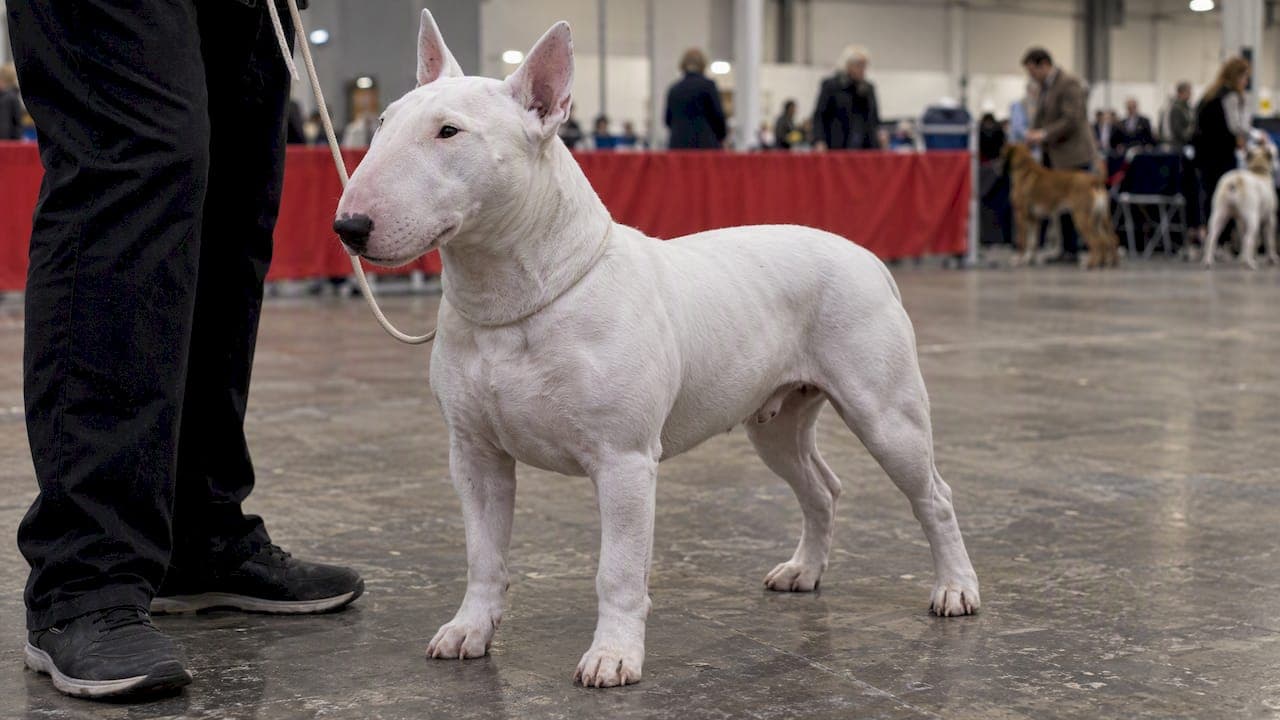
The modern Bull Terrier took shape in 19th-century England, built from stabilized bull-and-terrier crosses and brought into focus almost single-handedly by breeder James Hinks. The breed's signature egg-shaped head didn't appear until decades later. And the dog itself traveled a dramatic road, from pit fighter and ratter to beloved show dog and companion.
TL;DR:
- The Kennel Club identifies the Bulldog and now extinct White English Terrier as foundation breeds; later Dalmatian, Greyhound, and Spanish pointer contributions are less certain.
- Hinks showed refined white dogs in Birmingham in 1862, while the Bull Terrier Club formed in 1887, formalizing the breed decades after its debut.
- The fully developed head came much later than Hinks’s dogs; Lord Gladiator, born in 1917, is often cited as its first clear example.
- All white breeding lines were linked to higher deafness rates, prompting breeders to introduce colored lines that were eventually accepted into breed standards.
Table of Contents
- 1. Early bull-and-terrier background in 18th and 19th century England
- 2. James Hinks and the emergence of the modern Bull Terrier
- 3. How the Bull Terrier's distinctive egg-shaped head developed
- 4. Other breeds historically used to shape the Bull Terrier
- 5. Timeline of Bull Terrier shows, clubs, and breed standards
- 6. Coloration, deafness, and how health concerns reshaped breeding
- 7. From pit fighter to show dog: the Bull Terrier's changing role
- 8. Why a book lover's take on Bull Terrier history holds up
- 9. Notable Bull Terriers in history and their significance
- 10. Evolution of Bull Terrier temperament and behavior traits over time
- 11. Historical breeding challenges and responses beyond deafness
- 12. Bull Terriers in popular culture and media through history
- Why this history still shapes how we see the breed today
- FAQ
- Sources
1. Early bull-and-terrier background in 18th and 19th century England
Picture the back alleys of Georgian and Victorian England: rat pits, dogfighting rings, and farmyards crawling with vermin. That's the world that produced the "bull and terrier," a working type that fused the raw grip of a Bulldog with the sharp, fast instincts of a terrier.
Breeders of the era weren't thinking about show rings or breed standards. They wanted a dog that could do a job, and do it ruthlessly well. Bulldogs brought bite strength and a refusal to let go. Terriers brought speed, agility, and a predator's nose for rats. Cross them, and you got something unsettling and effective: a dog built for combat and vermin control in equal measure, according to Britannica's summary of the breed's origins.
Social forces shaped every decision breeders made. Consider what was driving demand:
- Blood sports like bull-baiting and pit fighting created a market for dogs that could win fights and survive them.
- Rat-baiting contests, often staged for gambling audiences, rewarded dogs with lightning reflexes and killer instinct.
- Farms and stables needed working terriers to keep vermin populations under control, a far less glamorous but equally important role.
- Urban poverty meant these dogs were often bred informally, with pedigrees tracked more through reputation than paperwork.
None of this produced anything close to the Bull Terrier we'd recognize today. Early bull-and-terrier dogs were variable in size, color, and build. Some leaned more Bulldog, thick and low. Others leaned more terrier, lighter and quicker. What they shared was purpose, not appearance.
That inconsistency is exactly what later breeders set out to fix. The raw material existed by the early 1800s. What came next was the work of turning a scrappy, function-first type into something with a consistent look, a name, and eventually a place in the show ring instead of the pit. That transformation didn't happen by accident, and it didn't happen slowly. It happened because one Birmingham breeder decided the bull-and-terrier deserved better than a life defined by violence.
2. James Hinks and the emergence of the modern Bull Terrier
James Hinks worked out of Birmingham in the mid-1800s, and according to Wikipedia's account of his life, he's the breeder most directly credited with bringing the Bull Terrier into something resembling its modern form. The Kennel Club's breed history confirms the core claim: the modern Bull Terrier descended from crosses of the Bulldog and the now-extinct White English Terrier, and Hinks gets credit for stabilizing that type during the 1850s and 1860s.
Breeder lore from the period names specific dogs tied to his program, including one called Old Madman and a bitch named Puss, sometimes referenced alongside a Young Puss in later accounts. These names persist in breed histories not because every detail is independently verified, but because they're the thread connecting Hinks' kennel to the dogs that followed.
A few things define what Hinks was actually trying to accomplish:
- He pushed toward a cleaner, all-white coat, a visual signature that would set his dogs apart from the mixed-color bull-and-terrier stock that came before.
- He wanted refinement without sacrificing structure, a dog that looked sharper and more elegant than its pit-fighting ancestors.
- He reportedly brought in other breeds to achieve that look, a detail that matters more in the next stage of the breed's development.
Pro Tip: When you read breed histories citing specific dogs by name, treat them as documented breeder tradition rather than forensic fact. Record-keeping in this era was informal, and names like Old Madman survive because they were repeated, not because they were notarized.
Hinks showed his refined white dogs in Birmingham in the 1860s, and that decision to put them in front of judges and spectators, rather than keep them in the pit, set the entire trajectory of the breed. He wasn't just breeding a better bull-and-terrier. He was inventing a show dog out of a fighting dog's bones, and the industry around him would spend the next several decades catching up to that idea.
3. How the Bull Terrier's distinctive egg-shaped head developed
Here's something that surprises a lot of people: the Bull Terrier's head, the single most recognizable feature of the breed, the downward-sloping, egg-shaped profile with no stop between forehead and muzzle, wasn't part of Hinks' original dogs. It developed later, through continued selective breeding.
The FCI breed standard's historical notes place the first standardization of that egg-shaped head in the 1850s under Hinks, but the fully realized version, the head without any stop at all, took longer to emerge and stabilize as the breed ideal.
Breed histories point to a dog named Lord Gladiator, born in 1917, as a milestone example, often cited as the first dog to clearly display the modern no-stop profile that breeders had been working toward for decades. That's more than half a century after Hinks' original Birmingham dogs, which tells you how gradual this particular change actually was.
Why pursue such an unusual head shape at all? Part of the answer lies in the breeds brought into the mix during this period, crosses that lengthened the muzzle and altered the skull's proportions in ways that eventually produced that convex, egg-like curve. The result is a head shape found nowhere else in the dog world, a profile so distinctive that it functions almost like a signature.
It's worth sitting with how unusual this is in breed development generally. Most physical traits that define a breed trace back to function, speed for a sighthound, a dense coat for a cold-climate worker. The Bull Terrier's head served no working purpose. It was an aesthetic pursuit, refined across generations purely because breeders decided it should exist, and it became the single feature that makes the dog instantly identifiable even to people who know nothing else about the breed.

4. Other breeds historically used to shape the Bull Terrier
Hinks didn't work in isolation, and the dogs he produced weren't the result of a single cross repeated endlessly. Breed historians point to several other breeds as likely contributors, though the strength of evidence varies considerably from one claim to the next.
According to Britannica, later breeders folded in Dalmatian, Spanish pointer, and Greyhound bloodlines to refine the look and improve agility. The reasoning tracks: a Dalmatian cross could reinforce the drive toward an all-white coat, while Greyhound influence would add leanness and speed to a frame that started out stockier and more Bulldog-like.
The documented and suggested contributors generally break down like this:
- White English Terrier: the primary documented partner to the Bulldog in creating the original bull-and-terrier base, per the Kennel Club's own breed history.
- Dalmatian: cited by Britannica and in Wikipedia's account of Hinks' breeding as a likely source of the clean white coat.
- Greyhound: credited with contributing speed and a leaner build, softening the bulkier Bulldog influence.
- Spanish pointer: mentioned in Britannica's summary as a refinement cross, likely aimed at muzzle length and agility.
- Collie or Borzoi influence: referenced more anecdotally in some breed accounts, with thinner documentation than the crosses above.
Treat these with appropriate caution. Some, like the White English Terrier connection, rest on solid breed-club documentation. Others, particularly the Collie and Borzoi mentions, lean more on repeated breeder tradition than verified pedigree records. Nineteenth-century breeding logs were often informal, kept by memory and reputation rather than registry paperwork, so some of this ancestry will always carry a degree of uncertainty.
5. Timeline of Bull Terrier shows, clubs, and breed standards
The path from Hinks' kennel to a formally recognized breed followed a fairly clear sequence of milestones, and laying them out in order makes the pace of change easier to grasp.

Hinks first showed his refined white dogs in Birmingham in the 1860s, with the FCI standard pointing specifically to 1862 as the year the breed appeared in its early recognizable form. That public debut mattered enormously: it moved the Bull Terrier from backstreet pits into a competitive, aesthetic context where breeders had to answer to judges rather than gamblers.
The Bull Terrier Club formed in 1887, giving the breed its first organized body dedicated to defining and protecting type. That's a full quarter-century after the Birmingham shows, which gives you a sense of how long it took enthusiasts to formalize what Hinks had started informally.
From there, kennel clubs in multiple countries built out their own standards, with the Kennel Club in Britain and the FCI internationally both maintaining breed pages that trace this same lineage back to Hinks and the Bulldog and White English Terrier cross.
The Miniature Bull Terrier followed a separate and later path.
6. Coloration, deafness, and how health concerns reshaped breeding
For decades after Hinks, all-white Bull Terriers were the standard, prized precisely for the clean coat he'd worked to establish. But that pursuit of pure white came with a cost that breeders eventually couldn't ignore.
Historical accounts referenced in breed histories link all-white breeding lines to a higher incidence of deafness, a pattern tied to the genetics of pigmentation in dogs more broadly. As that connection became better understood in the early 20th century, breeders began deliberately introducing colored lines rather than continuing to select for white coats alone.
Colored Bull Terriers were gradually bred and eventually formally accepted into breed standards, a shift that prioritized the dogs' well-being over a purely cosmetic preference that had defined the breed since Hinks' era. It's a rare example in dog breeding history where health considerations won out over an established aesthetic ideal, rather than the other way around.
If you're researching a Bull Terrier's background or considering what health screening looks like for the breed today, our coverage of Bull Terrier health issues digs into what modern owners should know, though any specific medical concern is always a conversation for a veterinarian rather than a blog post.
7. From pit fighter to show dog: the Bull Terrier's changing role
The Bull Terrier's job description changed completely over the course of a single century. It started as a dog bred for the pit, valued for aggression and gameness against other animals. By the time Hinks' refined white dogs were winning attention at Birmingham shows, the breeding priority had already flipped toward appearance and temperament suited to exhibition and companionship.
That shift in purpose rewired what breeders selected for, so owners today need to consider the best dog food for Bull Terriers to maintain their health and energy. Working performance, the ability to fight or kill vermin, stopped being the measure of a good dog. Conformation to a visual standard took its place, along with a temperament steady enough to handle crowds, judges, and family life rather than combat.
Related offshoots emerged from similar bull-and-terrier stock during this same general period, developing their own identities as Staffordshire-type lines rather than staying folded into the Bull Terrier's story. The broader lesson holds across all of these related breeds: dogs built for the pit became dogs built for the parlor, and that transition reshaped temperament as thoroughly as it reshaped appearance.
8. Why a book lover's take on Bull Terrier history holds up
We've spent real time with this breed's history, not as veterinarians or professional breeders, but as storytellers drawn to a dog whose backstory reads like fiction: violent origins, an eccentric Birmingham breeder, a head shape invented for no practical reason at all. That's exactly the kind of material our site returns to again and again in essays on how specific dog breeds show up in fiction and folklore.
If this history caught your attention, our piece on why Bull Terriers keep appearing in literature looks at how the breed's unusual silhouette and reputation have shaped its role as a character type across stories. Our blog archive holds more of this kind of breed-focused writing, built on the same approach: lean on primary breed authorities like the Kennel Club and FCI for the historical record, and bring our own interpretive lens to what that history means and why it resonates.
We're not here to replace a vet or a breed club. We're here to help you see the story behind the dog.
9. Notable Bull Terriers in history and their significance
A handful of individual dogs show up again and again in Bull Terrier histories, each marking a turning point in how the breed looked or was understood.
Old Madman and Puss, tied to James Hinks' original Birmingham kennel, represent the foundation stock from which the entire modern breed descends, according to Wikipedia's account of Hinks' breeding program. Their names persist in breed lore specifically because they mark the moment the bull-and-terrier type began its transformation into something deliberately refined.
Lord Gladiator, born in 1917, holds a different kind of significance. He's commonly cited as the first dog to display the fully modern egg-shaped head without a stop, the physical trait that would come to define the breed more than any other. His appearance in the historical record functions as a marker: before him, breeders were working toward that head shape; after him, it existed as a visible reality other breeders could select toward.
These aren't celebrity dogs in the modern sense. There's no surviving photograph gallery or detailed biography. What they offer instead is a timeline anchor, proof points that let us trace exactly when and how the Bull Terrier's appearance shifted from Hinks' first refined whites to the dog recognized in show rings today.
10. Evolution of Bull Terrier temperament and behavior traits over time
Temperament tracked right alongside appearance as the breed's purpose changed. The original bull-and-terrier dogs needed aggression toward other animals and a willingness to fight, traits that were actively selected for when the dogs worked pits and rat contests.
As Hinks and later breeders pushed the Bull Terrier toward the show ring, a different temperament became the goal. A dog that could handle crowds, stand calmly for judging, and live comfortably in a family home needed steadiness and sociability toward people, even while retaining the tenacity and confidence that made the breed distinctive in the first place.
That combination, a dog that's playful and people-oriented at home but still carries real physical confidence and drive, is a direct inheritance from this dual history. If you're curious how that history translates into a modern dog's daily needs, our breakdown of Bull Terrier temperament looks at the exercise and engagement a dog with this kind of heritage tends to need.
The breed never fully lost its working-dog intensity. It just got redirected, from pit combat toward games, exercise, and an almost comedic enthusiasm for mischief that current owners know well.
11. Historical breeding challenges and responses beyond deafness
Deafness tied to all-white lines gets the most attention in breed histories, but it wasn't the only health consideration breeders wrestled with as they pushed the Bull Terrier toward its modern form.
Aggressive selection for the egg-shaped head, a trait with no functional purpose, carried its own risks. Breeding hard toward a single cosmetic feature, as breeders did for decades after Hinks, always raises the possibility of narrowing the gene pool and concentrating other inherited issues along with the desired trait. Historical breeders had none of the genetic tools available today. They worked by observation and selective pairing, adjusting course when problems became visible rather than predicting them in advance.
The introduction of outside breeds, Dalmatian, Greyhound, Spanish pointer, as described in Britannica's breed summary, wasn't only about appearance. Crossbreeding of this kind also functioned as a practical, if unintentional, way of refreshing the gene pool during a period when the breed's overall numbers were still small and concentrated around a handful of kennels. Early breed development, across nearly every dog breed from this era, involved this same trial-and-error relationship between appearance goals and the health tradeoffs that came with chasing them.
12. Bull Terriers in popular culture and media through history
The Bull Terrier's striking silhouette made it a natural fit for visual media almost as soon as the modern type stabilized. That unmistakable head, paired with a muscular, compact build, gave illustrators and later photographers and filmmakers a shape that reads instantly, even in silhouette.
The breed's cultural visibility grew alongside its transition from working dog to companion animal. As Bull Terriers became fixtures in homes rather than pits, they also became fixtures in advertising, illustration, and eventually film and television, often cast for exactly the qualities that once made them dangerous: physical confidence, an intense stare, and an unmistakable presence.
That same visual drama is part of what draws storytellers to the breed today. Our own exploration of Bull Terriers in literature traces how that striking appearance and the breed's dual reputation, fierce origins paired with genuine loyalty, make it a compelling character across different kinds of stories. A dog with this much history packed into its profile practically writes itself into fiction.
Why this history still shapes how we see the breed today
The most important thing this history teaches is that the Bull Terrier's most famous feature, that egg-shaped head, was never about function. It was an aesthetic choice, pursued deliberately across generations, and that fact alone should reframe how people think about breed development generally. We tend to assume physical traits trace back to purpose. This breed proves that assumption wrong.
Where conventional retellings fall short is in treating Hinks as a solitary genius working from a single formula. The record, pieced together from Kennel Club and FCI historical notes, points to something messier and more interesting: a breeder iterating over decades, pulling in other breeds, adjusting for health problems like deafness only after they became impossible to ignore.
If you take one thing from this history, let it be curiosity about the gap between a breed's origin story and its modern identity. The dog in your living room carries a Birmingham pit-fighter's bloodline and a show breeder's obsession with a head shape nobody needed. That tension is the real story.
— Mark
FAQ
What was the original purpose of the Bull Terrier?
The earliest bull-and-terrier dogs were bred for blood sports like bull-baiting and dogfighting, along with vermin control on farms and in cities, according to Britannica's breed history. James Hinks later redirected the breed toward exhibition and companionship starting in the 1860s.
What two breeds make up a Bull Terrier?
The Kennel Club identifies the Bulldog and the now-extinct White English Terrier as the foundation cross behind the modern Bull Terrier. Later breeders, including Hinks, added other breeds such as the Dalmatian and Greyhound to refine the look.
What is special about Bull Terriers?
Their most distinctive trait is an egg-shaped head with no stop between the forehead and muzzle, a profile found in no other breed. That head developed gradually after Hinks' original dogs, with Lord Gladiator, born in 1917, often cited as an early example of the fully modern shape.
How did the Bull Terrier get its head?
The egg-shaped head resulted from decades of selective breeding after Hinks first began refining the type in the 1850s, with crosses to breeds like the Greyhound and Spanish pointer likely contributing to the lengthened muzzle, per Britannica. The fully realized no-stop profile wasn't clearly established until the early 20th century.
Are Bull Terriers good pets?
Bull Terriers bred for the show ring and companionship carry a temperament shaped by over a century of selection for sociability alongside their original confidence and drive. Prospective owners researching the breed's daily exercise and engagement needs can find more detail in our temperament overview.
Sources
- Bull Terrier | Breeds A to Z | The Kennel Club
- Bull Terrier | Britannica
- James Hinks — Wikipedia
- Fédération Cynologique Internationale (FCI) standard — Bull Terrier