
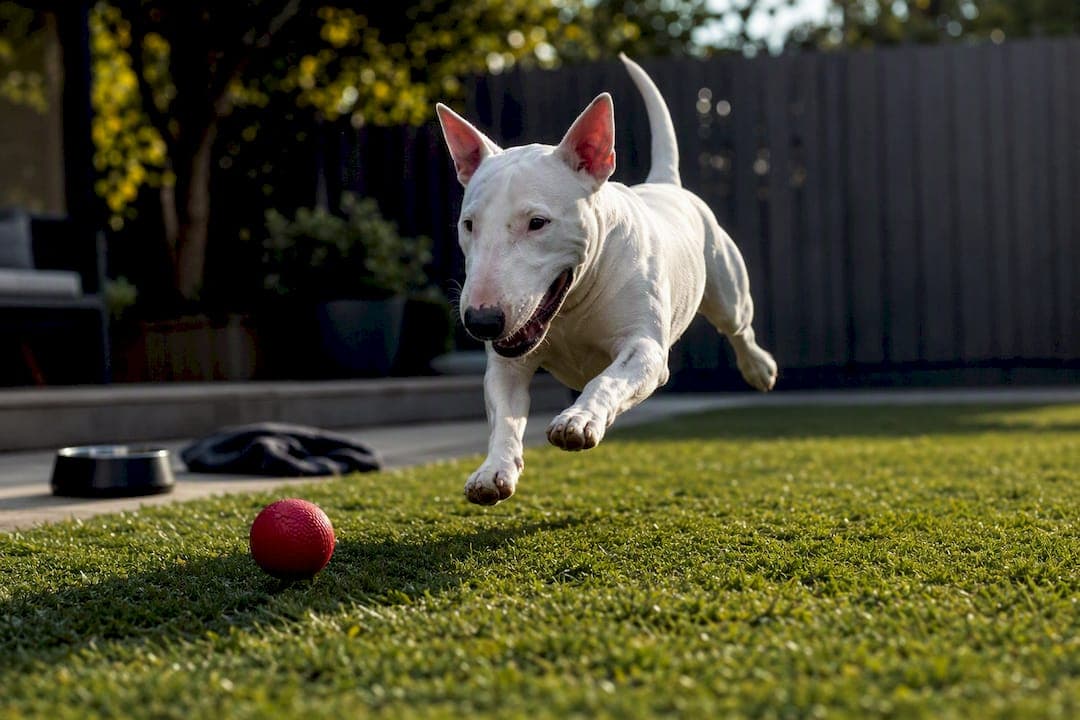
The Bull Terrier's temperament is playful, clownish, and fiercely devoted, wrapped around a stubborn streak that punishes lazy training. This is a dog that will make you laugh at 7 AM and test your patience by 7:15. Get ahead of it with early, consistent, reward-based socialization, and you get a comedian for a companion. Skip that step, and the same intelligence turns into chaos on a leash.
TL;DR:
- Early socialization and consistent, reward-based training are essential to prevent stubbornness from turning into chaos, especially around resource guarding and chasing.
- Supervision and structured play are crucial when interacting with children, as their enthusiasm can lead to accidental injuries if boundaries are not set.
- The breed's reaction to other dogs and small animals varies widely, requiring controlled introductions, leash training, and professional intervention if reactivity appears.
- Starting socialization between 8 and 12 weeks with gradual, positive exposure to environments and commands markedly improves long-term behavior and impulse control.
- Boredom and isolation can trigger repetitive behaviors and stress, so daily physical and mental activities, along with early crate training and inclusion, are vital for well-being.
Table of Contents
- What Is the Bull Terrier Temperament Really Like?
- How Do Bull Terriers Behave With Children?
- Are Bull Terriers Friendly Toward Other Dogs and Animals?
- When Should You Start Training and Socializing a Bull Terrier?
- How Much Exercise and Mental Stimulation Does a Bull Terrier Need?
- What Behavior and Health Issues Change a Bull Terrier's Temperament?
- Is a Bull Terrier Right for You?
- What Do Stress and Anxiety Look Like in a Bull Terrier?
- Can Bull Terriers Live With Cats and Small Animals?
- Living With the Grin: An Author's Take
- Ready to Meet Milo and Ze?
- Sources
What Is the Bull Terrier Temperament Really Like?
That egg-shaped head hides a genuinely funny dog. Breed profiles consistently describe the Bull Terrier as comical and mischievous, the kind of animal that invents its own games and insists you watch. They bond hard with their families, often shadowing one person from room to room like a furry, muscular ghost.
The official Kennel Club breed standard calls for a dog "of even temperament and amenable to discipline," but the standard also admits to obstinacy. That word choice matters. It is not describing a defiant dog. It is describing a smart one that questions instructions it does not respect.
Stubbornness in a Bull Terrier usually reads as independent thinking rather than outright rebellion, and that distinction changes how you train one. Day-to-day, expect a few recurring behaviors that catch new owners off guard:
- Resource guarding around food, toys, or favorite resting spots if boundaries were not set early.
- Strong chase drive toward squirrels, cats, or anything that moves fast and unpredictably.
- "Trancing", a strange, slow-motion walk under low branches or through curtains that looks alarming but is largely harmless.
- Repetitive behaviors, including tail-chasing, which breed health guides flag as a genuine risk rather than a quirky habit.
Pro Tip: Treat the first sign of a repetitive spin or chase loop as a training cue, not entertainment. Redirect it into a structured game before it becomes the default response to boredom.
How Do Bull Terriers Behave With Children?
Bull Terriers with children tend to be enthusiastic, physical, and genuinely affectionate. That enthusiasm is exactly the problem for toddlers or unsteady kids, since a solid dog does not always register that a shoulder bump can knock a young child flat.
Supervision is not optional with this breed around young children. A few habits keep the relationship warm instead of chaotic:
- Never leave a Bull Terrier and a young child unsupervised, regardless of how "good" the dog seems.
- Teach children to avoid grabbing ears, tails, or loose skin, since a startled reaction from a strong dog escalates fast.
- Build impulse control early with "wait" and "leave it" cues before the dog is strong enough to knock someone over.
- Redirect rough play into structured tug or fetch, with a clear start and stop signal, so mouthy excitement has an outlet.
Pro Tip: If your Bull Terrier starts stiffening, staring, or ignoring a "settle" cue during play with kids, treat that as a warning sign worth a call to a certified trainer, not something to wait out.
Are Bull Terriers Friendly Toward Other Dogs and Animals?
Here is where the breed's reputation gets complicated. Bull Terriers can be genuinely warm with people while still reacting poorly to unfamiliar dogs. The Royal Kennel Club's breed guidance is direct about this: some individuals show nervousness or aggression toward other dogs without deliberate, early socialization.
A practical approach looks like this:
- Start puppy classes in a controlled setting where every dog present has been health screened and temperament checked.
- Stage introductions to new dogs one at a time, in neutral, low-stimulation spaces, never at a crowded dog park.
- Practice leash skills relentlessly. A Bull Terrier that pulls toward another dog is far harder to redirect than one trained to check in with you first.
- Watch body language with cats and small animals given the breed's chase drive, and never assume a calm first meeting guarantees a calm second one.
- Bring in a professional behaviorist the moment reactivity shows up rather than hoping it resolves on its own.
When Should You Start Training and Socializing a Bull Terrier?
Start at 8 to 12 weeks. That window is not arbitrary. It lines up with the age range where puppies absorb new experiences without the fear responses that show up later, and it is the timeline breed experts consistently recommend for structured socialization.
Here is a realistic path through the first few months:
- Weeks 8 to 10: Focus on name recognition, gentle handling, and calm exposure to household sounds and textures.
- Weeks 10 to 12: Enroll in puppy kindergarten if the facility requires proof of first vaccinations, giving controlled exposure to other vaccinated puppies.
- Weeks 12 to 16: Introduce loose leash walking, "sit," and "leave it," using short five to ten minute sessions two or three times a day rather than one long drill.
- Months 4 to 6: Layer in recall practice in a fenced yard, polite greeting behavior with visitors, and impulse control around food and toys.
- Months 6 and beyond: Reinforce everything around real distractions: other dogs on walks, children playing, delivery drivers at the door.
Reward-based methods work far better than corrections here, because stubbornness in this breed tracks closer to intelligence than defiance. A dog that is thinking its way around a command needs a better reason to comply, not a harsher one.
Pro Tip: Keep a simple milestone checklist taped to the fridge: reliable recall indoors, polite greetings on leash, and a solid "leave it" around food. If you're not hitting those by six months, that's the moment to book a session with a certified trainer rather than push through alone.
How Much Exercise and Mental Stimulation Does a Bull Terrier Need?
This breed does not do well as a backyard dog left to its own devices. Bull Terriers consistently do best living inside as full household members, and guides on the breed are blunt about how poorly they handle long stretches of isolation.
Plan on roughly 45 to 60 minutes of real activity daily, split across a couple of sessions:
- A brisk walk with actual sniffing time, not just a lap around the block.
- One structured play session, like fetch with a clear release cue, to satisfy chase drive without letting it spiral into obsessive looping.
- A short scent or puzzle game most days, since mental fatigue tires a Bull Terrier out faster than physical exercise alone.
- Crate training introduced early and paired with calm, positive associations, so alone time at home does not become a trigger.
Feed this dog on a schedule in its own space, and manage toys deliberately if any early resource guarding shows up. Boredom is the enemy here. An under-stimulated Bull Terrier finds its own entertainment, and you usually will not like what it picks.
What Behavior and Health Issues Change a Bull Terrier's Temperament?
Some temperament shifts trace back to biology, not personality. White Bull Terriers carry an elevated risk of congenital deafness, which changes both training method and daily safety planning. A dog that seems to be ignoring commands may simply not be hearing them.
For a hearing-impaired Bull Terrier, shift training toward hand signals and vibration cues, and treat recall as unreliable off leash no matter how well trained the dog otherwise is. Secure fencing becomes a safety requirement, not a nicety.
The other flag worth watching is compulsive behavior. Tail-chasing and spinning are documented tendencies in the breed, and these habits can escalate quickly once they take hold.
- If tail-chasing shows up occasionally after excitement, redirect into a game and monitor.
- If it becomes frequent, ritualized, or hard to interrupt, treat that as a behavioral concern worth a vet visit to rule out pain or neurological causes.
- A sudden personality change in an adult dog, mostly deaf or not, deserves a veterinary hearing or pain screen before you assume it is "just behavior."
Bull Terriers typically live 10 to 14 years, and most of that life should be free of these compounding issues with early attention.
Is a Bull Terrier Right for You?
Answer these honestly before you commit. This is not a breed that forgives wishful thinking about your schedule.
- Can you commit close to an hour of active engagement daily, every day, for over a decade?
- Are you comfortable training a dog that argues back rather than one that complies instantly?
- Does your living situation allow you to avoid leaving the dog alone for long stretches?
- Can you fund puppy classes and, potentially, a professional behaviorist if reactivity develops?
- If adopting an adult, will you request a temperament report covering reactions to other dogs, people, and repetitive behavior history?
Meet the actual dog, puppy or adult, before deciding. A breed club or reputable rescue can tell you far more about an individual's real temperament than any written guide, including this one.
What Do Stress and Anxiety Look Like in a Bull Terrier?
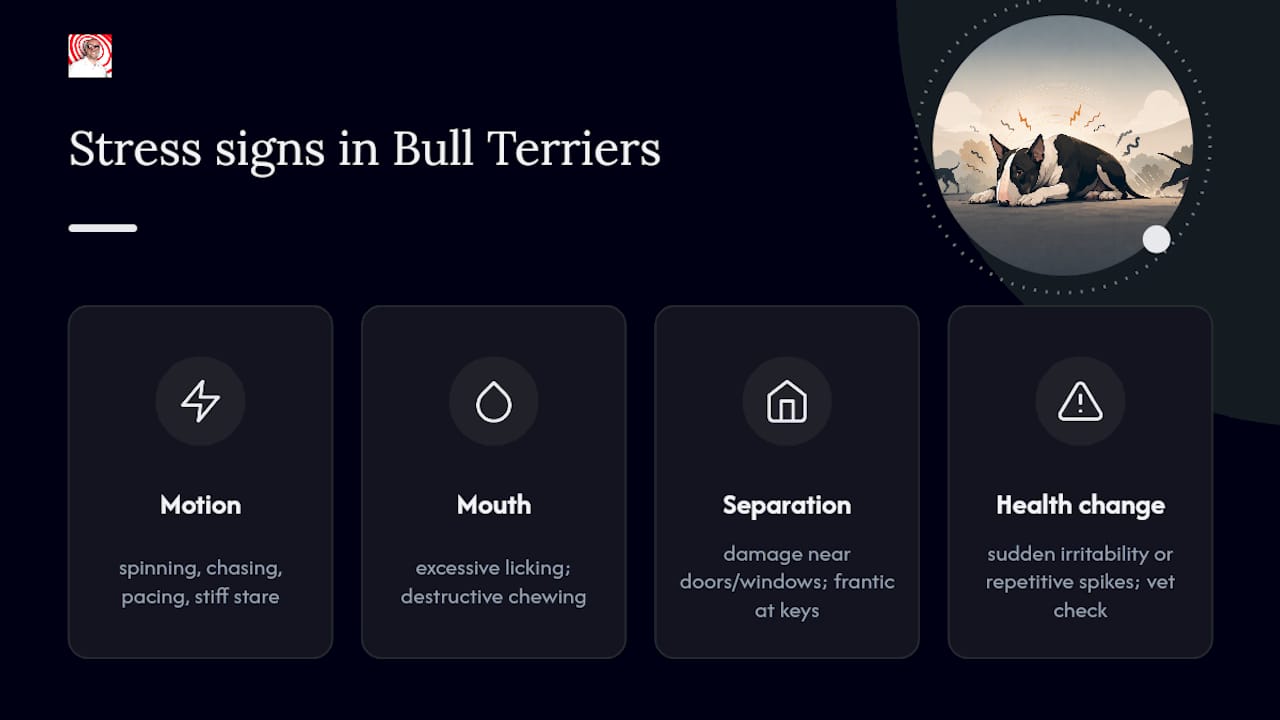
Stress in this breed rarely looks like classic trembling or hiding. Bull Terriers tend to externalize anxiety through motion and mouth.
Watch for excessive licking of paws or furniture, sudden spikes in chase or spin behavior, or a dog that cannot settle even after a long walk. Panting without heat or exertion, pacing between rooms, and destructive chewing that appears out of nowhere are common tells. Some dogs shift into a stiff, staring posture before a reactive moment, which is worth learning to spot early since it precedes trouble rather than following it.
Separation-related stress often shows up as damage concentrated near doors and windows, or as a dog that becomes frantic the moment you pick up your keys. Because Bull Terriers are wired for close human company, isolation is one of the most common stress triggers in the breed, and the fix is rarely more crate time. It is more inclusion.
A dog masking pain can also present as sudden irritability or a spike in repetitive behavior, so a change in temperament that appears overnight deserves a vet visit before you assume it is purely behavioral. Chronic stress left unaddressed tends to compound, turning an occasional tail-chase into a daily ritual. Catching the early signs, stiffness, pacing, excessive licking, gives you a much easier problem to solve than waiting for a full-blown compulsive pattern to set in.
Can Bull Terriers Live With Cats and Small Animals?
Mixed results is the honest answer, and it depends heavily on individual temperament and how early socialization was handled. Some Bull Terriers live peacefully alongside cats they were raised with from puppyhood. Others retain a strong prey drive toward anything small and fast, regardless of how much training you invest.
The chase instinct that makes this breed so entertaining during fetch is the same instinct that makes small animals risky housemates. Rabbits, guinea pigs, and other pocket pets are generally a poor match, since a moment of excitement can turn deadly fast even in a dog with no history of aggression.
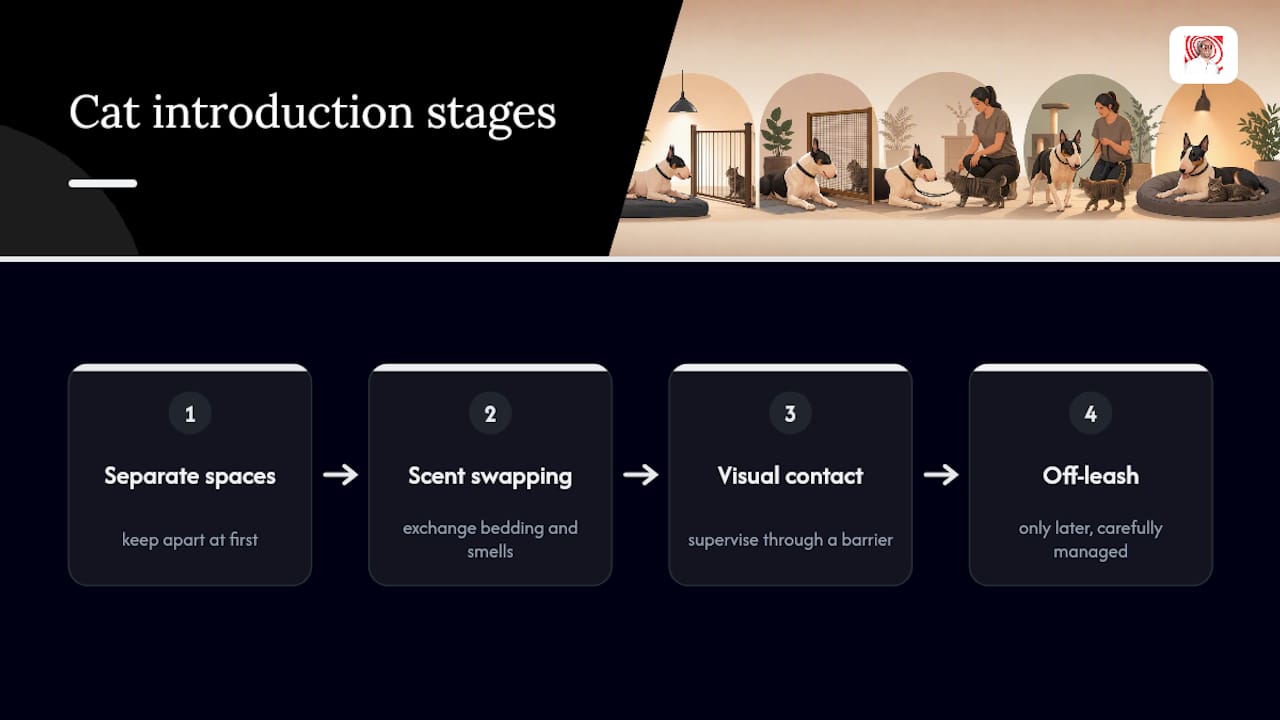
Cats are a different calculation. A Bull Terrier raised from puppyhood alongside a confident, dog-savvy cat has a real shot at a peaceful household. Introducing an adult Bull Terrier to a new cat is a much bigger gamble, and it should happen slowly: separate spaces first, scent swapping, then supervised visual contact through a barrier before anything off leash.
Never leave a Bull Terrier and a small pet unsupervised, no matter how long they have coexisted without incident. Instinct can override months of calm behavior in a single unguarded moment. If you already own smaller animals and are considering a Bull Terrier, talk to a rescue or breeder candidly about the individual dog's history with other species before bringing it home. Some dogs are simply not safe housemates for anything smaller than themselves, and that is a fact worth knowing before day one rather than after an incident.
Living With the Grin: An Author's Take
I wrote Milo & Ze because Bull Terriers are genuinely funny animals, and fiction lets you show that goofiness without pretending the training work disappears. Real dogs need the socialization and structure this article covers. Stories just make the payoff easier to picture. If you want more on the breed's health side, the Bull Terrier health guide on this site covers what deafness and other conditions mean for daily life.
— Mark
Ready to Meet Milo and Ze?
If the Bull Terrier's clownish streak already has you smiling, Milo & Ze: A Bull Terrier Puppy Adventure captures exactly that comic, big-hearted energy in story form. It is one of several titles in the children's books collection built around animal companions kids actually recognize from real life. Fans of Mark Watson's storytelling style beyond the puppy tales can browse the full book catalog for horror thrillers and Creepypasta anthologies that share the same sharp, character-driven voice. For a look at how other writers use dogs as characters in fiction, this piece on dogs in storytelling is worth a read.
Sources
- Bull terrier - Woodgreen pet explorer
- Bull Terrier — Royal Kennel Club — Breed standard
- Bull Terrier — Vetstreet
- Bull Terrier — The Kennel Club — Breed standard