

A Bull Terrier is a muscular, egg-headed troublemaker with a heart built for one thing: you. These bull terrier facts add up to a clear verdict: they're playful, stubborn, and fiercely loyal dogs suited to active owners who can commit to daily exercise and firm, consistent training. First-time dog owners and households with unsupervised toddlers should think twice. Health checks, training tricks, and daily-care routines are all coming up.
TL;DR:
- White Bull Terriers have a higher risk of congenital deafness, especially if they carry the pure white coat trait, requiring hearing tests from breeders.
- The breed's stubborn independence and strong prey drive mean early socialization and consistent training are essential for safe household integration.
- Responsible breeders conduct health screenings for deafness, heart issues, and kidney disease, which directly impact the breed's typical lifespan of 10 to 13 years.
- Daily exercise should total about 45 minutes to an hour, split between walks and mental activities, with grooming limited to weekly brushing and monthly baths.
- Proper early bonding, establishing routines, and vet visits within the first few days are critical for developing a well-adjusted Bull Terrier puppy.
Table of Contents
- Bull Terrier Facts About Appearance and Coat Varieties
- The History Behind the Breed's Odd Head and Fighting Past
- What Is Bull Terrier Temperament Really Like?
- Bull Terrier Health Issues and What Lifespan to Expect
- Daily Care: Exercise, Grooming, and Feeding Guidelines
- Training a Bull Terrier: Where to Start and What Works
- Breed Standards: What Kennel Clubs Look for in a Bull Terrier
- Your First Week and Beyond With a New Bull Terrier
- Where These Bull Terrier Facts Come From
- Why Most Bull Terrier Advice Misses the Point
- Sources
- FAQ
Bull Terrier Facts About Appearance and Coat Varieties
You could pick a Bull Terrier out of a lineup blindfolded, almost. That famous egg-shaped head, curving in an unbroken arc from skull to nose, has no equal anywhere else in the dog world. Small, triangular, deep-set eyes give the face its trademark mischievous squint, and the muscular, broad-chested frame makes even a resting Bull Terrier look ready for action.
The breed splits into two sizes recognized separately by most kennel clubs: the Standard Bull Terrier, generally a larger and heavier dog, and the Miniature Bull Terrier, a smaller but similarly stocky variety. Coat color runs in two broad camps, and the difference matters beyond looks.
- White: solid white coats, sometimes with colored head markings, but linked to higher rates of congenital deafness.
- Colored: brindle, red, fawn, black, or tricolor coats, generally with lower deafness risk.
- Coat texture: short, flat, and glossy on both varieties, which keeps grooming simple.
If you're meeting a puppy at a shelter or breeder, check both ears respond to sound and ask directly about the litter's hearing-test results.
The History Behind the Breed's Odd Head and Fighting Past
Bull Terriers trace back to 19th-century England, born from crossing Bulldogs with the now-extinct White English Terrier to create a faster, gamer dog for the pit. Breeders later folded in Dalmatian, Spanish Pointer, and Greyhound blood to refine the build and temper the look.
Breeder James Hinks pushed the type toward the all-white "White Cavalier" in the mid-1800s, aiming for a dog that looked as elegant as it fought hard. As organized dogfighting fell out of favor and eventually was outlawed, the breed's role flipped from bloodsport competitor to show dog and companion. Breed clubs formed soon after, and kennel clubs worldwide, including The Kennel Club in Britain, granted formal recognition that still shapes today's standard.
What Is Bull Terrier Temperament Really Like?
Playful bordering on absurd, that's the honest answer. Bull Terriers are often described as "clownish," a term the Bull Terrier Club of America uses deliberately, because these dogs genuinely seem to enjoy making their owners laugh. They bond hard with people, crave physical closeness, and generally do poorly as a dog left alone in a backyard all day.
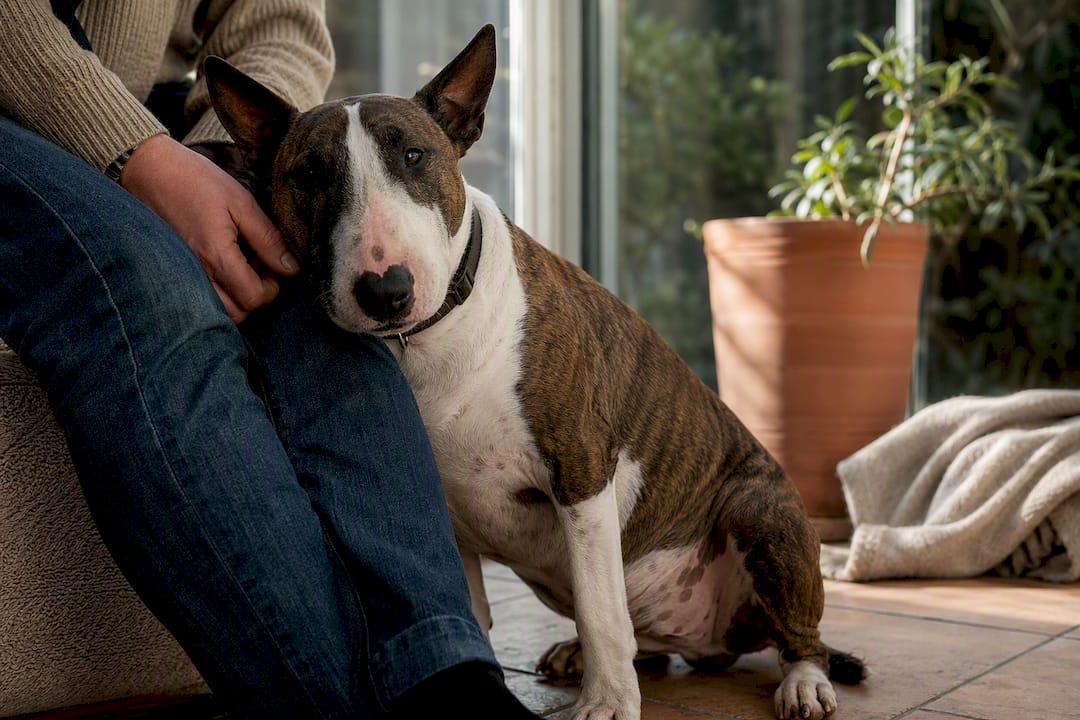
That affection comes wrapped in a stubborn streak. Bull Terriers were bred to make independent decisions in a fight, and that instinct hasn't fully faded. Expect a strong prey drive around small animals and, without early socialization, potential friction with other dogs.
Who should own one? Run through this before you commit:
- An active household that can deliver daily exercise, not just a yard to roam in.
- Owners willing to stay consistent with training rules rather than bending them.
- Close supervision around young children, since Bull Terriers play rough without meaning harm.
- Some prior dog-ownership experience, ideally with a strong-willed breed.
Pro Tip: When meeting a litter, watch how each puppy responds to being gently rolled onto its back. A pup that settles quickly and re-engages with tail wagging usually shows better resilience than one that stays rigid or bolts the moment it's released.
Bull Terrier Health Issues and What Lifespan to Expect
Deafness is the headline health concern, and it clusters heavily in white-coated lines. Responsible breeders test litters early, since a portion of all-white puppies are born with partial or total hearing loss in one or both ears.
Beyond hearing, the breed carries a handful of recurring predispositions worth knowing before you sign a purchase agreement.
- Skin allergies: prone to dermatitis and food or environmental sensitivities.
- Heart conditions: predispositions to cardiac issues that make baseline screening worthwhile.
- Kidney disease: hereditary kidney problems appear at higher rates than in many other breeds.
- Lethal acrodermatitis: a rare, fatal genetic skin disorder that affects only white puppies and has no cure.
- Laryngeal issues: some dogs develop noisy breathing or laryngeal paralysis later in life, an under-recognized respiratory concern worth a vet visit if you notice it.
Bull Terriers typically live 10 to 13 years, a range drawn from breed surveys and lifespan estimates rather than any single guaranteed figure. Ask breeders for BAER hearing tests, cardiac screening, and kidney panels before you commit to a puppy. A breeder who can't produce paperwork on any of the three is a red flag, not a minor gap.
Daily Care: Exercise, Grooming, and Feeding Guidelines
Boredom is the enemy here, not exercise itself. A Bull Terrier does well with roughly 45 minutes to an hour of activity daily, and the PDSA's clinical guidance backs that same daily target for keeping the breed physically and mentally settled.
- Exercise: split the hour between a real walk or jog and interactive play, tug, fetch, or scent games work well.
- Grooming: brush weekly to manage shedding, bathe monthly or as needed, and check ears, nails, and teeth on a rotating schedule.
- Feeding: measure portions rather than free-feeding; Bull Terriers gain weight easily and a heavier frame stresses joints and organs already under strain from breed-specific conditions.
- Housing: that short coat offers little insulation, so cold, wet climates call for a jacket outdoors and a warm spot indoors, never a kennel left outside overnight.
Pro Tip: Split one long walk into two shorter outings if your Bull Terrier seems restless by mid-afternoon. Their attention span for a single activity is shorter than their energy reserves, and a second outing often heads off evening zoomies before they start.
For structured routine ideas that pair physical output with mental work, the exercise routine breakdown covers three templates worth trying in the first month.
Training a Bull Terrier: Where to Start and What Works
Start before the second vaccination round closes the socialization window, typically by 12 to 16 weeks. Waiting until a puppy is fully vaccinated to introduce new people, dogs, and environments costs you the most valuable learning period of its life.
- Keep sessions short: five to ten minutes, several times a day, beats one long drilling session every time.
- Lead with play, not correction: reward-based methods land better with this breed than repetitive drilling, since Bull Terriers disengage fast when training feels like a chore.
- Stay consistent: one household rule enforced by everyone beats three rules enforced by no one.
- Get outside help early: if a puppy shows resource guarding or won't settle around other dogs by four months, a professional trainer or a structured puppy class solves problems faster than guesswork.
A play-first training framework built around 8 to 12 week progressions gives a more detailed week-by-week path than a single article can cover.
Breed Standards: What Kennel Clubs Look for in a Bull Terrier
Neither the Fédération Cynologique Internationale standard nor most national kennel clubs set fixed height or weight limits. Judges instead look for an impression of substance and power relative to a dog's size, alongside that unmistakable egg-shaped head and a strong, driving gait.
Health testing backs up the standard in practice. Look for BAER hearing certification, cardiac screening, and kidney panels on any breeder's paperwork, and ask whether they participate in a kennel-club interbreeding program, since Miniature and Standard lines cross under controlled approval specifically to widen genetic diversity and cut deafness rates. A breeder who dismisses these questions or waves off documentation isn't one to trust with a deposit.

Your First Week and Beyond With a New Bull Terrier
The first 72 hours set the tone for everything after. Establish a feeding schedule immediately, pick one designated sleep space, and book a vet visit within the first few days rather than waiting for a problem to force it. Short bonding play sessions matter more early on than long walks.
From there, a simple weekly template covers most of what a Bull Terrier needs: 45 to 60 minutes of daily exercise paired with 15 to 20 minutes of structured training or puzzle-feeding. For the full breakdown, the 72-hour puppy checklist and the temperament guide both go deeper than space allows here.
Where These Bull Terrier Facts Come From
Every claim above draws on kennel-club standards and veterinary sources: The Kennel Club for breeding rules, the FCI standard for conformation, the AKC for temperament, and Vetstreet for grooming and health guidance.
Why Most Bull Terrier Advice Misses the Point
Most breed guides treat temperament and health as separate topics, one chapter on personality, another on genetics, as if a dog's behavior and its body aren't tangled together. That's backwards for this breed specifically. A Bull Terrier's stubbornness isn't a personality quirk you train around; it's partly the same independent streak that made it useful in the pit two centuries ago, and it shows up again the moment a hearing-impaired puppy has to compensate for a sense it doesn't have.
The conventional advice, "get plenty of exercise and start training early," isn't wrong, but it treats every Bull Terrier as interchangeable. It isn't. A white puppy from an untested litter carries risks a brindle puppy from a health-screened breeder doesn't, and no amount of play-first training changes that math. If there's one thing to prioritize before anything else, it's the breeder's paperwork, not the puppy's cuteness. Everything downstream, from training success to a full lifespan, depends more on what you can't see at first glance than on what you can.
— Mark
Sources
FAQ
Is a Bull Terrier a Good Family Dog?
Bull Terriers can make loving, playful family dogs in active households, but they need supervision around young children due to their rough play style and strong build. Early socialization and consistent training make the difference between a great family dog and a handful.
What Is the Bull Terrier Famous For?
The Bull Terrier is famous for its unmistakable egg-shaped head and clownish, high-energy personality, traits the American Kennel Club highlights as the breed's signature. It's also known historically as the breed developed for 19th-century English bloodsports before transitioning into a companion dog.
Are Bull Terriers Autistic?
Bull Terriers aren't autistic; dogs can't receive that diagnosis, which applies to humans. Some Bull Terriers do show repetitive spinning or tail-chasing behavior, sometimes linked to compulsive disorder tendencies in the breed, but that's a distinct issue from autism.
What Two Breeds Make a Bull Terrier?
The Bull Terrier originated from crossing the Bulldog with the now-extinct White English Terrier in 19th-century England. Later breeders added Dalmatian, Spanish Pointer, and Greyhound bloodlines to refine the type into the dog recognized today.