
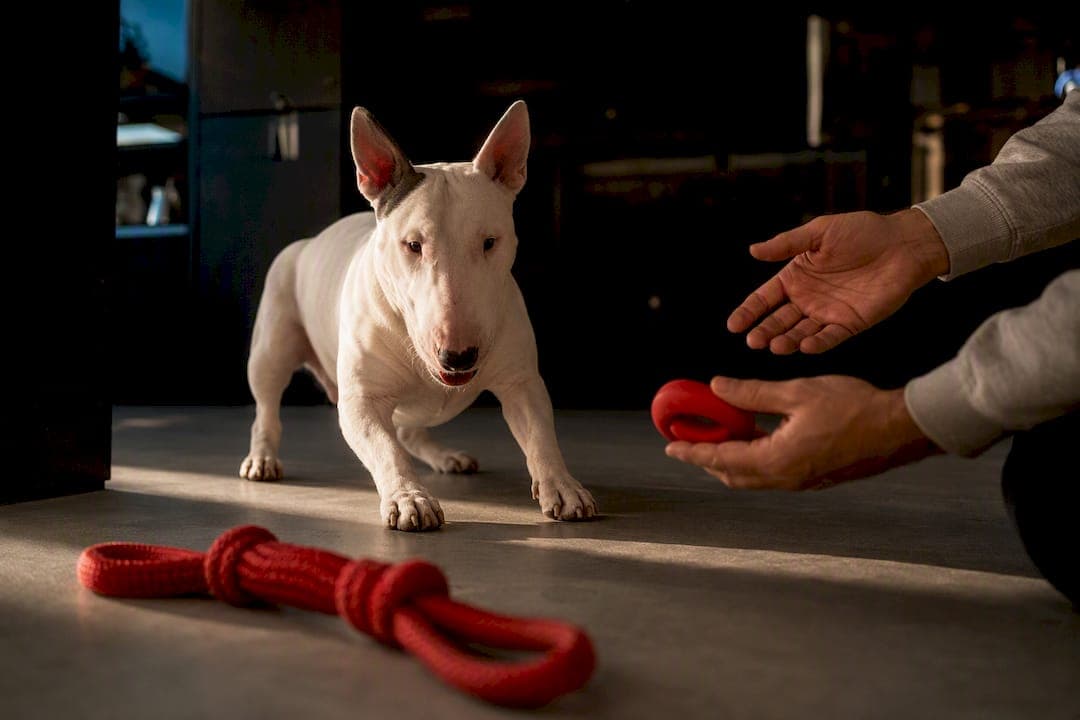
The safest, most effective approach for Bull Terrier training methods is reward-based positive reinforcement, delivered in short, high-energy sessions and backed by real daily exercise. Think three or four five-minute bursts, not one long grind. Reward big, keep sessions playful, and always pair training with a good run beforehand. Cover the commands, the body language, the boredom traps, and you're set.
TL;DR:
- Short, high-energy reward-based training sessions paired with daily exercise are essential for effective Bull Terrier training.
- These dogs are sensitive to corrections, so positive reinforcement and early socialization are key to prevent behavioral problems.
- Managing prey drive and reactivity involves structured socialization, resource guarding prevention, and avoiding aversive tools like shock collars.
- Consistent household rules, routine, and patience build leadership and improve cooperation, especially with the breed's tendency toward stubbornness.
- Mental stimulation through trick training and enrichment helps prevent destructive behaviors driven by boredom or excess energy.
Table of Contents
- What Makes Bull Terrier Training Methods Different From Other Breeds?
- Core Training Methods for Bull Terrier Owners
- How Do You Teach Basic Obedience Commands to a Bull Terrier?
- Managing Reactivity, Resource Guarding, and Other Safety Issues
- Exercise and Enrichment: The Fuel Behind Every Training Session
- Socializing a Bull Terrier Without Setting Off Reactivity
- An 8 to 12 Week Bull Terrier Training Plan You Can Actually Run
- House Training and Crate Training a Bull Terrier
- Stopping Chewing and Digging Before They Become Habits
- Building Leadership Without Dominance Tactics
- Trick Training and Advanced Skills for a Sharper Mind
- A Breed-Aware Approach Changes Everything
- Keep the Bonding Going Beyond the Training Sessions
- Sources
- FAQ
What Makes Bull Terrier Training Methods Different From Other Breeds?
Here's the thing about Bull Terriers: they don't respond to training the way a Labrador or a Border Collie does, and treating them like a generic "dog" is where most owners go wrong.
That egg-shaped head hides a mind that's stubborn, playful, and surprisingly sensitive all at once. Push too hard with corrections, and a Bull Terrier doesn't just resist. It can shut down entirely, refusing to engage at all. RSPCA guidance on dog training makes this point clearly: reward-based methods work because harsh corrections backfire on sensitive breeds, killing the very engagement you're trying to build.
Three traits drive everything else in this guide:
- Sensitivity beneath the bravado. They look tough, but a sharp scolding can make them wary of training altogether.
- High energy paired with a low boredom threshold. A Bull Terrier left under-stimulated will invent its own entertainment, usually something you won't love.
- Real prey drive. Many Bull Terriers fixate hard on small animals or other dogs, which directly shapes how you build recall and leash manners.
These traits set the rules for everything downstream. Sessions stay short because attention fades fast. Rewards have to be irresistible because a squirrel across the yard is stiff competition. Socialization starts early and stays structured because prey drive doesn't fade with age, it gets managed.
Core Training Methods for Bull Terrier Owners
Positive reinforcement isn't a philosophy here. It's a mechanical process, and getting the mechanics right matters more than the theory.
A high-value reward for most Bull Terriers is not kibble. It's something they'd crawl across broken glass for: small pieces of cooked chicken, cheese, or a squeaky toy reserved only for training. Timing beats generosity. Mark the exact moment your dog performs the behavior, then reward within one or two seconds. Wait longer than that and the dog connects the treat to whatever it did after the correct behavior, not the behavior itself.
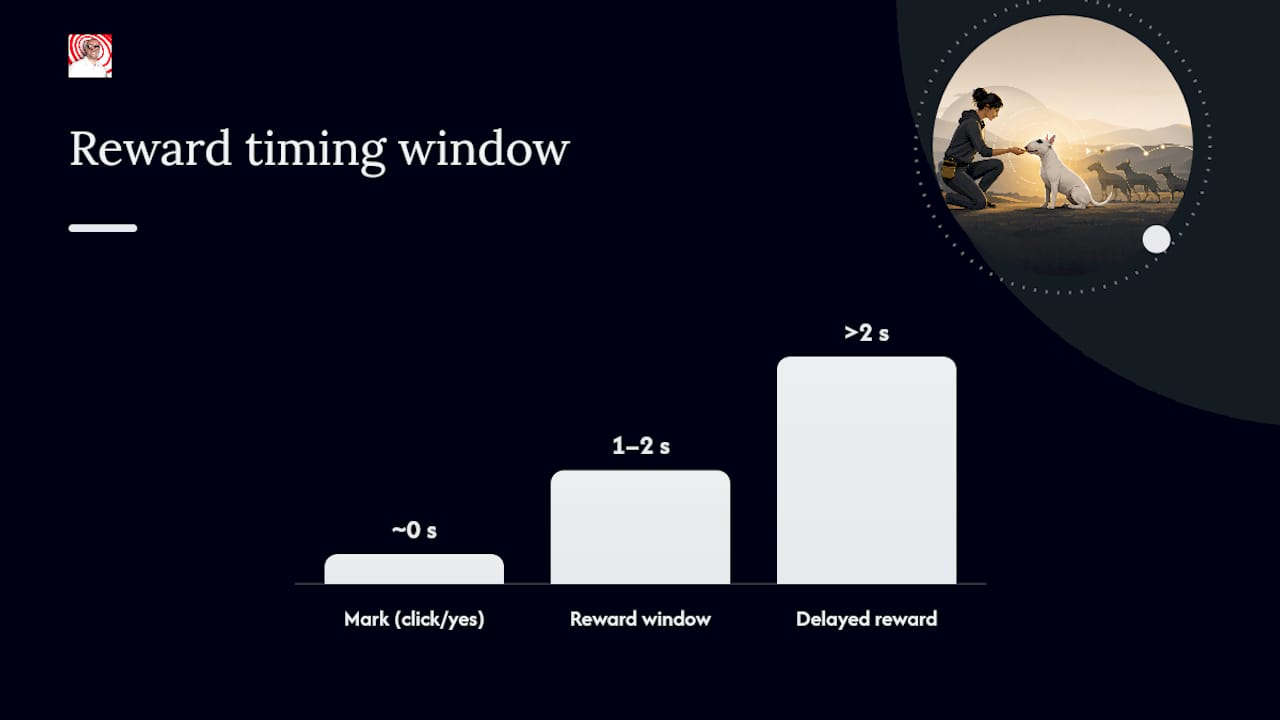
A clicker or a sharp verbal marker like "yes" solves the timing problem. Click the instant your dog's rear hits the floor for a sit, then treat. After a week or two of consistent pairing, the dog learns the click itself predicts good things, which lets you mark behavior faster than your hand can move toward a treat pouch. Once a command is reliable across different rooms and mild distractions, start phasing out food on every single rep, rewarding every second or third success instead.
Three shaping strategies work well for this breed:
- Luring guides the dog into position with a treat held near the nose. Best for teaching sit or down fast, but fade the lure within a handful of reps or the dog starts waiting for it.
- Shaping rewards small steps toward a full behavior. Useful for tricks or complex positions where luring gets clumsy.
- Capturing rewards a behavior the dog offers naturally, like lying down on its own. Bull Terriers offer plenty of capturable behavior if you're watching for it.
Leash equipment matters more with this breed than most, given how hard a Bull Terrier can pull once prey drive kicks in. A front-clip harness redirects pulling sideways instead of letting the dog drag you forward, and a well-fitted head collar gives extra steering without any neck pressure. Introduce either gradually, with treats and short indoor wear time, before clipping on for a real walk.
Pro Tip: Run three to four sessions a day at around five minutes each, and switch up the skill or game each time. A Bull Terrier that gets bored mid-session will start improvising, and improvised behavior is rarely the behavior you wanted.
Always end on a win. If a session is going sideways, drop back to something the dog already knows, get one clean rep, reward, and stop there.
How Do You Teach Basic Obedience Commands to a Bull Terrier?
Every command below follows the same skeleton: lure or capture the behavior, mark it, reward it, then fade the lure. What changes is the specific trap each command sets for Bull Terrier owners.
- Sit. Lure the nose upward and slightly back until the rear drops, mark, treat. Fade the lure within five to seven successful reps, and vary where you practice so the dog doesn't think "sit" only applies in the kitchen.
- Down. Lure from a sit toward the floor between the front paws. Bull Terriers sometimes flop dramatically or roll over here. Reward the moment the belly touches ground, not the theatrics that follow.
- Stay. Add duration only after the command is solid. Count one second, release, reward. Add a second at a time rather than jumping to thirty seconds, which just teaches the dog that stay is a coin flip worth breaking early.
- Recall (come). This is the one worth the most patience. Practice on a long line in the yard before ever trying it near distractions. Reward recall with something better than anything else available. Never call your dog to end playtime, get a bath, or face anything unpleasant, or the word itself becomes a warning sign to ignore.
- Loose-leash walking/heel. Use the stop-and-stand method: the moment the leash tightens, stop moving and wait. The dog learns pulling gets nowhere, while a slack leash gets forward progress. A front-clip harness makes this method far easier to enforce on a breed with this much pulling power. If you spot a trigger, like another dog, redirect attention with a treat before the fixation sets in, not after.
- Leave it / drop it. Start with a low-value item on the floor. Cover it with your hand if the dog goes for it, reward the instant it backs off, then progress to items in the open. For drop it, trade up rather than yanking an object away, which prevents resource guarding from ever taking root.
For recall specifically, the fix for a strong prey drive isn't more corrections, it's a better reward economy. Introduce exceptional rewards, proof the behavior across increasingly distracting settings on a long line, and build a reliable "trade and reward" habit as a backup plan for anything you can't fully prevent, according to breed-specific training guidance.
A command counts as reliable once your dog performs it correctly on the first ask, in a new location, with a mild distraction present, most times. That's the milestone to work toward, not a perfect performance in your living room.
Managing Reactivity, Resource Guarding, and Other Safety Issues
Not every behavior problem gets solved with more treats and patience. Some need a triage step first: is this a training gap, or a safety issue?
If a behavior involves biting, intense growling over objects, or reactivity that escalates rather than settles with distance, that's a safety issue. Management comes before retraining. Blue Cross's guidance on dog behavior problems recommends identifying the trigger and the emotional state behind it first, then structuring the environment so the unwanted behavior simply can't happen while you build a better response.
Practical tools for that structure:
- Leashes and long lines keep control in unpredictable environments without physical confrontation.
- Physical barriers (baby gates, crates, closed doors) prevent rehearsal of guarding or reactive behavior around triggers.
- Distance management means recognizing your dog's reactivity threshold and staying beyond it until training closes the gap.
For reactivity toward other dogs, counter-conditioning works by pairing the trigger, at a distance the dog can tolerate calmly, with something wonderful. Move closer only in small increments, and only once the dog stays relaxed at the current distance across multiple sessions.
Resource guarding gets a stepwise fix: start by tossing extra-good treats near the food bowl from a distance, gradually approaching as the dog stays calm, and never punish a growl. Punishing the warning just removes the warning, not the underlying tension.
Pro Tip: Skip anything aversive, shock collars, prong collars, physical corrections. These raise fear and aggression risk in sensitive breeds instead of resolving it, per expert-reviewed Bull Terrier tips.
If a behavior doesn't improve with consistent management and reward-based retraining, or if it involves any bite risk, contact a qualified veterinary behaviorist rather than pushing through alone.
Exercise and Enrichment: The Fuel Behind Every Training Session
A tired Bull Terrier is a trainable Bull Terrier. Skip the exercise, and no clicker on earth will hold that dog's attention.
Physical outlets that suit the breed's build include fetch, flirt-pole chasing, tug with clear rules (release on command, no exceptions), and short agility drills. Mental outlets matter just as much: puzzle feeders at mealtime, scent games hiding treats around a room, and regular rotation of toys so nothing gets stale. Enrichment and exercise aren't optional extras bolted onto training. Physical and mental stimulation together are what prevent the boredom-driven destructive behavior that undoes weeks of progress.
- Exercise before a training session, not after, so your dog arrives with edges taken off rather than pent-up energy still humming.
- Aim for a substantial daily activity window split across walks, play, and mental games, tailored to your individual dog's age and fitness.
- Rotate activity types across the week so no single outlet gets stale.
Our breakdown of Bull Terrier exercise routines covers three specific weekly structures that pair physical exertion with training windows, worth a look if you want a ready-made schedule instead of building one from scratch.
Socializing a Bull Terrier Without Setting Off Reactivity
Early exposure shapes everything that follows, and the window for easy socialization is shorter than most owners assume.
Puppies benefit from short, positive exposures to new people, surfaces, sounds, and calm dogs during their early weeks, always kept upbeat and never overwhelming. Adult Bull Terriers with limited socialization history need a more careful approach: parallel walking alongside a calm dog at a comfortable distance, gradually closing the gap over multiple sessions, works far better than a face-to-face introduction.
Watch the body language, not just the outcome. Stiff posture, a hard stare, or a tucked tail all signal it's time to add distance, not push through.
- Stop any introduction the moment either dog shows stress signals rather than waiting for an actual reaction.
- Keep first meetings short, on neutral ground, with both dogs leashed and handlers relaxed.
- Skip crowded dog parks entirely for a Bull Terrier with any reactivity history. Structured one-on-one meetings are safer and more productive.
A dog that stays reactive despite consistent, careful exposure deserves a session with a qualified trainer or behaviorist rather than more solo attempts.
An 8 to 12 Week Bull Terrier Training Plan You Can Actually Run
Structure beats improvisation, especially with a breed that tests boundaries the moment routine gets loose. A week-by-week breed-specific plan sequences skills so each week builds on real success rather than guesswork.
- Weeks 1 to 2: Focus entirely on engagement and name recognition. Reward eye contact and check-ins constantly. This is the foundation everything else sits on.
- Weeks 3 to 4: Introduce sit, down, and a marker word or clicker. Keep every session under five minutes, three to four times daily.
- Weeks 5 to 6: Add recall on a long line in low-distraction settings, plus loose-leash walking basics indoors and in the yard.
- Weeks 7 to 8: Proof existing commands around mild distractions. Start leave it and drop it work with low-value items.
- Weeks 9 to 10: Take commands into real-world settings: quiet streets, a friend's calm dog, a new room. This is where recall gets tested for real.
- Weeks 11 to 12: Layer in stay duration, tighter heel work, and begin trick training for mental variety.
If a week's goal isn't reliable by its end, repeat it rather than pushing forward. A shaky recall on week six is a signal to add another week, not a reason to panic. Pause the plan entirely and get professional input if reactivity, guarding, or fear responses escalate instead of easing with practice.
House Training and Crate Training a Bull Terrier
Crate training works well for this breed precisely because Bull Terriers like having a den, a spot that's theirs and predictable. Size the crate so your dog can stand, turn, and lie down comfortably, nothing more, since extra space just invites accidents in the far corner.
Introduce the crate slowly. Toss treats inside during the first few days, feed meals in there once your dog enters willingly, and never use it as punishment. A crate associated with timeout becomes a crate your dog resists entering at bedtime.
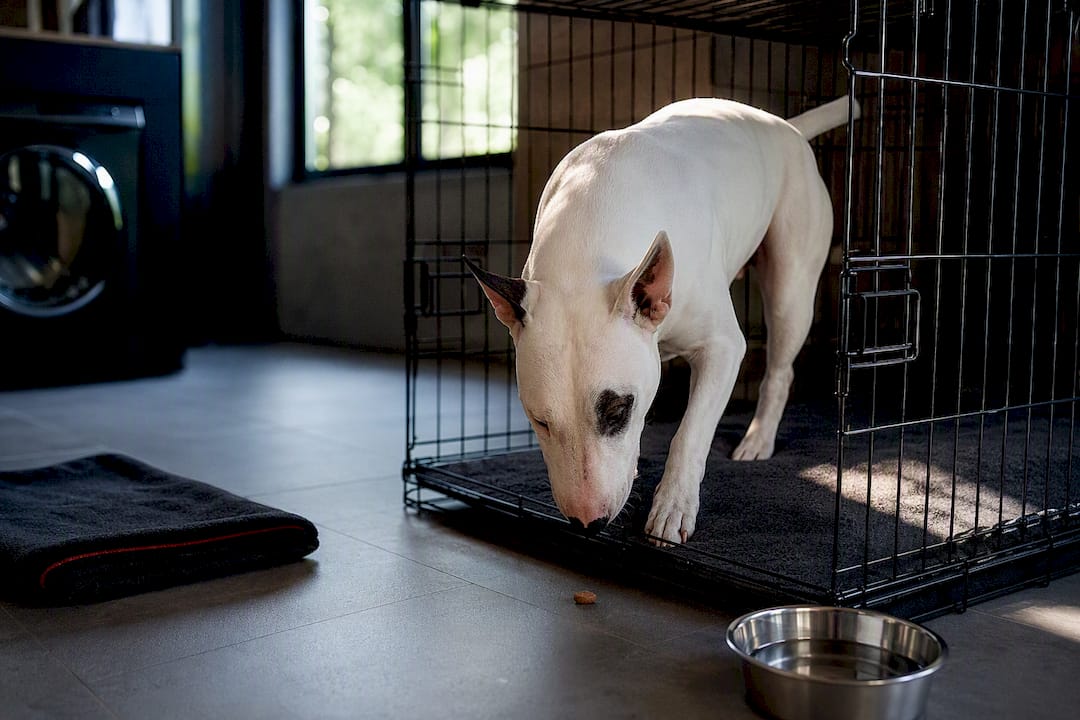
For house training itself, consistency in timing beats everything else. Take your puppy out immediately after waking, after meals, and after play sessions, since those three moments trigger the strongest urge to go. Reward the second your dog finishes outside, not on the walk back in, so the connection between "outside" and "good things happen" stays crystal clear.
Overnight, most puppies need a bathroom break every few hours until bladder control catches up with age, typically improving steadily over the following months. Accidents indoors call for a thorough clean with an enzymatic cleaner, since lingering scent invites repeat visits to the same spot. Skip the scolding. A Bull Terrier that gets punished for an accident it doesn't understand often just learns to hide before going, which makes the problem harder to catch, not easier.
Stopping Chewing and Digging Before They Become Habits
Chewing and digging aren't defiance. They're a Bull Terrier telling you it needs more to do.
Puppies chew because they're teething and exploring the world through their mouths. Adults chew and dig mostly out of boredom, excess energy, or plain habit that never got redirected early. The fix isn't punishment, it's substitution. Keep a rotating supply of durable chew toys around, and the instant you catch your dog chewing something off-limits, swap it for an approved toy and praise the switch.
Digging often has a specific trigger worth identifying: boredom, cooling off on hot ground, or hunting something moving underground. A designated digging spot, a sandbox or a loose patch of yard where digging is fully allowed, can redirect the instinct rather than fighting it outright.
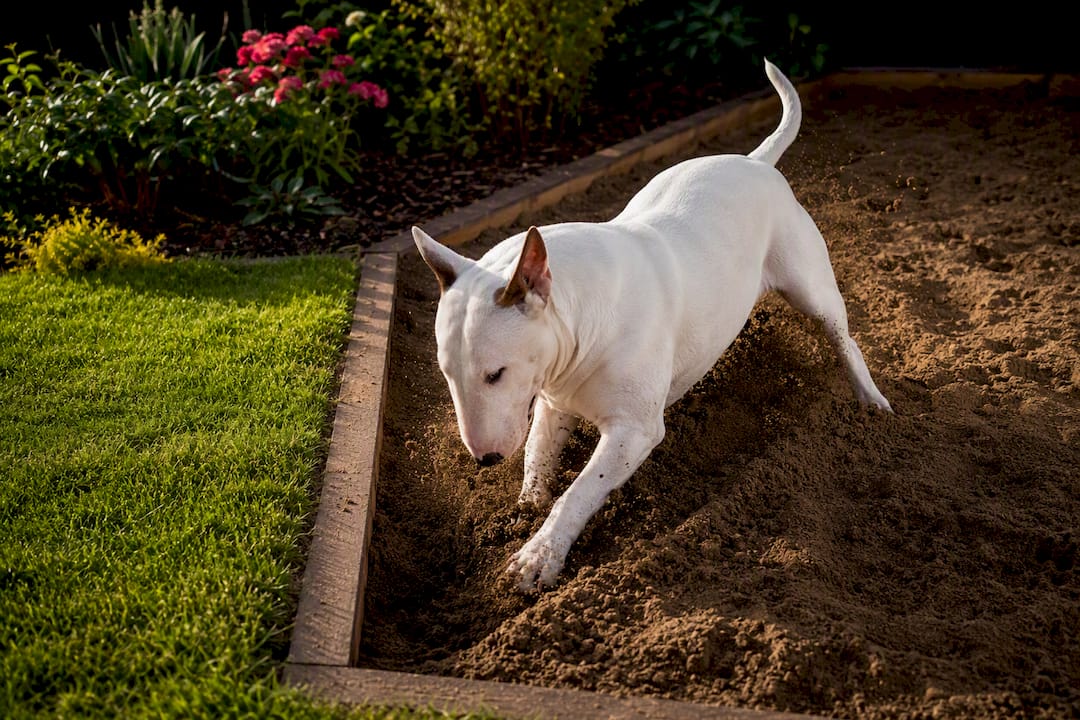
Both behaviors drop sharply once a dog gets enough physical exercise and mental engagement during the day. A Bull Terrier that's genuinely tired by evening has far less energy left over for excavating your flower bed. If chewing or digging persists despite consistent redirection and adequate exercise, treat it as a signal to increase enrichment variety rather than escalating consequences.
Building Leadership Without Dominance Tactics
Forget the old "alpha" framing. What a Bull Terrier actually needs isn't a dominant pack leader, it's a predictable one.
Consistency is the real leadership tool here. If sitting before meals is the rule on Monday, it stays the rule on Friday, and it stays the rule whether you're tired or in a hurry. Mixed signals, sometimes allowing jumping on the couch, sometimes not, confuse a dog far more than any single firm boundary ever would.
Everyone in the household needs to use the same cues and the same rules. A dog that gets "off" from one person and "down" from another for the same behavior takes twice as long to learn either one. Write your household's core rules down if that helps keep everyone aligned.
Leadership built on consistency and reward, rather than force, produces a dog that chooses to cooperate rather than one that complies out of fear. That distinction shows up clearly in how a Bull Terrier behaves when you're not actively correcting it, which is really the whole point of training in the first place.
Trick Training and Advanced Skills for a Sharper Mind
A Bull Terrier that's mastered sit, stay, and loose-leash walking still needs a mental outlet, and trick training fills that gap without any risk of overtraining the basics into boredom.
Spin, shake, "touch" (nose-to-hand targeting), and play dead all build on the same shaping and marking skills already covered, just applied to something novel and fun. Targeting in particular pays off well beyond the trick itself. A dog trained to touch your hand on cue is a dog you can redirect fast in a real-world distraction, since "touch" becomes a built-in reset button.
Puzzle-based games rank among the best mentally engaging activities: teach your dog to find a specific named toy among several, or work up to a simple scent-detection game with treats hidden around a room. These games tap the same problem-solving drive that makes an under-stimulated Bull Terrier so inventive about mischief, just aimed somewhere useful instead.
Advanced work like agility courses or structured tug-with-rules games also builds impulse control alongside physical skill, since your dog has to listen for release cues mid-excitement. That combination of drive and self-control is exactly what makes trick training worth the extra ten minutes a day.
A Breed-Aware Approach Changes Everything
Most training advice treats dogs as interchangeable, and that's exactly where Bull Terrier owners get burned. This breed rewards patience and punishes force, and the gap between those two approaches shows up faster here than in almost any other breed I've researched.
Escalate to a behaviorist the moment you see bite risk, intense guarding, or reactivity that isn't easing with consistent management. There's no shame in that call. Consistency, short wins, and real daily exercise do more for a Bull Terrier's behavior than any single clever technique.
— Mark
Keep the Bonding Going Beyond the Training Sessions
Training builds the skills, but the bond behind those skills often grows in quieter moments, a bedtime story, a shared routine, a book that gets your household thinking about your dog differently. There is supplementary support available in the form of story-driven reading that can reinforce the patience and consistency covered in this guide, without pretending to replace hands-on training or professional behavior help when a dog genuinely needs it.

Browse the full books collection for titles that pair well with a Bull Terrier household, including children's titles built around routine and companionship themes that work well for family read-aloud time. Pair your reading with two practical blog posts, one on structuring exercise routines and one on surviving the first days with a new puppy. Pick a title from the books page and add it to tonight's routine.
Sources
- RSPCA — Dog training advice
- Blue Cross — What to do if your dog has a behaviour problem
- TailorPup — How to train a Bull Terrier: 12-week plan (2026)
- Hepper — How to train a Bull Terrier: 10 expert tips
FAQ
Are Bull Terriers Difficult to Train?
They're not difficult so much as sensitive to method. Reward-based training with short, engaging sessions produces steady results, while harsh corrections tend to backfire and cause a Bull Terrier to disengage entirely.
How Can I Train My Bull Terrier Effectively?
Use high-value rewards, mark behavior with a clicker or verbal cue, keep sessions to three or four five-minute bursts a day, and always exercise before training so your dog has the focus to succeed.
Do Bull Terriers Ever Calm Down?
Most Bull Terriers mellow noticeably by age three or four, though their energy and playfulness rarely disappear entirely. Consistent exercise and training earlier in life make that calmer stage far more manageable.
Do Bull Terriers Love Their Owners?
Yes, Bull Terriers are known for forming intensely loyal, affectionate bonds with their households, often described as "clownish" companions who thrive on attention and inclusion in family activities.