
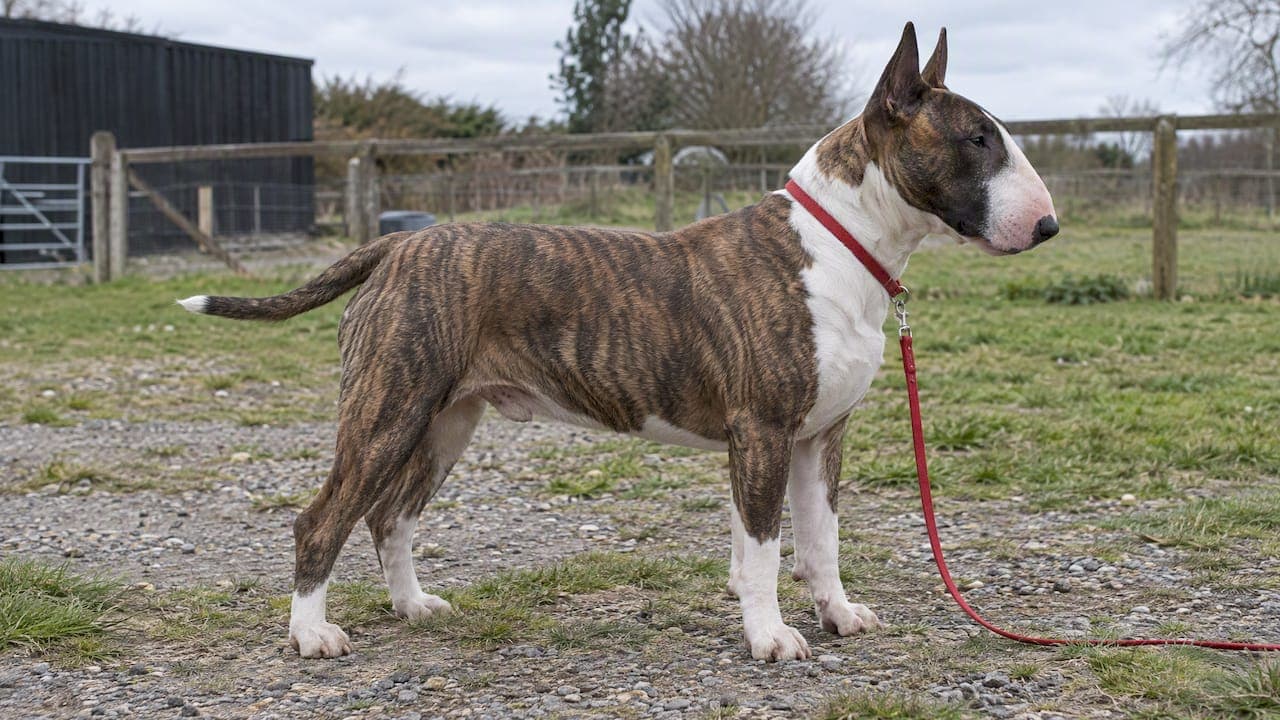
The Bull Terrier breed standard defines the ideal as a strongly built, muscular, well-balanced dog carrying the breed's unmistakable egg-shaped head, set out by The Kennel Club, the Fédération Cynologique Internationale and the American Kennel Club. It also covers temperament, faults and the note that there are no fixed height or weight limits, only the impression of maximum substance for size and sex.
TL;DR:
- Ask breeders for Hereditary Nephritis and Posterior Lens Luxation genetic test records; request hearing results for dogs with white coats before choosing a puppy.
- About 20% of white Bull Terriers experience deafness, often in one ear; tail chasing affects 5% to 10%, while skin allergies affect 15% to 25%.
- Evaluate movement at a free, balanced trot, then check the short, flat, harsh coat and acceptable colors, including white, brindle, red, fawn, or tricolor.
- A calm, spirited dog should show no hostility; the standard flags aggression and excessive shyness, but does not explain how temperament is inherited.
Table of Contents
- Official breed standard summary: Kennel Club, FCI and AKC
- Appearance and conformation: what to check from head to tail
- Size, proportions and movement judges look for
- Temperament and behavior expectations in the standard
- Health considerations and the tests responsible breeders recommend
- How to apply the breed standard in practice
- Why the Bull Terrier's look keeps finding its way into our stories
- FAQ
- Sources
Official breed standard summary: Kennel Club, FCI and AKC
The Kennel Club and FCI publish Bull Terrier standards. We find it worth knowing where each document comes from before you compare a dog against it.
- The Kennel Club: describes the breed as strongly built, muscular, well balanced and active, with a keen, determined, intelligent expression, and it forms the basis for UK show judging.
- FCI: Standard N°11 places the Bull Terrier in Group 3, Terriers, Section 3, Bull type Terriers, with the current valid version dated September 8, 2026.
Appearance and conformation: what to check from head to tail
The FCI standard records the breed's egg-shaped head.
The Kennel Club standard describes the breed's head shape.
Size, proportions and movement judges look for
Here's the part that surprises a lot of first-time buyers: the standards set no fixed height or weight. Instead, both the Kennel Club and FCI documents call for the impression of maximum substance consistent with quality and sex, meaning a dog should look as powerful as its frame allows without appearing coarse.
The Kennel Club standard emphasizes soundness and warns against exaggerations detrimental to health. It also describes the Bull Terrier's physical features and movement.

Temperament and behavior expectations in the standard
The Kennel Club standard describes a keen, determined and intelligent expression.
- Disqualifying faults: the FCI standard lists aggressive or overly shy dogs.
The standard describes the breed's desired traits, but does not establish how temperament is inherited. We go deeper into the daily reality of that spirited nature, including why the breed needs 45 to 60 minutes of play every day, in our temperament guide.
Health considerations and the tests responsible breeders recommend
The standard sets the look and the manner, but health screening is what keeps a Bull Terrier sound enough to meet it for a full lifetime. Two tests sit at the top of every reputable breeder's checklist: Hereditary Nephritis (HN) and Posterior Lens Luxation (PLL), both flagged by breed-health guidance as conditions that demand genetic testing before breeding.
- Deafness: affects roughly 20% of white-coated Bull Terriers, often in one ear only, which still allows a full, happy life with the right awareness.
- Compulsive tail-chasing or spinning: reported in about 5% to 10% of the breed.
- Skin allergies (atopic dermatitis): affect an estimated 15% to 25% of Bull Terriers.
- Patellar luxation: also noted as a recurring concern worth screening for early.
Early screening may help identify health concerns. Our guide for new owners discusses what to ask a breeder before bringing a puppy home.
How to apply the breed standard in practice
Whether you're judging, breeding or simply buying, the standard becomes useful the moment you turn it into a checklist.
- Inspect the head first: confirm the egg-shaped profile, flat skull and scissor bite before looking at anything else.
- Check the coat and color: short, flat and harsh, with pure white or an acceptable brindle, red, fawn or tricolor pattern.
- Watch the gait: look for a free, balanced trot rather than an exaggerated reach.
- Assess temperament on the spot: a dog should handle calmly, with spirit but no hostility.
- Request health clearances: ask for HN and PLL testing records, plus hearing results where the dog is white-coated.
Pro Tip: Consider a dog's welfare and soundness alongside its appearance.
Why the Bull Terrier's look keeps finding its way into our stories
The Bull Terrier's distinctive appearance makes it an appealing subject for a story. That egg-shaped head alone has launched more plot ideas than we'd like to admit. If the breed's presence in fiction and folklore interests you as much as its conformation, our piece on Bull Terriers in literature is worth a look.
— Mark
FAQ
What are the downsides of having a Bull Terrier?
Prospective owners should consider exercise and mental stimulation needs, training, and health concerns such as deafness and skin allergies. Checking health clearances and committing to daily play and training routines before buying addresses most of these concerns early.
Is a Bull Terrier a good house dog?
A Bull Terrier may make a good house dog, depending on its needs and the home environment. Consider the breed's exercise and training needs, and review the Kennel Club standard for its description of the breed.
What two breeds make a Bull Terrier?
The Bull Terrier's early development is discussed in our breed history piece. Our breed history piece traces that development from working dog to show standard in more detail.
Do Bull Terriers bark a lot?
Barking varies between individual dogs. Exercise and mental stimulation may help address barking associated with boredom.