
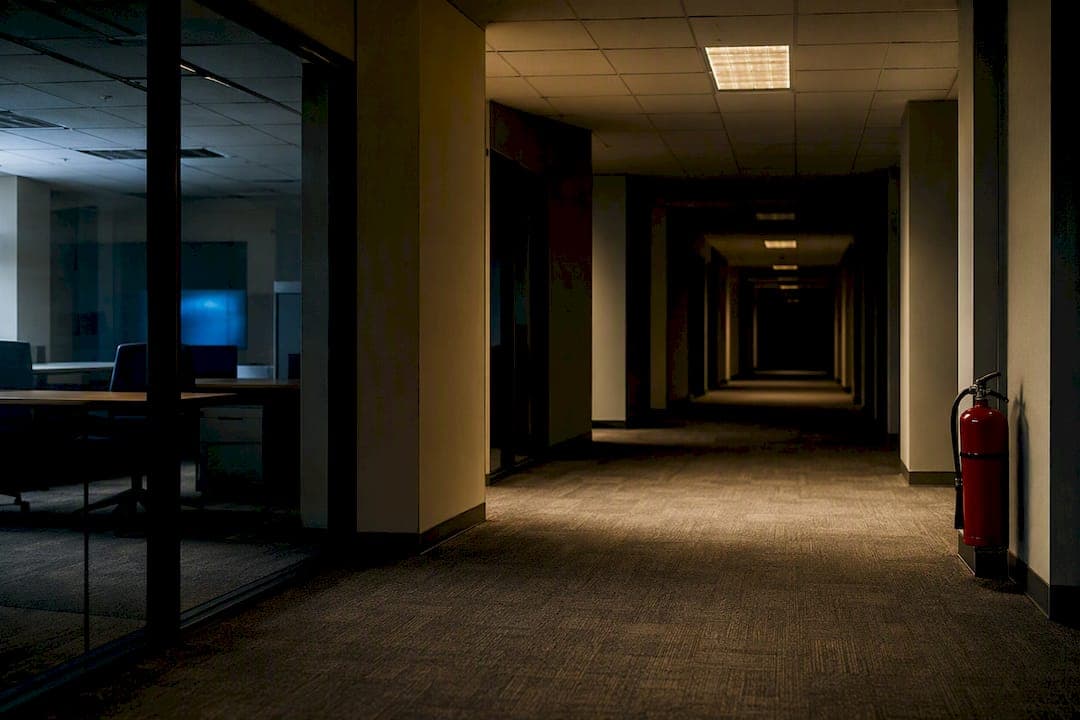
The Backrooms are a collaborative internet myth about accidentally "no-clipping" out of reality into an endless, fluorescent-lit maze of empty office space. The 2026 film treats that maze less like a haunted house and more like a memory-tinged limbo, and its ending resolves into a question about whether escape is even the right goal. Stick around. The full picture, from a grainy 2002 photograph to a director's deliberate pruning of fan lore, is more unsettling than the jump scares suggest.
TL;DR:
- The film's ending suggests that time inside the Backrooms is fluid and subjective, making escape dependent on individual perception and triggers rather than a straightforward exit.
- Ascertain that the film's canon is what Kane Parsons chose to include, as he intentionally limited the lore to avoid overcomplicating the environment and maintain ambiguity.
- The myth originated from a 2002 photograph linked to a HobbyTown USA renovation, which gained momentum after 2019 when fans imagined a no-clipping scenario across layered fan-created levels.
- The story resonates because the environment embodies familiar spaces that feel wrong, and the maze’s looping nature is a metaphor for trauma, memory, or dissociation in psychological readings.
- Fan lore differentiates terms like async, levels, and escape mechanics, but the film simplifies these concepts, focusing on memory, timing, and specific objects rather than clear-cut rules.
Table of Contents
- Origins and early meme history
- How the film adapts the myth
- Core lore terms: Async, levels, and escape mechanics
- Themes and interpretations: why the Backrooms resonates
- Provenance and timeline: from photo to film
- An author's view on setting, ambiguity, and escape
- [If your appetite for internet-born horror is not satisfied yet, Creepypasta anthologies collect collaborative, myth-built dread into stories you can read tonight. No portal required, no VR headset, just the same unsettling pull that made a construction photo into a phenomenon. Start with Creepypasta - Volume 1: The First Fifty Stories if you want the classics that built the genre, or browse the full Creepypasta Books collection to find your next read.](#if-your-appetite-for-internet-born-horror-is-not-satisfied-yet-creepypasta-anthologies-collect-collaborative-myth-built-dread-into-stories-you-can-read-tonight-no-portal-required-no-vr-headset-just-the-same-unsettling-pull-that-made-a-construction-photo-into-a-phenomenon-start-with-creepypasta-volume-1-the-first-fifty-storieshttpsmarkwatsonbookscombookscreepypasta-volume-1-the-first-fifty-stories-terrifying-tales-featuring-if-you-want-the-classics-that-built-the-genre-or-browse-the-full-creepypasta-bookshttpsmarkwatsonbookscomcollectionscreepypasta-books-collection-to-find-your-next-read)
- Sources
- FAQ
Origins and early meme history
The Backrooms began, unglamorously, as a single photograph: a dim, yellow-walled interior with looping carpet, no windows, and nothing that should exist in a normal building. That image traces back to a 2002 HobbyTown USA renovation in Oshkosh, uploaded to the web in 2003 as an ordinary construction diary entry. Nobody thought it was scary at the time. It just sat there.
The myth clicked into place in 2019, when a poster paired the image with an idea rather than a caption: what if you no-clipped out of reality into a place like this and could never get back? That single prompt spread fast, and fans immediately started building on it.
- No-clipping: a term borrowed from video games, describing a glitch that lets a player pass through solid geometry into space that was never meant to be seen.
- Liminal space: an in-between architectural setting, like an empty mall or a motel hallway, that feels wrong precisely because it is designed for transition, not permanence.
- Fan levels: numbered zones invented by the community, each with its own hazards, rules, and internal logic, stacked on top of the original photo like sedimentary layers.
How the film adapts the myth
The 2026 feature keeps its plot lean. Clark and Mary, the two leads, stumble through a retail store that turns out to hide a portal, and the maze on the other side does not play by the rules either of them expects. That is as far as the setup goes without wrecking the experience for anyone who has not watched it yet.
Spoiler warning for everything below this point.
- The ending suggests that time inside the Backrooms is not simply endless, it is looping and subjective, which means Clark's sense of "getting out" may not match anyone else's definition of escape.
- The final scenes lean into an ambiguous reading where survival and entrapment are not opposites, they are two conditions that can be true of the same character at once.
- A third, more grounded reading treats the ending as psychological: the maze as an externalized stand-in for grief or dissociation, with the physical escape mattering less than what Clark chooses to believe.
Director Kane Parsons has said he built the feature from his own 2022 short films rather than trying to absorb every piece of fan-made lore, a decision he frames as avoiding "lore bloat." That choice matters for how you read the ending: Parsons is not obligated to honor every wiki entry a fan community has produced since 2019, and he has said as much. What counts as canon in the film is whatever he chose to keep, not whatever has accumulated online.
Core lore terms: Async, levels, and escape mechanics
Fan wikis and the film do not always mean the same thing by the same word, so the vocabulary is worth sorting out before you argue about theories with anyone.
- Async: in the film's internal mythology, a specific entity or system tied to the maze's rules, narrower and more concrete than the sprawling, half-institutional "Async" some fan lore describes.
- Level 0: the canonical starting level, all yellow wallpaper and buzzing lights, functioning as the maze's front door and the baseline against which every deeper level gets scarier.
- Entities: fan lore splits roughly into two camps, ecological readings that treat the maze's creatures as something closer to an immune response protecting the space, and monster readings that treat them as straightforward predators.
- Escape mechanics: the film uses memory, timing, and specific object triggers rather than a simple door out, which is part of why "can you leave" does not have a one-line answer.
Pro Tip: If a fan theory hinges on a term the film never actually uses on screen, treat it as fan lore, not canon, until Parsons confirms it in an interview.
Themes and interpretations: why the Backrooms resonates
An empty office at 2 a.m. should not be frightening. It usually is anyway, and that gap is the whole engine of liminal-space horror: familiar architecture stripped of the people and purpose that normally make it feel safe. Scholarly commentary on the Backrooms frames the meme as functioning more like a place you inhabit than a story you finish, which explains why it never really needed a plot to survive online for years before the film existed.
The film leans into a trauma-adjacent reading too. A maze that loops, forgets, and repeats behaves a lot like memory does after something bad happens, and several critics have read the ending through that lens rather than a literal survival-horror one.
What keeps the property alive is participation, not just viewing. Fans have built VR walkthroughs, YouTube found-footage series, and role-play communities that treat the Backrooms as somewhere to visit rather than something to read about, and that shift from story to space changes what "escape" even means. In a story, escape is a plot beat. In a space you can keep re-entering, escape is optional.

Provenance and timeline: from photo to film
Provenance sounds like a dry academic concern until you realize how much fan argument depends on it. Knowing exactly where the founding image came from is the difference between "authentic found footage" and "someone's renovation photo that got recontextualized," and only one of those is true.
Once the HobbyTown origin was confirmed, a chunk of the mystique around the photo's "authenticity" as staged found footage collapsed, though the myth itself never needed that mystique to keep spreading.
An author's view on setting, ambiguity, and escape

Setting can do more work than plot if you let it. The Backrooms prove that an environment with no characters and barely any story can still generate dread, because the space itself carries the tension, not the events inside it.
What keeps fans returning is restraint. Parsons narrowed the lore rather than expanding it, and that discipline is what let the ending stay ambiguous without feeling incomplete. If you are building your own liminal-horror setting, resist the urge to explain everything. Let one detail stay wrong forever.
— Mark
If your appetite for internet-born horror is not satisfied yet, Creepypasta anthologies collect collaborative, myth-built dread into stories you can read tonight. No portal required, no VR headset, just the same unsettling pull that made a construction photo into a phenomenon. Start with Creepypasta - Volume 1: The First Fifty Stories if you want the classics that built the genre, or browse the full Creepypasta Books collection to find your next read.
Sources
- Cultural commentary and archival note on the Backrooms photo and liminal spaces
- Kane Parsons interview about adapting Backrooms for film
FAQ
What is the story behind the Backrooms?
The Backrooms started as a 2002 photograph from a HobbyTown USA renovation, later paired in 2019 with the idea of "no-clipping" out of reality into an endless maze. The concept grew through fan-made levels and lore before Kane Parsons adapted a narrowed version of it into a 2026 feature film.
How would you explain Backrooms to someone new to it?
Picture an office building with nobody in it, hallways that never end, and the sense that you slipped into it by accident. The Backrooms concept works because that emptiness itself feels wrong, not because monsters are chasing you.
Can you ever leave the Backrooms?
In the film, escape is not a simple door out. It depends on memory, timing, and specific triggers, and the ending leaves whether Clark truly escapes deliberately unresolved.
What did the ending of the film mean?
The ending points toward time inside the maze being looping and subjective rather than linear, so "getting out" may mean something different for each character. Many readings treat it as a psychological stand-in for grief or dissociation rather than a literal survival story.
What is Async in Backrooms lore?
In the film, Async refers to a specific entity or system tied to the maze's internal rules, which is narrower than the sprawling institutional version some fan wikis describe. Director Kane Parsons has said he deliberately trimmed broader fan lore to keep the story coherent.