

The advantages of writing horror hit three targets at once: sharper craft, real psychological payoff, and a distinct professional edge. Practice horror and you build tension, pacing, atmosphere, and dialogue skills that transfer straight into any genre you write next. You also get something rarer: catharsis, a way to process fear, and a workshop for empathy. Here's what backs that up, with craft examples, quick exercises, and honest talk about the challenges.
Quick preview of the advantages:
- Tightens tension and pacing control
- Forces atmosphere-as-character skills
- Trains dialogue under pressure
- Delivers catharsis and emotional processing
- Builds resilience through controlled fear
- Sharpens empathy via extreme-stakes characters
- Opens niche publishing and anthology paths
- Creates a distinct, memorable author brand
Key Takeaways
Writing horror builds transferable craft skills, delivers genuine psychological benefits, and opens practical publishing paths that few other genres offer as efficiently.
| Point | Details |
|---|---|
| Craft transfer is real | Tension, pacing, and panic dialogue skills built in horror carry directly into other genres. |
| Catharsis has substance | Creating and controlling fictional fear gives writers a structured way to process real anxiety. |
| Exercises work fast | Timed drills like the dread pacing exercise produce measurable skill gains quickly. |
| Ethics require attention | Accurate content warnings and purposeful violence keep horror responsible without softening it. |
| Short formats lower barriers | Anthologies and creepypasta-style collections let new horror writers publish and build audience quickly. |
Table of Contents
- How Writing Horror Sharpens Your Storytelling Craft
- What Are the Psychological Benefits of Writing Horror?
- What Career Advantages Come With Writing Horror?
- Practical Exercises to Build These Skills Fast
- Is Horror Hard to Write, and How Do You Handle Triggers Responsibly?
- An Author's Take on What Horror Actually Teaches You
- Ready to Put These Skills Into Practice?
- Recommended Reading for Horror Writers
- Frequently Asked Questions
- Sources
How Writing Horror Sharpens Your Storytelling Craft
Horror is unforgiving. Readers know the tropes, so you can't fake dread. That pressure is exactly why attempting the genre acts as one of the best exercises available for refining tension, atmosphere, pacing, and dialogue, skills every fiction writer needs regardless of what they write next.
Three quick examples of what that looks like on the page:
- Tension: a character hears footsteps stop outside her door and the silence that follows says more than any scream.
- Atmosphere: a house that "settles" every night at the same hour turns an ordinary sound into a countdown.
- Panic dialogue: "The door. The door was locked. I locked it. I know I locked it" reads truer than a calm explanation ever could.
That third example matters more than it looks. Forced logical dialogue during panic breaks reader immersion, so horror trains you to write fragments and repetition instead of complete, composed sentences.
Pro Tip: Write a scene with your character in mortal danger, then rewrite their dialogue removing every complete sentence. If it still reads as terrified, you've found the right rhythm.
Every one of these skills cashes out elsewhere. Romance runs on the same denied-gratification mechanics horror uses to build dread, since restraint and withheld resolution increase emotional payoff in both genres. Thrillers borrow horror's scene economy directly for pacing. Learn to build atmosphere in horror and you'll never write a flat setting again.
What Are the Psychological Benefits of Writing Horror?
Creating a monster gives you something rare: control over the thing that scares you. Horror authors describe the genre as a safe channel to process real fear, not by hiding from it but by naming it, shaping it, and deciding how it ends.
That same act deepens empathy. Writing a character through extreme adversity forces you to sit inside their fear, their reasoning, their small acts of courage under impossible pressure. You come out understanding people better, including yourself.
Horror's real value isn't gore. It's that the genre lets writers explore hope and humanity by putting characters through survival and showing what endures on the other side.
That framing changes how you approach a scene. A character who survives isn't just alive at the end. They're changed, and writing that change is where the emotional weight lives.
Personal benefits writers report:
- A safe outlet for real anxieties
- Increased tolerance for sitting with discomfort on the page
- Deeper character empathy from extreme-stakes writing
- A concrete sense of narrative control over chaos
What Career Advantages Come With Writing Horror?
Horror builds a distinct author brand faster than most genres, largely because readers who love it are loyal, vocal, and easy to find. That community also drives discovery through festivals, horror-specific anthologies, and short-fiction circuits.
Short formats lower the barrier to entry. Creepypasta-style anthologies and horror short fiction let new writers publish quickly and build an audience without a finished novel.
- Horror pairs naturally with romance, literary fiction, and thriller for cross-genre appeal.
- Short story collections and anthologies serve as low-risk calling cards for editors and readers alike.
- Horror's market is smaller than romance or crime, but the genre regularly crosses into mainstream success when the writing quality holds up.
If you want to test market fit fast, submit one tight short story to a themed anthology before committing to a full manuscript.
Practical Exercises to Build These Skills Fast
You don't need months to feel the difference. Targeted drills break fear down into triggers, timing, and structure, which means you can practice specific skills in a single sitting.
- Ten-minute dread drill: Write a scene where your character debunks a strange sound three times, and each explanation fails a little more. Stop before revealing the cause.
- Domestic-uncanny prompt: Take a normal household object and write 500 words making it feel wrong without changing what it does.
- POV panic shift: Write the same tense moment twice, once close third-person and once first-person fragmented, then compare which lands harder.
- Pacing beat count: Track how many tension beats appear per 1,000 words in a published horror scene, then match that rhythm in your own draft.
More prompts to try: a countdown that never explains itself, a mirror that reflects half a second late, a phone call where the caller repeats your character's exact words back.
Pro Tip: Get one honest beta reader to flag every point where tension dipped. If they can't point to a spot, you've built sustained dread instead of a single scare.
Is Horror Hard to Write, and How Do You Handle Triggers Responsibly?
Yes, and the difficulty is specific: sustaining dread without repeating yourself, and writing violence with purpose instead of shock value. Both are craft problems, not talent problems, and both improve with the exercises above.
Ethics matter here more than in most genres. Content warnings in your blurb aren't a concession, they're a courtesy that lets the right readers find your book and the wrong readers skip it.
Editing checkpoints worth running on every draft:
- Cut any violence that doesn't reveal character or raise stakes.
- Check whether trauma is explored or just used for shock.
- Confirm your blurb signals tone accurately (psychological dread versus graphic horror).
- Read the ending for whether it earns catharsis or just stops.
Pro Tip: Choose beta readers who read horror regularly for sensitive material. Someone unfamiliar with the genre often flags normal horror conventions as excessive, which skews your revisions.
An Author's Take on What Horror Actually Teaches You
Writing panic dialogue for a character trapped in a collapsing structure taught me more about pacing than a decade of general fiction had. The scene needed short lines, interrupted thoughts, and silence used as punctuation. Cutting it down forced a tighter grip on rhythm than I'd ever applied before.
The moment you stop writing fear "correctly" and start writing it honestly, fragmented, repetitive, illogical, your dialogue improves everywhere else too.
Pro Tip: Read your panic dialogue aloud. If it sounds too composed, you're still narrating fear instead of writing it.
Markwatsonbooks' Creepypasta anthologies exist partly because short horror fiction is where this kind of skill compounds fastest.
Ready to Put These Skills Into Practice?
The fastest way to see how these techniques work on the page is to read horror built around exactly this kind of tension and pacing. Markwatsonbooks' horror collection puts craft lessons like dread pacing and panic dialogue into finished stories you can study line by line, and the Creepypasta anthologies show how short-form horror builds atmosphere fast. Browse the full book catalog to see how these techniques play out across formats.
Recommended Reading for Horror Writers
- Why Every Writer Should Try Their Hand at a Horror Story for the craft-transfer argument in full.
- Horror Writing Exercises: Break Down Fear Mechanics for more dread-building drills.
- Building Atmosphere in Horror for setting-as-character techniques.
- Horror Writing Tips That Build Real Dread for practical pacing advice.
- How to Create Scary Characters That Haunt Readers for antagonist design.
- Survival Themes in Horror for the thematic depth behind catharsis and resilience.
Frequently Asked Questions
What are the main advantages of writing horror for a fiction writer? The core advantages of writing horror are craft growth in tension and pacing, psychological benefits like catharsis and resilience, and professional advantages including a distinct author brand and accessible short-form publishing paths.
Is horror harder to write than other genres? Horror demands precise control over dread and purposeful use of violence, which makes it technically demanding, but the difficulty comes from craft specifics, not raw talent.
How does writing horror improve general storytelling skills? It forces mastery of tension, atmosphere, and dialogue under stress, all of which transfer directly into romance, thriller, and literary fiction writing.
Do I need trigger warnings for horror fiction? Accurate content warnings in your blurb help the right readers find your book and let sensitive readers make an informed choice before starting.
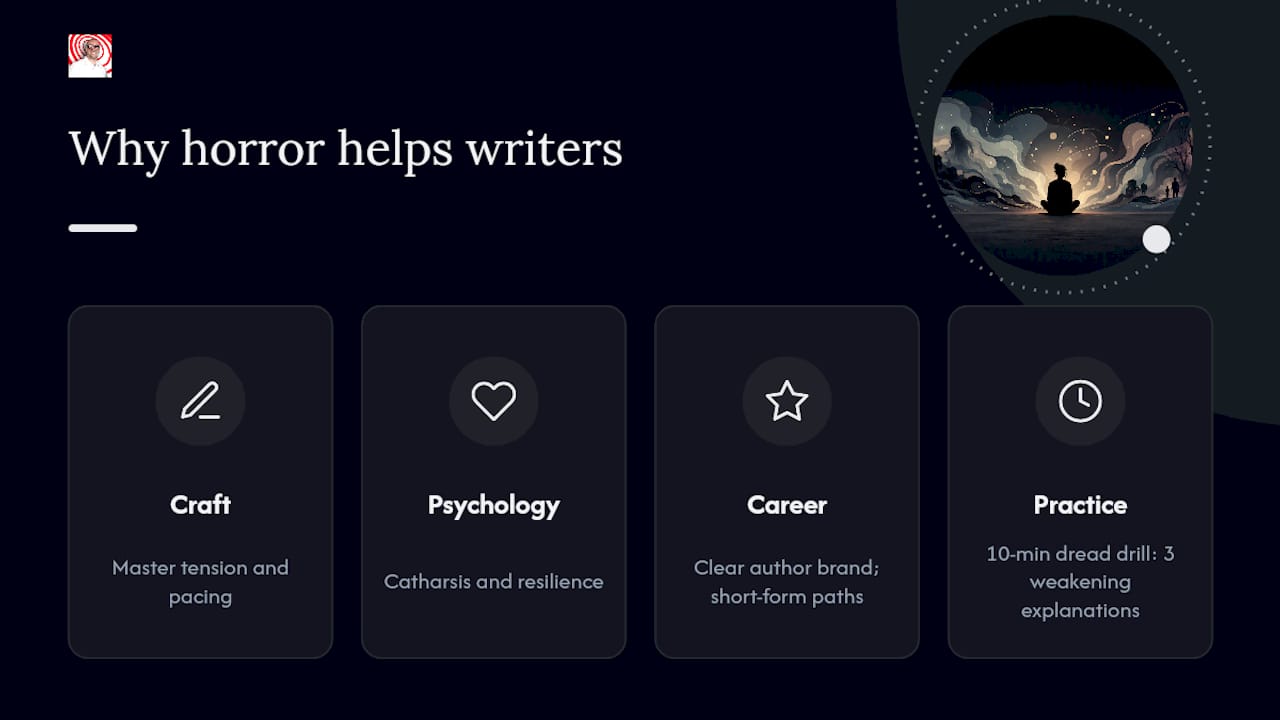
What's a fast way to start practicing horror writing skills? Try a ten-minute dread drill where a character debunks a strange occurrence three times, each explanation weaker than the last, without ever revealing the cause.
Sources
- Why Every Writer Should Try Their Hand at a Horror Story - WRITERS HELPING WRITERS®
- Desire and dread: how to use horror to deepen emotional stakes - Writer's Digest
- Horror Writing Exercises: Break Down Fear Mechanics