

TL;DR:
- Storytelling through personal, consistent narratives helps to build emotional bonds and trust with pets over time. Research shows that human-written stories evoke stronger emotional responses and attachment compared to AI-generated content. Establishing routines and observing behavioral cues are essential for strengthening pet-owner relationships gradually and effectively.
Storytelling in pet bonding is defined as the deliberate practice of sharing narratives about your pet's experiences, emotions, and daily life to deepen emotional connection and build lasting trust. The role of storytelling in pet bonding goes far beyond reading a book aloud to your dog. It shapes how you observe, interpret, and respond to your pet's signals. Recent research from John Benjamins and the American Animal Hospital Association confirms that narrative-driven communication strengthens the human-animal bond in measurable ways, influencing owner behavior, care quality, and emotional investment. If you want a deeper, more trusting relationship with your pet, storytelling is one of the most powerful tools you have.
How do storytelling narratives influence emotional bonding with pets?
The emotional mechanism behind storytelling and pet bonding is concrete, not abstract. Human-written narratives significantly influence both emotional valence and arousal in pet owners, while AI-generated text affects valence only. That distinction matters. Arousal is the emotional activation that drives real behavior, like spending more time with your pet, responding to stress signals, or adjusting your daily routine to meet their needs.
Stories that work for pet bonding share specific qualities:
- Unconditional love themes: Narratives where the pet is safe, seen, and valued create the emotional warmth that owners transfer into real interactions.
- Daily routine anchors: Stories tied to walks, meals, and play sessions give pets predictable, sensory-rich experiences they begin to associate with safety.
- Sensory specificity: Describing the feel of fur, the sound of a purr, or the smell of a familiar blanket activates emotional memory more effectively than generic phrases.
- Universal trust themes: Stories where a character earns trust gradually mirror the actual bonding process, reinforcing patience in the owner.
The sensory channel matters too. Text versus visual illustrations produce different emotional response qualities, with illustrated narratives generating stronger immediate emotional engagement. This is why picture books featuring animals, like those used in structured programs, are so effective for building empathy and attachment.
Framing your pet as a family member inside your stories also changes your behavior. Owners who frame pets as family show increased commitment to care, better adherence to routines, and stronger emotional investment. The story you tell yourself about your pet shapes how you treat them every single day.

Pro Tip: Write or speak one short story about your pet each week, grounded in a real moment you shared. Concrete, personal narratives produce stronger emotional responses than generic or AI-generated content.
What is the timeline for bonding through storytelling with pets?
Trust with a pet does not arrive on day one. Attachment and trust develop over weeks to months, requiring consistency and predictable routines. Understanding this timeline helps you use storytelling at the right pace, rather than overwhelming your pet with intense affection before they feel safe.
The bonding process follows a recognizable arc:
- Decompression phase (days 1 to 3): Your pet is absorbing a new environment. Keep narratives calm and repetitive. Speak in a low, steady tone. Describe what is happening around them without excitement or urgency.
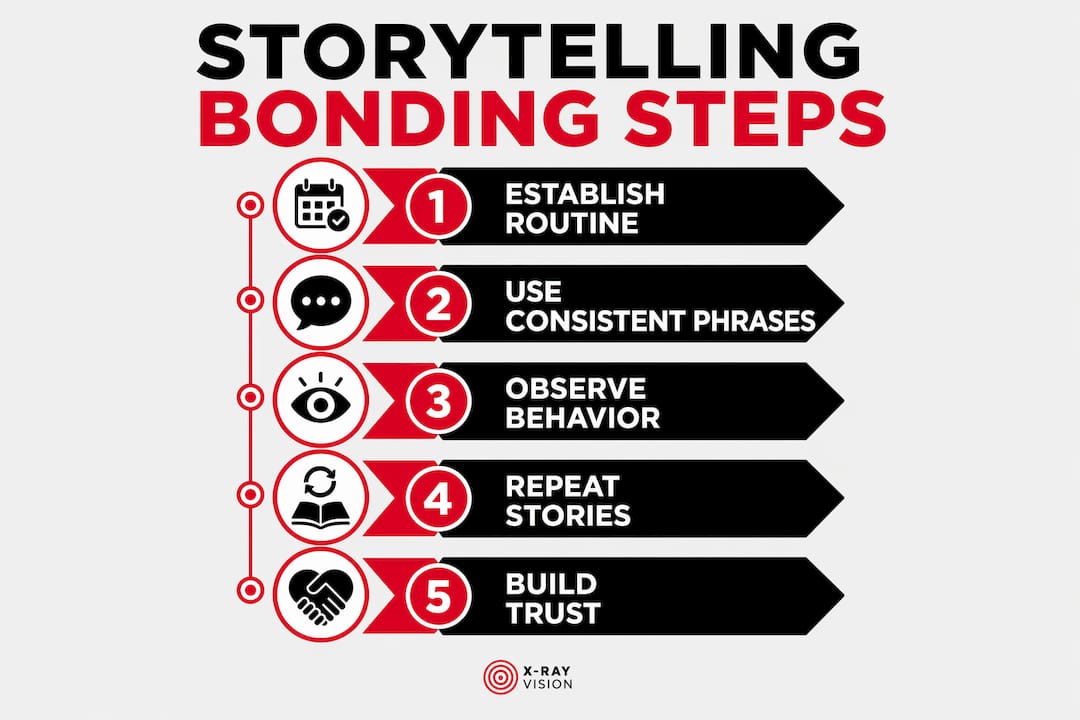
- Settling phase (weeks 1 to 3): Your pet begins recognizing your voice and routines. This is when consistent storytelling during meals, walks, and bedtime starts building real associations. Repeat the same phrases and tones.
- Trust phase (weeks 4 onward): Behavioral markers appear. Your pet seeks you out for comfort, checks in during outdoor time, and shows calm posture in your presence. Storytelling here can become more expressive and interactive.
- Full attachment (months 2 to 3): Your pet feels fully at home. Stories can now include new experiences, mild challenges, and shared adventures without triggering anxiety.
Pairing narrative repetition with observable behavioral cues is the most effective way to build trust gradually. Watch for soft eyes, a relaxed tail, and unprompted proximity as signs your storytelling routine is working.
Avoid rushing this process. Inconsistent messages, like alternating between loud excitement and long silences, confuse pets and slow trust development. Calm, predictable narrative tone is the foundation.
Pro Tip: Use the same opening phrase every time you begin a storytelling session with your pet. Repetition creates a conditioned signal that tells your pet: "This is safe. This is us."
How can pet owners use storytelling to interpret pet communication?
Storytelling and animal empathy work in both directions. You are not just narrating to your pet. You are learning to read their responses and refining your approach based on what you observe. This is called iterative, observation-driven storytelling, and it strengthens shared understanding of pet needs over time.
Research from the University of California highlights that button soundboard devices demonstrate dogs can use meaningful words to express complex needs, with thousands of documented button presses revealing emotional and physical communication. This is the extreme end of pet communication technology, but it points to something every pet owner can practice without any device at all.
Here is how to build an observation-driven storytelling practice:
- Watch the body, not just the face. Tail position, ear angle, and muscle tension tell you whether your narrative tone is landing as calm or as stimulating.
- Narrate stress signals out loud. When your pet shows tension, say it: "You're feeling unsure right now. That's okay. We're safe." This verbal acknowledgment helps co-regulate their emotional state.
- Track responses to specific phrases. If your dog perks up when you say "walk story time," that phrase has become a positive anchor. Use it deliberately.
- Adjust pacing based on relaxation cues. Slow blinking in cats, a dropped jaw in dogs, and loose body posture all signal that your storytelling tone is working. Speed up or add energy only when your pet is clearly relaxed.
Storytelling can co-regulate emotions during stressful transitions, like a vet visit, a move, or the arrival of a new family member. Narrating the experience in a calm, familiar voice lowers uncertainty and reinforces your role as a safe anchor.
Which storytelling formats work best for pet bonding?
Not all storytelling formats produce the same results. The format you choose shapes the emotional outcome for both you and your pet.
| Format | Emotional impact | Best use case |
|---|---|---|
| Human-written spoken narrative | High arousal and valence | Daily routines, bedtime, training sessions |
| AI-generated text read aloud | Valence only, lower arousal | Low-stakes background narration |
| Illustrated picture books | Strong immediate engagement | Family sessions, introducing new pets |
| Interactive co-created stories | Deepest personal resonance | Multi-caregiver households, children involved |
| Button soundboard sessions | Two-way communication | Dogs with advanced training, high-engagement owners |
Format, sensory channel, and personal experience co-creation all significantly affect emotional outcomes. The most powerful format combines spoken human narrative with sensory-rich details drawn from real shared experiences. Generic scripts or AI-generated content simply do not produce the same emotional activation.
Co-creative storytelling, where multiple family members contribute to the pet's narrative, builds a shared emotional vocabulary around the animal. This is especially effective in households with children, where collaborative storytelling about pets strengthens bonds across the whole family, not just between one owner and the pet.
Pro Tip: Read illustrated animal stories aloud to your pet during calm evening hours. The combination of your voice, the visual imagery, and the routine timing creates a multisensory bonding experience that spoken words alone cannot replicate.
Practical storytelling techniques to strengthen your pet bond
Consistency is the engine of every effective pet bonding story. Here is a practical framework you can start using today.
- Anchor stories to daily routines. Narrate the morning walk, the feeding ritual, and the evening wind-down in the same sequence each day. Pets learn to anticipate these narrative moments as comfort signals.
- Use open-ended reflective pauses. Programs like RedRover Readers use animal-themed picture books with open-ended questions to build empathy and social-emotional learning. You can adapt this by pausing mid-story and observing your pet's reaction before continuing.
- Integrate storytelling into training. Narrate what your pet is doing well during a training session. "You sat so calmly. You trusted me. That's our story today." Positive narrative reinforcement deepens the emotional layer of behavioral training.
- Build a personal story library. Keep a short journal of real moments with your pet. These become the raw material for your most emotionally resonant narratives, because personal, concrete, co-created stories produce stronger emotional bonding than generic content.
Avoid these common pitfalls:
- Skipping storytelling sessions during busy weeks. Inconsistency breaks the conditioned safety signal you have built.
- Using a tense or hurried voice. Your pet reads your emotional state through tone, not just words.
- Neglecting your pet's behavioral feedback. If your pet leaves the room or shows tension, the narrative needs to slow down and soften.
- Treating storytelling as a performance. The goal is shared presence, not a polished delivery.
For more ideas on structuring engaging narratives, the storytelling tips for children resource at Markwatsonbooks offers practical frameworks that translate directly to pet bonding sessions.
Key takeaways
Storytelling strengthens pet bonds because personal, consistent, sensory-rich narratives build trust, co-regulate emotions, and create predictable safety signals that pets learn to recognize and seek out.
| Point | Details |
|---|---|
| Human-written stories outperform AI | Personal narratives drive both emotional arousal and valence, producing stronger bonding outcomes. |
| Trust builds over weeks, not days | Follow the decompression, settling, and trust phases before increasing narrative intensity. |
| Observation refines your approach | Watch behavioral cues after each session and adjust tone, pacing, and content accordingly. |
| Format shapes emotional impact | Illustrated books and spoken co-created stories produce the deepest emotional engagement. |
| Consistency is the core requirement | Daily routine-anchored storytelling creates conditioned safety signals pets actively seek. |
Why I think most pet owners underestimate storytelling
I have spent years working with narrative as a craft, and the pattern I see most often is this: people treat storytelling as entertainment rather than communication. With pets, that distinction is everything.
The owners who build the deepest bonds with their animals are not the ones who buy the most toys or spend the most money. They are the ones who show up with the same calm voice, the same familiar phrases, and the same patient attention every single day. That is storytelling in its most functional form. It is not about plot. It is about presence.
What surprises most people is how quickly pets begin to respond to narrative cues once you establish them. A dog who hears "walk story time" before a leash appears is not just excited about the walk. They are responding to a narrative anchor you built through repetition. That is a genuine communication system, and you created it through story.
The biggest mistake I see is impatience. Owners try storytelling for a week, see no dramatic change, and abandon it. Trust is a slow build. The research is clear on this. Weeks to months, not days. The owners who stay consistent are the ones who eventually describe their pet as "knowing exactly what I'm thinking." That is not magic. That is the result of hundreds of small, consistent narrative moments stacking up over time.
Tailor your stories to your specific animal. A high-energy border collie needs faster-paced, adventure-driven narration. A shy rescue cat needs slow, quiet, repetitive reassurance. Your pet's personality is the brief. Write to it.
— Mark
Stories that bring you and your pet closer
If you are ready to deepen your storytelling practice, the right books make a real difference. Markwatsonbooks offers a curated selection of children's books featuring animal stories that spark empathy, emotional connection, and shared reading experiences perfect for family bonding sessions with your pet nearby.

Whether you are reading aloud to a curious dog, a sleepy cat, or a room full of kids and animals, these illustrated stories create the multisensory atmosphere that makes bonding moments stick. Explore the full book collection at Markwatsonbooks and find the stories that will become part of your daily ritual.
FAQ
What is the role of storytelling in pet bonding?
Storytelling in pet bonding is the practice of using consistent, personal narratives to build emotional connection, trust, and predictable safety signals between owners and their pets. Research confirms that human-written narratives drive both emotional arousal and valence, producing stronger bonding outcomes than generic or AI-generated content.
How long does it take to bond with a pet through storytelling?
Attachment and trust develop over weeks to months, not immediately. Consistent daily storytelling tied to routines accelerates this process by creating conditioned safety signals that pets learn to recognize.
Can pets actually respond to storytelling?
Yes. Pets respond to tone, pacing, and repeated narrative phrases as communication signals. Research from the University of California shows that dogs can use button soundboards to express complex needs, demonstrating that two-way narrative communication with pets is genuinely possible.
What storytelling format works best for pets?
Spoken human narratives grounded in real shared experiences produce the strongest emotional response. Illustrated picture books add a visual sensory layer that deepens immediate engagement, making them ideal for family storytelling sessions.
How do I know if my storytelling is working?
Watch for behavioral markers: calm posture, soft eyes, unprompted proximity, and your pet checking in during outdoor time. These signals indicate that your narrative routine has become a recognized safety anchor.