

Whether a book is self-published or traditionally published directly shapes which editions exist, how fast a title appears, and where you can buy it. Markwatsonbooks itself is proof: some titles roll out as author-controlled paperbacks the week they're finished, others follow a longer, more polished production cycle. Before you buy, check three things:
- The imprint listed on the copyright page
- The ISBN prefix and who's credited as publisher
- Whether the title shows up in library catalogs or only on retailer and author sites
Key Takeaways
A book's publishing route determines its available formats, purchase channels, and long-term reissue prospects far more than it determines its quality.
| Point | Details |
|---|---|
| Check the copyright page first | The imprint name and ISBN prefix reveal whether a book is self-published or traditionally published. |
| POD means orderable, not stocked | IngramSpark listings make a book orderable by any store, but active shelf placement still requires a sales relationship. |
| Libraries favor traditional distribution | Wholesale networks give traditionally published books a real edge in library catalog presence. |
| Author sites hold exclusive editions | Signed copies and omnibus bundles, like those on Markwatsonbooks, often exist only through direct sales. |
| Rights control future availability | Self-published authors can reissue anytime; traditionally published backlist titles depend on the publisher's rights reversion timing. |
Table of Contents
- Self Publishing vs Traditional Publishing: Which Editions You'll Actually See
- Where to Buy Books From Each Publishing Route
- How to Tell If a Book Was Self-Published or Traditionally Published
- What Happens to Availability Years Later
- Author Perspective: Mark's Catalog Shows Both Routes in Action
- Why the Route Matters Less Than the Book in Front of You
- Sources
Self Publishing vs Traditional Publishing: Which Editions You'll Actually See
Crack open two books from different publishing routes and you'll notice the differences before you read a single page. Self-published titles overwhelmingly launch as ebooks first, with a print-on-demand (POD) paperback close behind. Traditional houses tend to launch multiple formats at once: hardcover, trade paperback, ebook, and often audiobook, all timed to the same release date.
That gap comes down to production economics, not quality. A self-published author can push a manuscript through Amazon KDP or IngramSpark and have a purchasable paperback within days, because POD prints one copy at a time with no warehouse and no minimum order. Traditional publishers use offset printing, which needs large print runs to be cost-effective, plus months of typesetting, proofing, and sales conferences before a single copy exists.
That's the trade-off in a sentence: self-publishing wins on speed, traditional publishing wins on format breadth at launch.
Here's what typically shows up by route:
- Self-published: ebook first, POD paperback shortly after, audiobook and translations only if the author invests separately
- Traditionally published: hardcover or trade paperback, ebook, and audiobook often launching together, with translation rights sold separately by the publisher
POD quality has closed the gap that used to make self-published books easy to spot. Industry observers now note that POD paperbacks are frequently indistinguishable from offset-printed books on the shelf, which means judging a book's route by its binding alone is a bad bet.
Pro Tip: Check the very last page or the inside back cover for a small line reading "Made in the USA" with a batch number and date. That's a POD fingerprint. Offset-printed books rarely carry it, since they're printed in bulk ahead of demand rather than one copy at a time.
Where to Buy Books From Each Publishing Route
Your shopping experience depends heavily on which route produced the book you want.
Traditionally published titles show up on physical bookstore shelves because publishers employ sales representatives who pitch upcoming lists to bookstore buyers months in advance, and because wholesale distribution networks place those books into stores and library systems as a matter of course. Libraries lean on the same wholesale relationships when building their catalogs, so traditionally published books tend to be easier to borrow, too.
Self-published books skip that infrastructure but aren't hard to find. They're reliably available through online retailers and the author's own storefront, and services like IngramSpark make them technically orderable by any bookstore in their network. Orderable isn't the same as stocked, though: a distributor listing gets a book into the system, but a shop still has to choose to put it on the shelf, and that choice usually requires an active sales relationship most self-published authors don't have.
If a title isn't sitting on a shelf near you, here's the fastest path to a copy:
- Search the retailer listing directly. Most self-published books are one click away on Amazon or the author's site.
- Check your library catalog. If it's traditionally published, there's a decent chance it's already there or available through interlibrary loan.
- Order through the author's website or its Ingram listing if you want to support the author directly.
- Ask your local bookstore for a special order. Any IngramSpark title is orderable even if the shop has never stocked it.
Used-market shopping fills the remaining gap, especially for older traditionally published titles that have gone out of print.
How to Tell If a Book Was Self-Published or Traditionally Published
Flip to the copyright page first. That's where the imprint name lives, and a quick search tells you whether it's a division of a major publisher, a small press, or the author's own company name. If the "publisher" and the author share a name or a clearly personal brand, you're likely looking at self-publishing.
Check these details next:
- ISBN prefix and distributor credit. Traditional publishers list their distributor; self-published books often list IngramSpark or KDP Print.
- Library catalog presence. Search WorldCat or your local library system. Wide library holdings usually point to traditional distribution.
- Production credits. Traditional books typically credit an editor, cover designer, and sometimes a literary agent by name.
- Trade review quotes. Blurbs from Kirkus, Publishers Weekly, or Booklist almost always mean a traditional or hybrid deal, since those outlets rarely review self-published work.
Pro Tip: If an author sells a unique edition, like a signed copy or a bundled omnibus, directly on their own site, that's often a sign of self-publishing or a hybrid arrangement where the author retained control over at least some editions.
What Happens to Availability Years Later
Publishing route also decides what happens to a book once the initial release window closes.
Traditional publishers hold subsidiary rights and typically make the call on translations, large audiobook deals, and reprint timing. That's good news when a publisher decides a backlist title deserves a fresh push, but it also means a book can sit out of print for years if the rights haven't reverted back to the author.
- Self-published authors keep those rights and can reissue, retranslate, or commission a new audiobook edition whenever they want.
- That flexibility depends entirely on the author's resources; a self-published book can also go quiet if the author moves on.
- If a title shows "out of print," check the author's site or socials for reissue news before hunting the used market, since a self-published author can bring a book back with a single upload.
Author Perspective: Mark's Catalog Shows Both Routes in Action
Markwatsonbooks carries titles across both paths, and the editions on offer reflect it. The Creepypasta anthologies, including the Creepypasta Omnibus One collection, are the kind of bundled, author-controlled edition that rarely shows up on a mainstream retailer page first. The children's titles follow a more conventional format rollout built for browsing and gifting.
Author-published storefronts often list editions that marketplaces simply don't carry, including signed copies and omnibus bundles built specifically for readers who want more than a single volume.
If you want to see how the choice plays out project by project, Mark's own step-by-step self-publishing guide walks through why a given title took the route it did. For the full shelf, the Books page is the most complete list of what's currently available and where.
Why the Route Matters Less Than the Book in Front of You
The instinct to treat self-publishing and traditional publishing as a quality hierarchy misses the point. Neither route guarantees a better book, only a different set of default editions and buying paths. Conventional advice fixates on which path authors "should" choose, when the more useful question for a reader is simpler: what exists right now, and how do you get it?
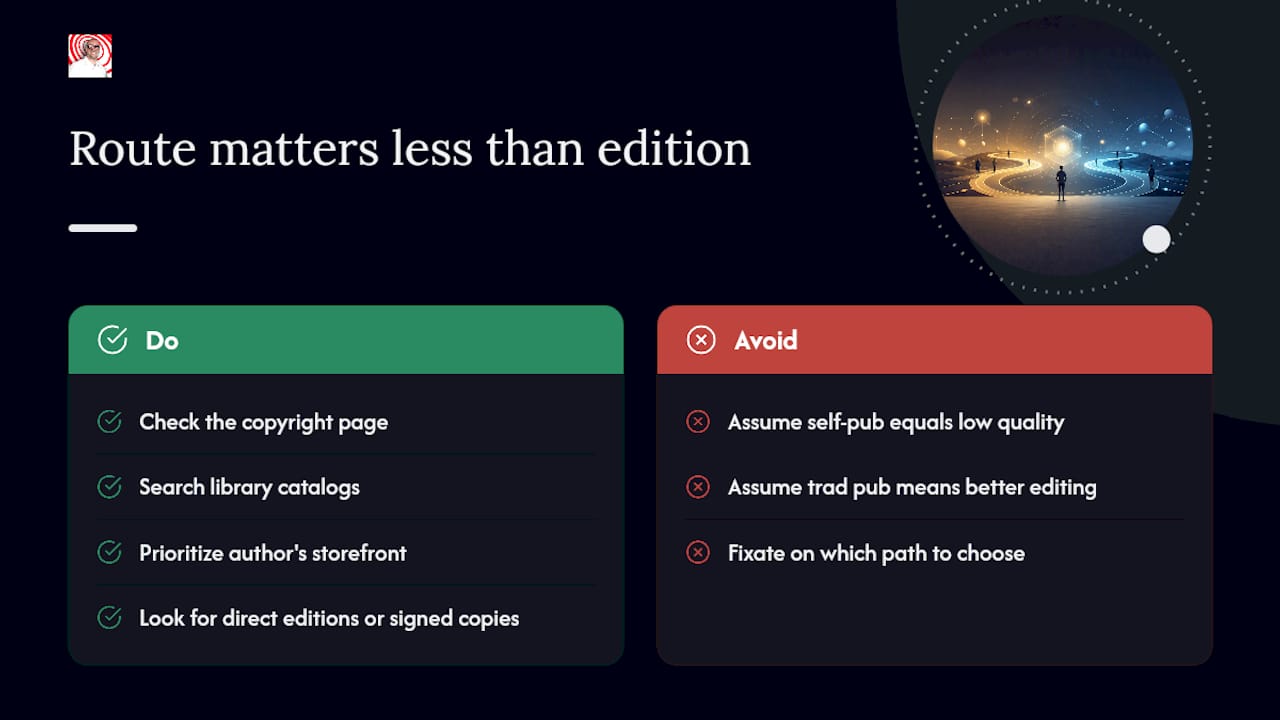
That's why checking the copyright page and searching a library catalog tells you more than any assumption about self-published books being rougher or traditionally published books being automatically better edited. Execution varies within each route far more than it varies between them.
If you're browsing Mark's catalog specifically, prioritize the author's own storefront first. Direct-sold editions, bundles, and signed copies often live there and nowhere else, which makes it the fastest way to see the full range a given route actually produced.
— Mark
Sources
- The nuts and bolts of distribution: how your book ends up in stores — Poets & Writers
- How Publishing Works: A Guide for Sci-Fi & Fantasy Writers – Brandon Sanderson
- Books