
A novella runs roughly between 17,500 and 40,000 words, while a novel typically starts at 50,000 words and often falls within the range common for commercial fiction. But word count isn't the real dividing line. The true difference is narrative scope: how many subplots, characters, and timelines a story needs to carry. A tight, single-thread horror concept can feel complete at 30,000 words. A story that spans years and voices needs the room a novel provides.
TL;DR:
- Most novellas fall between 17,500 and 40,000 words, with structure focused on a single conflict, character point of view, and compressed timelines.
- Novellas are designed for quick, one-sitting reading with a sharp midpoint turning point, unlike novels that develop slowly over many chapters and subplots.
- Publishing of novellas is common in genre fiction like horror and science fiction, often as standalone ebooks or bundled collections, thriving in digital and indie markets.
- Deciding whether to write a novella or a novel depends on the number of subplots, characters, worldbuilding, and the emotional or thematic scope of the idea.
- Length influences publishing options, as print favors full-length novels, while digital platforms and serialization better suit shorter novella formats.
Table of Contents
- Novella vs Novel Word Count: What the Industry Actually Uses
- How Do Novellas and Novels Differ in Structure?
- How Long Does It Take to Read a Novella vs a Novel?
- Should Your Idea Be a Novella or a Novel?
- How Do Publishers and Awards Treat Novella-Length Books?
- Novellas and Novels in Practice: Examples Worth Knowing
- Practical Ways to Trim a Novel Idea or Expand a Novella Idea
- Where Did the Terms "Novella" and "Novel" Come From?
- Why Novels Carry More Thematic Weight Than Novellas
- How Format Length Shapes Where and How a Book Gets Published
- Author Perspective: When I Pick a Novella vs a Novel
- Read Mark Watson's Short and Novella-Length Horror
- Sources
Novella vs Novel Word Count: What the Industry Actually Uses
Every writer eventually asks the same question: how many words actually makes something a novel instead of a novella? The honest answer is that there's no single legal threshold. Publishers, awards committees, and writing organizations each use slightly different bands, but they cluster around the same territory.
Here's the range most of the industry agrees on:
- Short story: typically under 7,500 words
- Novelette: roughly 7,500–17,500 words
- Novella: roughly 17,500–40,000 words
- Novel: 50,000 words and up, with many commercial fiction works commonly in the mid to high range.
A manuscript of about 200 pages at approximately 250 words per page generally accumulates near 50,000 words, an informal threshold where publishers often categorize works as novels rather than long novellas.
These numbers aren't arbitrary. Reedsy's word-count breakdown cites the same bands used across genre publishing, and Wikipedia's entry on the novella points to the Science Fiction and Fantasy Writers Association's own novella definition of 17,500 to 40,000 words as one of the most cited benchmarks in the business. But even SFWA's numbers exist to sort award submissions into fair categories, not to dictate how a story should be written. A romance novella and a literary novella can differ by thousands of words and still both be correct.
How Do Novellas and Novels Differ in Structure?
Word count is the symptom. Structure is the cause. A novella almost always centers on one conflict, often filtered through one or two points of view, moving through a compressed timeline that rarely jumps far in time or location. A novel has room to fork. It can run three subplots alongside the main one, hand chapters to five different characters, and let a theme develop slowly across a timespan measured in years instead of days.
That structural gap changes how a writer actually builds the thing:
- Novellas favor short chapters with immediate forward pressure. There's no room for a chapter that only sets mood.
- Novels can afford a slower chapter or two if it pays off character depth later.
- Novella scenes need to serve two or three purposes at once; novel scenes can specialize.
- Ensemble casts, nonlinear timelines, and layered symbolism belong to the novel's toolkit, not the novella's.
Selfpublishing makes the same point: novellas succeed through economy, while novels succeed through accumulation. A novella that tries to run four subplots usually collapses into a rushed novel instead of a satisfying novella. A novel that refuses to expand past one plot thread often reads thin, padded out to hit a word count it never earned.
Pro Tip: Count your point-of-view characters before you count your words. If you've got more than two people whose heads the reader needs to be inside, you're probably already writing a novel, whatever the manuscript says at the bottom of the page.
How Long Does It Take to Read a Novella vs a Novel?
A novella is built to finish in one sitting, or close to it. That's not a marketing gimmick. It shapes real plotting decisions. Readers who pick up a 25,000 word horror novella expect the inciting incident within the first few pages, not after a slow-burn first act. A novel can afford to let tension build across fifty pages before the plot fully kicks in, because the reader has already committed to a longer relationship with the book.
This compression changes where the big structural beats land:
- In a novella, the inciting incident often hits within the first 10 to 15 percent of the story, sometimes on page one.
- In a novel, writers can delay that same beat while establishing setting, voice, and secondary characters.
- Novellas frequently rely on one sharp turning point, sometimes called a wendepunkt, that reroutes the entire story at its midpoint.
- Novels can layer multiple turning points across different subplots without losing the reader.
Final Draft's breakdown of short-form versus long-form fiction makes the case that shorter works put readers closer to the climax from the start, while novels earn the right to a slower burn because they have more pages to spend. Twist endings work especially well in novellas for exactly this reason. There's less narrative distance for a reader to forget the clues you planted.
Should Your Idea Be a Novella or a Novel?
Before you commit to a word count, run the idea through a short checklist. It takes less time than writing a full outline, and it will save you from spending a year expanding a story that only had 30,000 words of material in it.
- How many subplots does the concept actually need? One or none points toward a novella. Two or more points toward a novel.
- How many point-of-view characters matter to the story? One or two fits a novella. An ensemble needs a novel's space.
- How much worldbuilding does the premise demand? A single location and short timeframe supports a novella. A built-out world with history and politics needs a novel to breathe.
- What's the emotional arc's timespan? Days or weeks suits a novella. Months or years usually needs a novel.
- Does the idea have "weight," or does it have "intensity"? Weight, meaning multiple threads and a sprawling cast, points to a novel. Intensity, meaning one sharp, sustained pressure, points to a novella.
Pro Tip: Write the opening scene before deciding anything. Then time yourself reading it aloud. If it feels like it's already moving at full speed, that pace usually can't sustain 300 pages; it's telling you the story wants to be short.
How Do Publishers and Awards Treat Novella-Length Books?
Novellas occupy an odd space in traditional publishing. Many literary presses avoid them because retail pricing and shelf space favor full-length novels. Genre publishing tells a different story entirely. Horror, science fiction, and romance markets regularly release standalone novellas, and awards in those genres, including SFWA's own Nebula categories, treat the format as a legitimate, distinct competition tier rather than a lesser cousin of the novel.
That opens up a few realistic paths for a novella-length manuscript:
- Submit it as a standalone ebook, where reader expectations around length are far more flexible than in print.
- Bundle several novellas into a themed collection, which is common practice in horror and Creepypasta-style anthologies.
- Use digital-first or independent publishing, where a shorter page count doesn't carry the same production-cost penalty print runs impose.
Genre readers, especially in horror, often want a book they can finish in one dark, uninterrupted sitting. That reader appetite is exactly why novellas keep thriving in genre fiction even as literary publishing leans toward doorstopper novels.
Novellas and Novels in Practice: Examples Worth Knowing
Some of the clearest lessons about form come from books that sit right at the boundary. George Orwell's Animal Farm runs under 30,000 words and works precisely because it never tries to be more than one sustained allegory. Joseph Conrad's Heart of Darkness stays novella-length by keeping its focus locked on one narrator's descent, never branching into subplots that would dilute the intensity.
Modern horror follows the same logic. Short, single-sitting horror novellas remain a staple of the genre because dread compounds fastest when there's no room for the reader to look away. A few boundary cases worth knowing:
- Some books marketed as "short novels" run close to 45,000 words, technically brushing novel territory by word count while still reading with a novella's tight focus.
- Award committees sometimes reclassify a borderline manuscript based on structure, not just its word count, when a story clearly behaves like a novella despite running slightly long.
- Publishers occasionally label the same manuscript differently across markets, calling it a novella in one country's edition and a "short novel" in another's.
Practical Ways to Trim a Novel Idea or Expand a Novella Idea
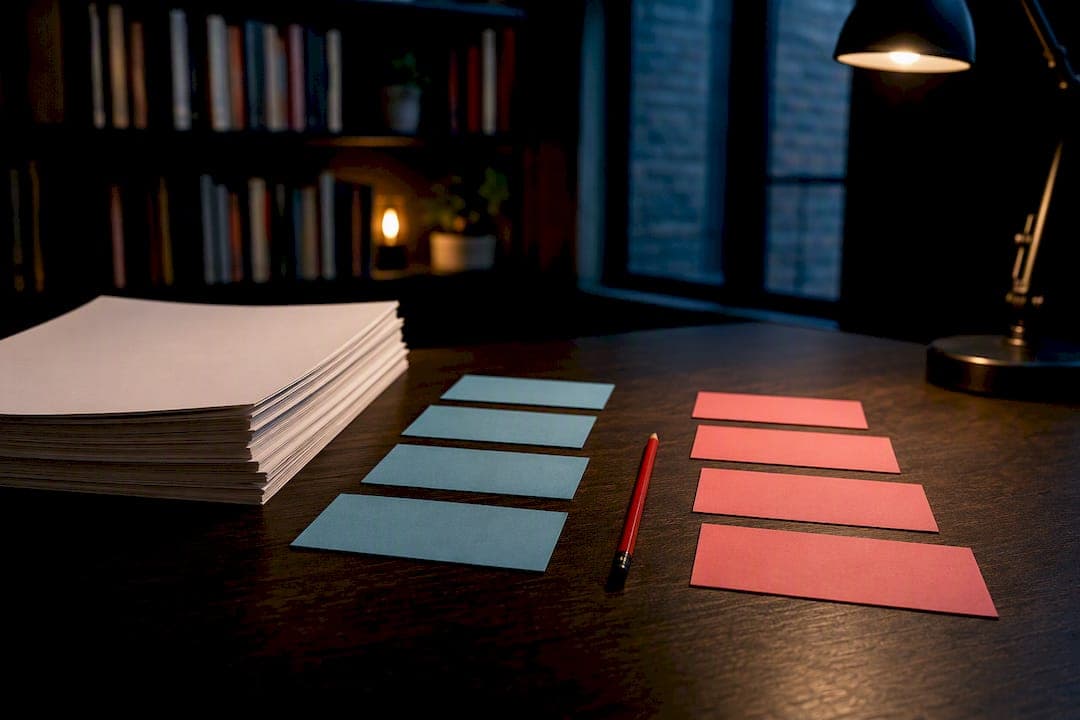
Cutting a bloated novel down to a novella starts with a plot-mapping exercise: list every scene on an index card, then ask whether the story collapses without it. Scenes that only exist to hit a word count target get cut first. Run a relevance filter on every remaining chapter, checking whether it advances the central conflict or just orbits it.
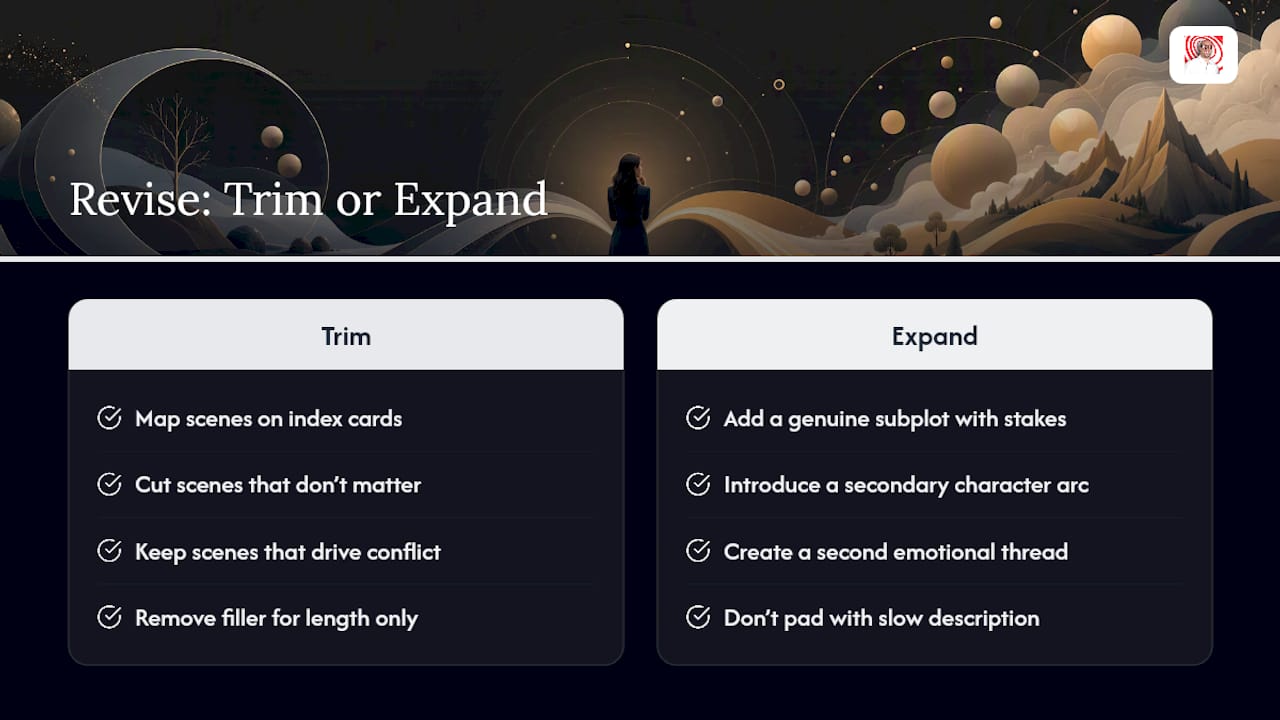
Expanding a thin novella into a full novel works best when the added material earns its place. Develop a genuine subplot with its own stakes, not a filler scene. Add a secondary character whose arc mirrors or complicates the protagonist's, giving readers a second emotional thread to invest in.
Pro Tip: Never pad a novella into a novel by slowing down prose or adding description for its own sake. If the story doesn't have a second conflict worth exploring, keep it tight and publish it as the novella it already is. Readers can tell the difference between depth and filler within the first three chapters.
Where Did the Terms "Novella" and "Novel" Come From?
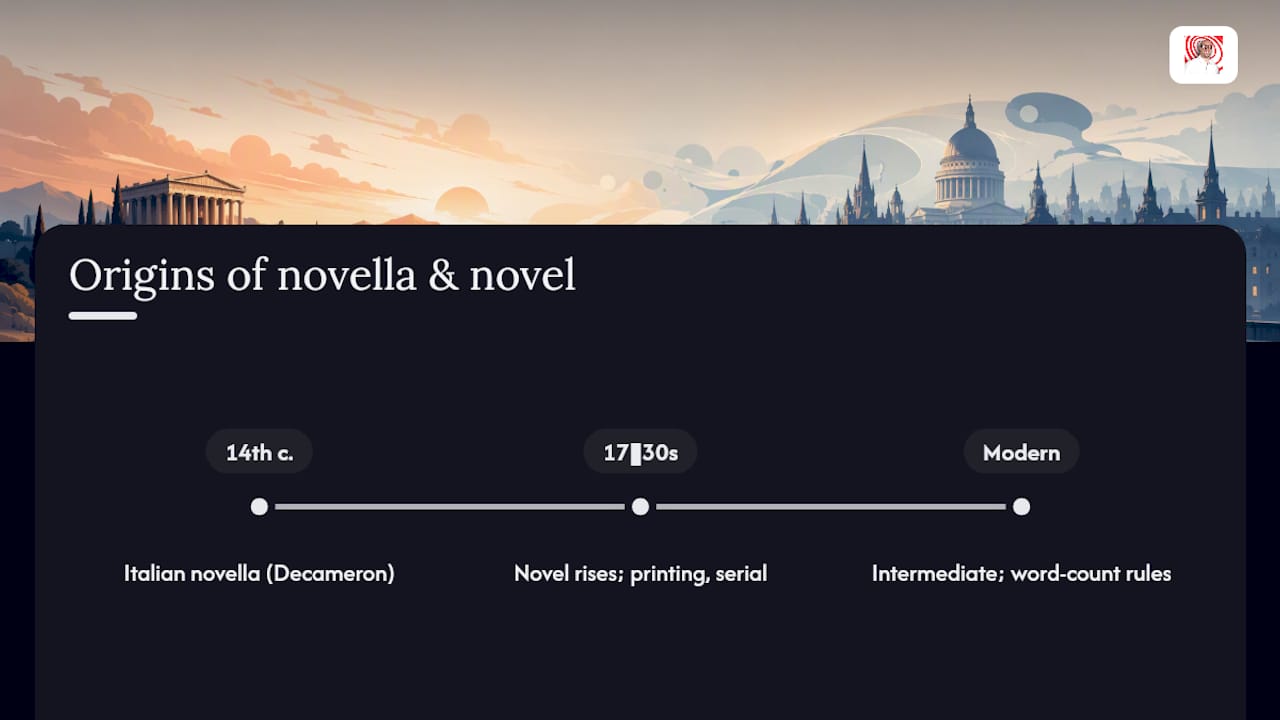
The word "novella" comes from Italian, originally describing a "new" short prose tale, tracing back to story collections like Boccaccio's Decameron in the 14th century. Those early novellas were compact narratives meant to be read or told in a single session, often collected into larger volumes rather than published alone.
"Novel" traces to a similar root but took a different path through English and French, eventually attaching itself to the longer prose fiction that emerged in the 17th and 18th centuries as printing costs dropped and serialized fiction created demand for extended, multi-part stories. By the time novelists like Defoe and Richardson were publishing, the novel had already split from its shorter cousin in both length and ambition.
The distinction has never fully stabilized since. Wikipedia's entry on the novella notes that the form has always sat in an "intermediate" zone, borrowing techniques from short fiction while attempting some of the thematic reach of a novel. That in-between status is exactly why modern definitions rely on word-count guidelines rather than a fixed historical rule. The forms evolved as different responses to how much room a story needed and how it would reach readers, not as fixed categories handed down from a rulebook.
Why Novels Carry More Thematic Weight Than Novellas
A novella can absolutely carry theme, but it usually explores one idea from a single angle. There's no room to test that idea against multiple characters' competing worldviews. A novel can put five characters in conflict over the same moral question and let each one complicate the answer, building thematic complexity through contrast rather than statement.
This isn't a hierarchy of quality. A novella's single-angle focus often produces sharper, more unified impact precisely because it doesn't dilute the theme across subplots. Heart of Darkness lands as hard as it does because every scene points at the same question. A novel earns its thematic complexity differently, through accumulation and contradiction across a longer span. Readers finish a strong novella with one idea driven home; they finish a strong novel having watched that idea tested from several directions.
How Format Length Shapes Where and How a Book Gets Published
Length doesn't just affect how a story reads. It determines which publishing paths are realistically open. Print runs favor novels because retail pricing, shelf space, and production costs punish shorter page counts; a $16 paperback that's only 120 pages tends to look overpriced to browsing shoppers, even when the writing justifies it.
Digital formats erase most of that penalty. An ebook priced fairly for its length doesn't need to compete for shelf space, which is a major reason novellas have found a stronger foothold in digital-first and independent publishing than in traditional print runs. Serialization adds another option entirely, letting a novella-length story release in parts, building an audience chapter by chapter before a bundled release. Horror and Creepypasta-style fiction lean into this model often, since short, high-impact installments suit episodic release better than a single 90,000 word manuscript ever could.
Author Perspective: When I Pick a Novella vs a Novel
I choose length by asking what the idea can honestly sustain, not what sounds more impressive on a cover. If the concept needs one sustained scare and a fast descent, it stays a novella. If it needs a wider cast or a slower unraveling, it becomes a novel. Reader expectations in horror reward both, which is why I write across formats rather than forcing every idea into the same shape. My blog covers more of that process if you want the deeper mechanics.
— Mark
Read Mark Watson's Short and Novella-Length Horror
If you want to see this distinction in action rather than just read about it, Some Creepypasta collections are built on the compressed intensity a strong novella demands. Every entry is designed to deliver its full impact without asking for a novel's worth of your evening.

The Creepypasta anthologies collect dozens of short, standalone horror tales, each one proof that a story doesn't need 90,000 words to leave a mark. For longer, single-narrative horror built on the same principles of focus and pacing, the full horror collection spans both novella-length and full novel works, so you can pick your reading commitment before you pick your nightmare. Browse a complete books catalog to find reading options.
Sources
- How many words in a novella, novel, novelette and short story? — Reedsy
- Novella — Wikipedia
- Selfpublishing
- 7 differences between short stories and novels — Final Draft blog