

If you want one place to start, grab Pamela Donovan's No Way of Knowing for the academic backbone, The Watkins Book of Urban Legends for a story-driven survey with real digital-media grounding, and the Digital Folklore reader for the deep dive into web culture itself. Researchers should lean toward Donovan and the IGI Global volume. Casual readers who want spine-tingling stories with real internet DNA should pick up an anthology like Mark Watson's Creepypasta collections. The full breakdown is below.
TL;DR:
- Scholarly works like Donovan's No Way of Knowing and the IGI Global volume provide rigorous analysis of how digital platforms shape rumor transmission and folklore evolution.
- Popular anthologies such as Mark Watson's Creepypasta collections offer primary stories stemming from online horror traditions, ideal for casual or experiential reading.
- Classic folklore frameworks, like Brunvand's Encyclopedia of Urban Legends, remain essential for understanding the foundational concepts that underpin internet-era legends.
- Digital folklore emphasizes mechanisms like viral sharing, platform influence, archival traces, and memetic mutation that drive the rapid spread and diversification of legends online.
- Researchers should prioritize books with extensive primary sources and avoid those relying solely on outdated platform assumptions or limited citations for serious academic work.
Table of Contents
- Best Internet Urban Legends Books: A Ranked Shortlist
- What These Books Reveal About Internet-Driven Legends
- How to Choose the Right Book for Your Purpose
- Mark's Reading Path Through Internet Folklore
- What to Watch Next in Digital Folklore
- Where to Read the Stories Behind the Theory
- Sources
- FAQ
Best Internet Urban Legends Books: A Ranked Shortlist
Urban legends used to travel by campfire, phone tree, and office break room. Now they travel by screenshot, algorithm, and copy-paste chain post. The books below track that shift from different angles, some scholarly, some popular, and one built specifically for readers who want the raw stories rather than the theory behind them.
1. No Way of Knowing: Crime, Urban Legends and the Internet
Pamela Donovan's book is the closest thing this list has to a foundational text. Donovan examines how crime legends and urban legends migrated onto newsgroups and mailing lists, tracing how those early online spaces reshaped the social context researchers use to study rumor. First published through Routledge's Studies in American Popular History and Culture series and later updated, it holds up because Donovan treats the internet as a site of transmission, not just a delivery mechanism for old stories. Best for: graduate students, true-crime readers who want scholarly rigor, and anyone researching how digital communities process fear collectively. UK readers can find it through most academic booksellers and major online retailers.
2. Digital Folklore (Reader)
Olia Lialina and Dragan Espenschied's edited reader flips the usual question. Instead of asking "what scary stories does the internet tell," it asks "what does the internet's own culture look like as folklore." The reader argues that user-created aesthetics and amateur web culture sit at the center of digital folklore, with the technology itself mattering less than how ordinary users expressed themselves through it. Expect essays on GeoCities pages, early memes, and the visual grammar of the amateur web. Best for: readers and researchers interested in internet culture broadly, not just legend narratives. It circulates as a free PDF and through academic library systems, so availability isn't a barrier.
3. Encyclopedia of Urban Legends
Jan Harold Brunvand didn't write about the internet directly in his most famous work, but you cannot understand internet-era legends without him. Brunvand established the FOAF concept (friend of a friend), the transmission mechanic that digital urban legends still rely on, just replacing the friend's cousin with a viral tweet. Brunvand remains the central reference point for urban legend studies broadly, and his Encyclopedia gives readers the comprehensive variant catalog that later digital-era authors build on. Best for: readers who want the classic framework before tackling internet-specific case studies. Widely stocked by UK and international booksellers, including reprint editions.
4. The Watkins Book of Urban Legends
Gail De Vos wrote the most recent popular-audience entry on this list, and it shows. The book collects modern legends while directly examining how social media has changed both the speed and the shape of their spread, rather than treating digital platforms as a footnote to older folklore. It reads more like a curated collection than a dense academic argument, which makes it the easiest entry point on this list for a non-specialist. Best for: casual readers who want legend history with clear digital-era relevance, without wading into theory. Available through Penguin Random House and standard UK retail channels.
5. The Digital Folklore of Cyberculture and Digital Humanities
This IGI Global edited volume is the most academically dense book here. It documents how folklore forms and mutates online, with case studies covering pandemic-era conspiracy narratives alongside more general theory about digital culture. If you're doing serious research, check the table of contents and bibliography before buying. Best for: graduate researchers and instructors building a syllabus around internet folklore theory. Sold directly through IGI Global and available via most academic library consortiums.
6. Creepypasta: Origins
For readers who want the primary material rather than the analysis, Mark Watson's Creepypasta: Origins collects terrifying tales built directly from the internet-horror tradition that spawned Slender Man, the Backrooms, and countless forum-born nightmares. It's not an academic study. It's the raw material scholars like Donovan and Brunvand are writing about. Best for: readers who finished the theory books and want to feel what internet horror actually reads like on the page.
7. Creepypasta, Volume 1 and Volume 3
Watson's ongoing Creepypasta series expands the anthology format across multiple volumes, each pulling together dozens of internet-horror stories in the tradition that made the genre a modern digital-folklore case study in its own right. Best for: readers building a full internet-horror library rather than a single title, or anyone who wants to see the format's range across a hundred-plus stories.
8. Blog-length primers as a supplement
Not every useful resource comes bound. Mark's own blog runs a long-form breakdown of digital folklore covering vernacular ecology and four case studies, which works well as a free companion to the denser academic titles above. Best for: readers who want a faster on-ramp before committing to a full book purchase.
What These Books Reveal About Internet-Driven Legends
Strip away the different formats and a consistent pattern emerges across nearly every serious study of internet urban legends: the mechanism of spread has changed even when the underlying fear has not.
Brunvand's FOAF concept, the idea that a legend always traces back to a friend of a friend who supposedly witnessed it, still holds. The internet just gave FOAF a screenshot and a share button. Donovan's research on crime legends moving into newsgroups and mailing lists shows the digital analogue clearly: instead of a friend's cousin, the source becomes an anonymous forum post with just enough plausible detail to spread.
Lialina and Espenschied push the conversation somewhere academics sometimes skip. Their argument centers on amateur web aesthetics, the DIY pages, the starry backgrounds, the awkward GIFs, as folklore in their own right, not just a container for scary stories. That distinction matters for anyone reading multiple books on this topic: some are studying the stories the internet tells, others are studying the culture the internet built while telling them.
Four mechanisms show up again and again across these sources:
- Viral sharing replaces word-of-mouth chains, compressing a legend's spread from weeks to hours.
- Platform affordances, meaning what a given site or app makes easy to do, shape which legends survive. A story built for a forum thread rarely translates cleanly to a short-form video app.
- Archival traces left behind on old forums and mailing lists give researchers something oral folklore never offered: a searchable paper trail.
- Memetic mutation lets a legend fork into dozens of regional or platform-specific variants almost simultaneously, rather than drifting slowly over generations.
That last point connects to a real research problem worth flagging: early web culture is disappearing faster than scholars can archive it. Platforms shut down, forums get deleted, and the amateur pages the Digital Folklore reader treats as primary source material often vanish without a trace. Every book on this list, in one way or another, is racing against link rot.
How to Choose the Right Book for Your Purpose
Not every title here suits every reader, and picking wrong usually means buying a dense academic monograph when you wanted campfire stories, or the reverse. Run through these three questions first.
- What's your depth goal? If you need citations, bibliographies, and a defensible theoretical framework for a paper or thesis, prioritize Donovan or the IGI Global volume. If you want an engaging read with historical grounding, De Vos or Brunvand fit better.
- What's your scope goal? Some books study legend content (the stories themselves), others study legend culture (the platforms and aesthetics that shape them). A scholarly distinction between academic folklore studies and popular collections exists precisely because readers often expect one and get the other. Know which you want before you buy.
- What's your format goal? Classroom or research use calls for a book with a real bibliography. Leisure reading calls for something like an anthology, where narrative quality matters more than citation depth.
Watch for a few red flags while shopping. Skip anything that leans entirely on outdated platform assumptions (a book that still treats MySpace or early Reddit as the current internet is behind the curve). Be wary of US-only framing if you want a global view of how legends spread, since digital folklore genuinely crosses borders faster than print folklore ever did. And check sourcing quality: a book citing Snopes threads as its only evidence base is a different animal than one citing peer-reviewed folklore journals.
Pro Tip: Before buying an academic title, look up its table of contents and bibliography online first. A thick bibliography with primary sources (forum archives, newsgroup logs, platform data) signals real research usability, while a thin one usually means the book leans on secondhand summaries rather than original digging.
Mark's Reading Path Through Internet Folklore
Curating Creepypasta anthologies while researching digital folklore for the blog means reading both sides of this shelf constantly: the theory and the raw stories it's theorizing about. That back-and-forth shapes how these picks got ranked.
Three paths work depending on where you're starting.
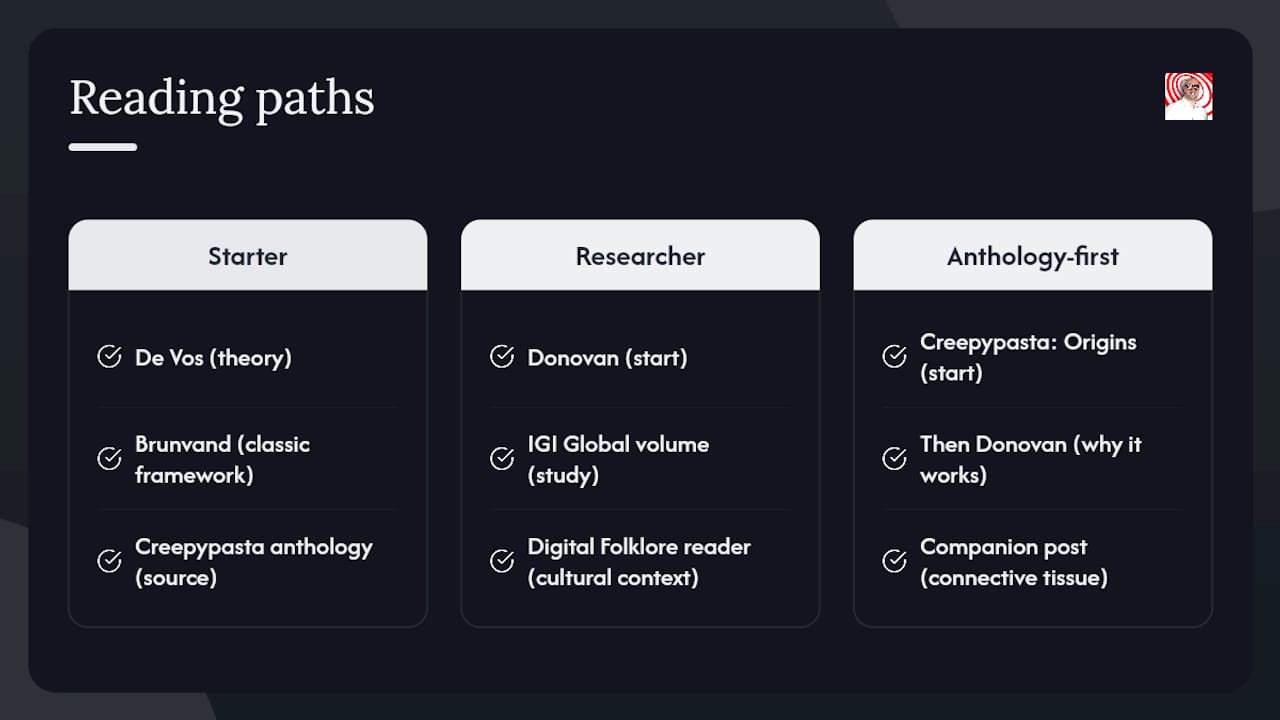
Starter path: Begin with De Vos, move to Brunvand for the classic framework, then read a Creepypasta anthology to see the mechanism in action. Researcher path: Donovan first, then the IGI Global volume, then the Digital Folklore reader for cultural context. Anthology-first path: Skip the theory entirely and start with Creepypasta: Origins, then circle back to Donovan once you're hooked on the source material and want to know why it works. A companion post on urban legends and modern horror fills in more of that connective tissue between old folklore and new fears.
What to Watch Next in Digital Folklore
The next wave of research problems isn't about which legends spread. It's about whether anyone will be able to study them at all. Platform shifts, short-form video, ephemeral stories, encrypted group chats, are already outpacing the archival methods that made Donovan's newsgroup research possible in the first place. A legend born on a platform with no permanent record leaves scholars with less to work from than a decade-old forum thread ever did.
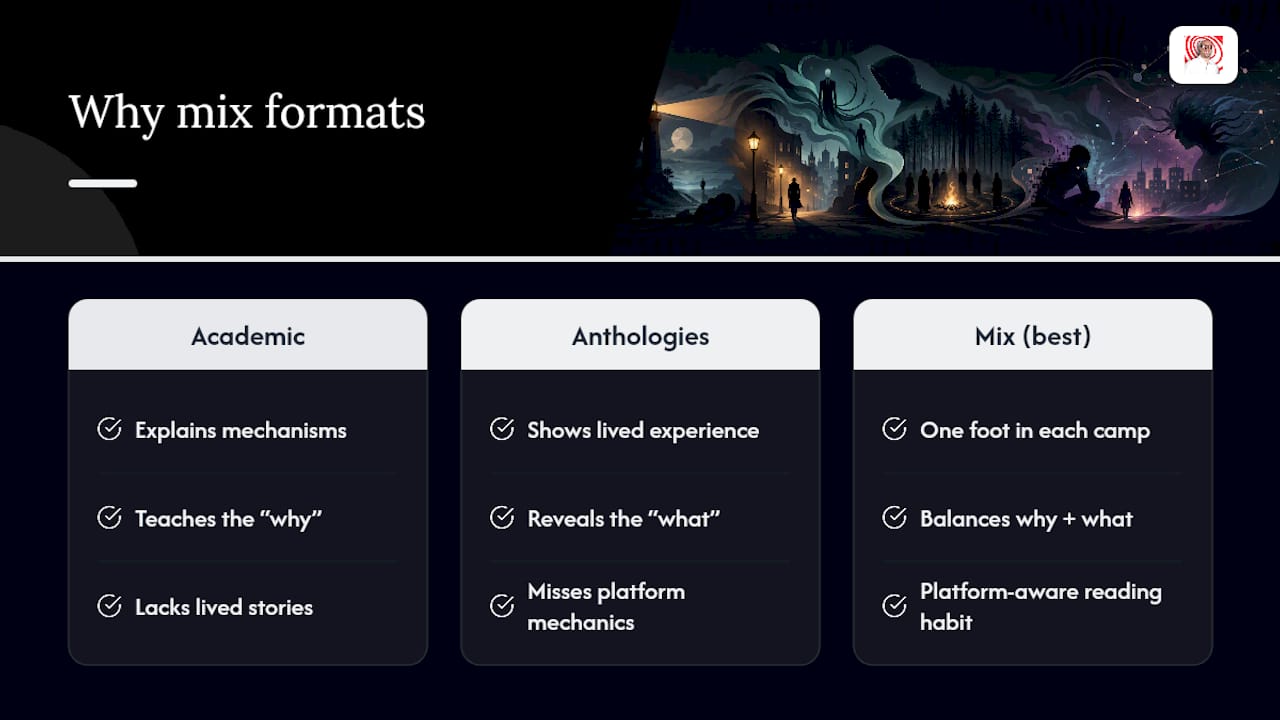
That's why mixing formats matters more than picking one lane. Academic texts explain the mechanism; anthologies and pop culture commentary on how online communities reshape story circulation show the lived experience of it. Read only theory and you'll understand the "why" without ever feeling the "what." Read only stories and you'll miss how deliberately platforms shape what spreads. The strongest readers on this subject keep one foot in each camp, and the shelf above is built to support exactly that habit.
— Mark
Where to Read the Stories Behind the Theory
Every book on the shortlist above explains how internet horror spreads. If you'd rather feel it firsthand, an online collection is where that primary material lives. The Creepypasta Books collection gathers curated internet-origin horror anthologies built in the same tradition Donovan and Brunvand study from the outside, forum-born characters, chain-post dread, and the kind of story that spreads because it's genuinely unsettling.
These are anthologies, not academic studies, so they suit readers who want a taste of internet-horror storytelling rather than a citation-ready thesis source. Titles like Creepypasta, Volume 1 and Volume 3 each collect dozens of stories from the format that made Slender Man and the Backrooms household names among horror readers. If the broader shelf leans toward theory, this is where you go to read the thing itself. Browse the Creepypasta Books collection and pick a volume to start with tonight.
Sources
- No Way of Knowing: Crime, Urban Legends and the Internet — Pamela Donovan
- Digital Folklore — Olia Lialina & Dragan Espenschied (reader)
- Commentary referencing Jan Harold Brunvand's role in urban legend scholarship
FAQ
What is the best book about urban legends?
For internet-specific coverage, Pamela Donovan's No Way of Knowing offers the strongest academic grounding, while Jan Harold Brunvand's Encyclopedia of Urban Legends remains the broadest reference for classic legend variants.
What is the scariest urban legend?
There's no single agreed-upon answer, but internet-native legends like Slender Man and the Backrooms are among the most widely cited examples of how digital platforms can generate a modern legend from scratch within a few years.
What is the most terrifying book ever written?
That's a matter of personal taste rather than a settled fact, but readers looking for internet-born horror in anthology form often start with collections like Creepypasta: Origins, which gathers stories from the tradition that produced many of today's most-discussed digital horror tales.
What book does Stephen King regret writing?
King has publicly expressed mixed feelings about Rage, a novel he wrote under the pen name Richard Bachman, and asked publishers to let it go out of print due to concerns about its content resonating with real-world school violence.
Are internet urban legends books good for research or just casual reading?
Both, depending on the title. Books like Donovan's No Way of Knowing and the IGI Global volume on cyberculture are built for research use with full bibliographies, while collections like The Watkins Book of Urban Legends or Creepypasta anthologies suit readers who want engaging stories without the theoretical framework.
Recommended
- 9 Starter Picks for Internet Horror and Why the Formats Scare
- The Most Iconic Creepypasta Characters and Their Dark Origins
- Creepypasta - Omnibus One: ONE HUNDED AND FIFTY COLLECTED STORIES: Terrifying Tales Featuring Slenderman, Jeff the Killer, Eyeless Jack, BEN Drowned, Laughing Jack, The Rake, Zalgo, and Others