
Want classic horror without spending a dime? Head straight to Project Gutenberg or Standard Ebooks and download the EPUB, no account needed. Chasing a current bestseller? Grab a library card, install Libby, and borrow it the way you'd borrow a paperback, minus the late fees. Want daily deals dropped into your inbox? BookBub and Freebooksy curate limited-time freebies and steep discounts every single day. Craving something read aloud in the dark? Librivox has thousands of public-domain audiobooks, free forever.
Here's your cheat sheet, matched to what you're actually after:
- Public-domain classics: Search Project Gutenberg or Standard Ebooks by title or author. Download instantly, no sign-up.
- Recent releases and bestsellers: Install Libby, link your library card, and place a hold.
- Limited-time freebies and advance copies: Sign up for alerts on BookBub, Freebooksy, or NetGalley.
- Free audiobooks: Search Librivox for the title, then stream or download the MP3.
Each route is legitimate. None of them require you to dig through sketchy file-sharing forums or hand over your credit card "just to verify your age."
Key Takeaways
The fastest path to free ebooks depends on your goal: public-domain sites for classics, library apps for bestsellers, and deal newsletters for time-limited freebies.
| Point | Details |
|---|---|
| Match source to need | Use Project Gutenberg or Standard Ebooks for classics, Libby for current titles, BookBub for daily deals. |
| Library apps scale for real | Libby has powered over 1 billion loans, proving library lending works for popular books. |
| Understand controlled digital lending | Open Library and the Internet Archive loan one digital copy at a time, just like a physical shelf. |
| Watch for piracy red flags | Missing metadata, installer prompts, or brand-new releases offered free are signs to walk away. |
| Sample before you buy | Markwatsonbooks offers free chapter previews and mailing-list giveaways as a legal entry point into its horror catalog. |
Table of Contents
- Best Sites to Get Free Ebooks by Type
- How Does Library Ebook Lending Actually Work?
- What Format Should You Download and Which App Opens It?
- How Do You Avoid Piracy Sites While Searching for Free Ebooks?
- Why Legal Free Access Matters for Authors and Readers
- The Real Problem With Most "Free Ebook" Advice
- Find Free Samples and Reader Perks on Markwatsonbooks
- Sources
Best Sites to Get Free Ebooks by Type
Not every free-ebook source works the same way, and knowing the difference saves you a wasted hour clicking around a site that isn't built for what you want. Some hand you a permanent file. Others loan you a temporary one. Here's how the major categories break down.
1. Public-domain repositories. Project Gutenberg is the granddaddy of them all, a nonprofit library that hosts roughly 75,000 to 79,220 titles, all copyright-expired, all free, no registration required. Its volunteer proofreaders have spent decades cleaning up scanned classics, which is why Dickens, Austen, and Lovecraft read cleanly on any device. Standard Ebooks takes a different angle: instead of chasing volume, it re-formats a smaller slate of public-domain titles with modern typography so they actually look good on a Kindle or Kobo screen instead of like a dumped text file.
2. Digital libraries with lending built in. Open Library and its parent, the Internet Archive, mix straightforward public-domain downloads with something called controlled digital lending. That means newer or still-copyrighted titles get loaned out one digital copy at a time, mirroring how a physical library only owns so many print copies.
3. Library apps for current titles. This is where most readers land once they've burned through the classics. Libby (built by OverDrive) and Hoopla connect straight to your local library account. Your library already pays for licenses on thousands of ebooks and audiobooks. Your card is the key.
4. Curated deals and advance copies. BookBub and Freebooksy send daily emails packed with limited-time free and deeply discounted titles across every genre, including erotica and erotic romance. NetGalley leans toward advance reader copies for reviewers, and BookFunnel is how a lot of independent authors distribute free samples and reader-magnet giveaways.
5. Audiobooks from volunteers. Librivox runs entirely on volunteer narrators reading public-domain texts aloud, and the whole catalog is free to stream or download.
A quick caveat worth knowing before you get your hopes up:
- Availability on Libby and Hoopla depends entirely on what your specific library system has licensed.
- BookBub and Freebooksy deals are genuinely time-limited. What's free today may cost $4.99 tomorrow.
- Some Internet Archive lending has faced legal disputes over copyright, so treat it as most reliable for older or clearly public-domain material.
How Does Library Ebook Lending Actually Work?
Borrowing an ebook feels almost too easy the first time, which makes people suspicious it's somehow not legitimate. It is. Here's the mechanism.
- Find your library system. Libby asks for your library's name or your zip code, then confirms which system serves you.
- Enter your library card number. No card yet? Many library systems now issue digital cards online, and some regional consortiums let residents apply for one without visiting a branch.
- Search and place a hold or borrow immediately. Popular new releases often carry a wait list, exactly like a physical copy would.
- Read in the app or send to a Kindle. Libby supports both.
- Let the loan expire on its own. No returning, no fines.
That automatic expiration is DRM (digital rights management) doing its job quietly in the background. It's why Libby has facilitated more than 1 billion loans without publishers losing control of how many copies circulate at once. Open Library runs on the same core principle through controlled digital lending: one digital copy, one borrower, at a time, just like a physical library shelf that only holds one book.
No local card? Some state library networks and university-affiliated programs offer remote digital cards to residents or alumni, so it's worth checking before assuming you're locked out.
Pro Tip: If your library shows a long wait list for a Libby title, check whether Hoopla or your library's OverDrive-powered website carries the same book with instant availability instead.
What Format Should You Download and Which App Opens It?
The file format determines which app you need, and mismatching the two is the single most common frustration people run into.
- EPUB is the universal standard, readable in Libby, Apple Books, Kobo, and most modern ereaders.
- PDF keeps a fixed layout, great for illustrated books or graphic-heavy content, less pleasant on a small phone screen.
- MOBI/AZW is Kindle's native format, though Amazon has increasingly shifted toward accepting EPUB directly.
For DRM-protected loans, Adobe Digital Editions handles some EPUB library books that Libby doesn't manage directly, while the Kindle app takes care of anything from the Amazon Kindle Store or Google Play Books. When a loan period ends, the file doesn't vanish so much as it stops opening. That's the DRM "return" happening automatically, no action required on your end.
Scale gives you a sense of why this system works at all: Project Gutenberg alone hosts tens of thousands of public-domain titles(https://en.wikipedia.org/wiki/Project_Gutenberg), and Libby's loan count has passed the billion mark. That's not a niche workaround. That's infrastructure.
Transferring a downloaded EPUB to a dedicated ereader usually just means dragging the file over USB or emailing it through your device's built-in send-to-Kindle feature, though DRM-locked library loans generally can't be moved this way and aren't meant to be.
How Do You Avoid Piracy Sites While Searching for Free Ebooks?
Public-domain titles are legal because their copyright has expired, full stop, and library loans are legal because your library purchased a license to lend them. Piracy sites operate outside both of those systems, and they're usually easy to spot once you know what to check.
- No publisher, ISBN, or author metadata listed anywhere on the page.
- Pop-up ad farms, redirect chains, or a demand to install a "special reader" before you can open anything.
- A brand-new bestseller offered as a free download the same week it hit shelves. Legitimate deals almost never work that way.
- Requests for a credit card "just for verification" on a supposedly free file.
Stick with nonprofit or library-backed platforms, and consider donating to organizations like Project Gutenberg or the Internet Archive that keep this infrastructure running for free. If a free preview hooks you, buying the author's full collection afterward is the simplest way to say thanks. Laws around ebook piracy also vary by country, so when something feels off, that instinct is usually right.
Why Legal Free Access Matters for Authors and Readers
Free samples aren't charity. They're how readers find authors they'd never have risked money on otherwise, and that discoverability cuts both ways. A public-domain classic sitting on Project Gutenberg introduces a reader to a genre. A free first chapter or a mailing-list giveaway introduces that same reader to a living author's voice.
A reader who finds a free sample and comes back to buy the full series isn't a lost sale. That reader is the whole point of offering the sample in the first place.
Markwatsonbooks offers exactly this kind of entry point, with sample chapters and mailing-list giveaways built for readers who want to test the waters before committing. If a free story lands for you, the most useful thing you can do afterward is simple: leave a review, tell a friend, or pick up the next book in the series.
The Real Problem With Most "Free Ebook" Advice
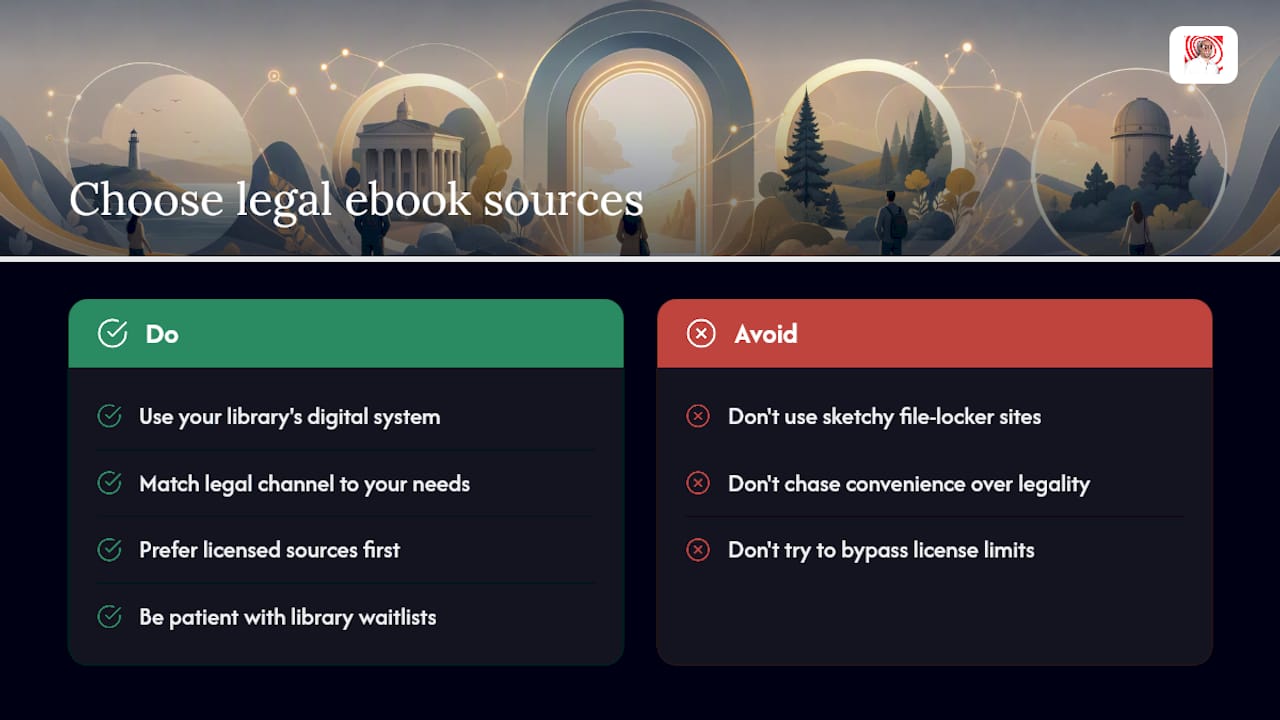
Most guides to free ebooks treat every source as interchangeable, as if Project Gutenberg and a random file-locker site solve the same problem. They don't. The actual skill here isn't finding a free ebook. It's matching the right legal channel to what you actually want to read.
Readers chasing convenience over legitimacy are the ones who end up on sketchy sites loaded with installer prompts, hunting for a bestseller that was never going to be free legally in the first place. That instinct is understandable. It's also exactly backwards. The wait list on Libby for a hot new release exists because your library only licensed so many copies, the same limit that exists on a physical shelf. Working around that limit isn't a shortcut. It's a signal you've wandered into piracy territory.
What I'd prioritize first: get comfortable with your library's digital system before you go hunting anywhere else. It quietly solves more of your reading list than any deal newsletter ever will, and it does it without a single legal gray area.
Find Free Samples and Reader Perks on Markwatsonbooks
Public-domain libraries and lending apps solve a lot, but they can't get you inside a story built specifically for horror readers who want something new. That's where sampling directly from an author's own site earns its place. Markwatsonbooks offers free chapter previews and mailing-list giveaways you won't find on a library loan shelf or a daily-deal newsletter, because they're author-backed rather than third-party licensed.

The difference matters: a library loan or a Gutenberg download gives you a finished, often decades-old work. A preview from Markwatsonbooks gives you a taste of a current series and current Creepypasta anthologies built specifically for readers who want their scares fresh, not public domain. If a sample chapter grabs you the way a good freebie should, the full catalog is waiting on the Books page, ready whenever you decide to keep reading.