
Metaphors, similes, personification, alliteration, and foreshadowing are the literary techniques you will run into most often in fiction, poetry, and exam passages. Each one bends language on purpose, and each one leaves a fingerprint you can learn to spot. A metaphor calls one thing another thing outright ("the classroom was a zoo"). A simile makes the comparison explicit with "like" or "as" ("she is like a rainbow"). Personification hands human traits to something non-human, the way the wind "screams" through trees in a horror scene. These aren't decoration. They're tools writers reach for when plain description won't hit hard enough.
Here's a working list to keep beside you while you read:
- Metaphor — "Time is a thief." Effect: compresses a big idea into one sharp image.
- Simile — "Brave as a lion." Effect: makes an unfamiliar quality easier to picture.
- Personification — "The old house groaned in the storm." Effect: builds mood and menace.
- Alliteration — "Suffocating steam." Effect: adds rhythm and, here, discomfort.
- Onomatopoeia — "The engine howled." Effect: drops the reader into the sound itself.
- Foreshadowing — A character mentions a storm coming; three chapters later, everything falls apart. Effect: builds dread and anticipation.
- Irony — A fire station burns down. Effect: creates a jolt, sometimes dark humor.
- Symbolism — A caged bird standing in for lost freedom. Effect: adds a layer of meaning beneath the plot.
- Hyperbole — "I've told you a million times." Effect: exaggerates for comic or emotional punch.
- Repetition — A phrase returning three times across a chapter. Effect: hammers home a theme.
- Anaphora — "We shall fight on the beaches, we shall fight on the landing grounds." Effect: builds momentum and conviction.
- Rhetorical question — "Do you think I enjoy this?" Effect: persuades without needing an answer.
- Flashback — A scene jumps ten years back mid-chapter. Effect: fills in motive or backstory.
- Motif — A recurring image, like mirrors throughout a novel. Effect: ties disparate scenes to one theme.
Study resources like BBC Bitesize and Purdue OWL organize these the same way most English teachers do, and a novel like 1984 or To Kill a Mockingbird will show you five or six of them in a single chapter if you read closely. Once you can name what you're seeing, the next step is understanding how these techniques group into families, and how to spot them cold in a passage you've never read before.
Key Takeaways
Literary techniques work by turning plain information into a specific reader experience, and naming the technique matters less than explaining the effect it creates.
| Point | Details |
|---|---|
| Four main categories | Group techniques as figurative, sound, structural, or rhetorical to study them faster. |
| Effect beats labeling | Always follow a technique's name with why the writer chose it, not just what it's called. |
| Read aloud for sound devices | Alliteration, assonance, and consonance are easiest to catch by hearing a passage, not just scanning it. |
| Structure rewards rereading | Foreshadowing and motif often only become obvious the second time through a text. |
| See techniques in full fiction | Mark Watson's Creepypasta anthologies and children's books show these devices working across complete stories, not just single sentences. |
Table of Contents
- What Are Literary Techniques, Exactly?
- Figurative Language Examples and How Each One Works
- Sound Devices: How Repeated Sounds Shape Meaning
- Structural Techniques That Shape How a Story Unfolds
- Rhetorical Devices for Persuasion and Emphasis
- How to Spot and Analyze Techniques in a Passage
- How Writers Actually Use These Techniques
- Why These Techniques Change How You Read and Write
- Where to Find These Techniques in Full Stories
- Frequently Asked Questions
- Sources
What Are Literary Techniques, Exactly?
A literary technique is any deliberate choice a writer makes with language, sound, or structure to create a specific effect on the reader. That's it. No mystery, no hidden code. When an author repeats a consonant sound to build tension, or jumps the timeline to plant a clue, that's a technique doing its job.
Here's where students get tripped up: the terms "literary technique," "literary device," and "figure of speech" get used almost interchangeably, but they aren't identical.
- Literary technique is the broadest term. It covers anything from word choice to plot structure.
- Literary device usually means the same thing as technique in most classrooms and study guides, including Grammarly's own glossary, though some teachers use "device" specifically for structural or narrative choices.
- Figure of speech is narrower still. It refers only to figurative language, meaning metaphor, simile, personification, and similar comparisons that aren't meant literally.
So every figure of speech is a literary device, but not every literary device is a figure of speech. Alliteration, for instance, is a device but not a figure of speech, because it works through sound, not comparison.
Look at the difference plain writing makes next to technique-driven writing:
- Literal: "The room was quiet." Technique-driven: "Silence pressed against the walls like a held breath." (personification plus simile)
- Literal: "He was very angry." Technique-driven: "He was a kettle two seconds from boiling over." (metaphor)
- Literal: "The wind blew hard." Technique-driven: "The wind hissed and clawed at the shutters." (personification, sound choice)
Same information, completely different reader experience. That gap is the entire reason these techniques exist.
Figurative Language Examples and How Each One Works
Figurative language is where most students start, and for good reason: it's the most visible category and the one tested most often. These devices all work by asking you to picture one thing as something else.
Metaphor states a direct comparison without "like" or "as." "Laughter is the best medicine" is a classic example, and it works because it compresses an abstract claim into something concrete and memorable, according to BBC Bitesize's breakdown of fiction techniques.
Simile makes the same kind of comparison but flags it openly with "like" or "as." "She is like a rainbow" tells you exactly how to read the image, which makes similes gentler and often clearer than metaphors for younger readers or complex ideas.
Personification gives human qualities to something that isn't human. "The wind screamed through the trees" is a textbook horror-genre example, and it works because it makes an inanimate threat feel alive and intentional.

Symbolism uses one object or image to represent a larger idea. A wilting rose can stand for lost love; a cracked mirror can stand for a fractured identity. Symbolism rewards close readers because it operates quietly, underneath the plot.
Allegory stretches symbolism across an entire story. George Orwell's Animal Farm uses farm animals to represent an entire political revolution, so every character and event carries double meaning.
Irony creates a gap between what's expected and what actually happens. A fire station burning down is situational irony. A character claiming "I never lie" while lying is verbal irony. Both create tension, and often dark humor.
Hyperbole is deliberate exaggeration. "I've told you a million times" isn't meant to be believed. It's meant to convey frustration through scale.
Understatement (litotes) does the opposite: it downplays something for effect. Calling a hurricane "a bit of wind" makes the danger feel almost sarcastic, which can land harder than stating it plainly.
Metonymy substitutes something closely associated with a thing for the thing itself. "The White House announced" stands in for the President's administration.
Synecdoche uses a part to represent the whole, like calling a car "wheels" or workers "hands."
Pro Tip: When you're stuck choosing between metaphor, simile, and analogy, check for the comparison word first. No "like" or "as"? It's a metaphor. Has "like" or "as"? It's a simile. If the comparison stretches across several sentences to explain something complex, like comparing the human eye to a camera, that's an analogy, not a simile.
These devices work because they force the reader to build a picture rather than just receive information, which is the whole idea behind "show, don't tell" as a writing principle. Grammarly's list of common literary devices groups metaphor, symbolism, and irony among the most frequently tested, which tracks with what shows up on most reading comprehension exams.
Sound Devices: How Repeated Sounds Shape Meaning
Sound devices work on your ear before they work on your brain. You can often catch these just by reading a passage aloud, which is exactly why teachers ask students to do that.
Alliteration repeats the initial consonant sound across nearby words. "Suffocating steam" isn't just descriptive, it's uncomfortable to say, and that discomfort mirrors the scene it describes, a pattern BBC Bitesize highlights in its breakdown of tension-building techniques.
Assonance repeats vowel sounds instead of consonants. "The rain in Spain falls mainly on the plain" strings together long "a" sounds that give the line a sing-song rhythm.
Consonance repeats consonant sounds anywhere in a word, not just the start. "Pitter-patter" repeats the "t" sound in the middle, building a light, quick rhythm that mimics rainfall.
Onomatopoeia uses words that imitate the sound they describe. "Howling," "buzz," and "crackle" don't just describe noise, they recreate it on the page, pulling the reader directly into the sensory moment.
Rhyme links words through matching end sounds. Beyond poetry, rhyme shows up in slogans and children's books because it makes language stick in memory.
Here's how to catch these in the wild:
- Read the passage aloud. Sound patterns that hide on the page jump out the second you hear them.
- Underline repeated first letters or sounds, then check whether they cluster around a specific mood, tension, comfort, humor.
- Ask what the sound mimics. A hissing "s" sound often signals danger or secrecy; soft "m" and "l" sounds often signal calm.
Micro-practice: Take any paragraph from a book on your shelf and read it aloud twice. The second time, mark every repeated sound you hear. Nine times out of ten, you'll find at least one sound device the writer placed on purpose, especially in horror or poetry where mood carries as much weight as plot.
Structural Techniques That Shape How a Story Unfolds
Structural devices aren't about individual words. They're about how a writer organizes information across a scene, chapter, or entire book, and that organization does as much emotional work as any metaphor.
Foreshadowing plants an early hint about something that happens later. A character casually mentioning a storm on the horizon, three chapters before disaster strikes, is foreshadowing at work. Its function is almost always to build suspense and reward attentive readers on a second read.

Flashback interrupts the current timeline to show something from the past. A character freezing at the sight of a scar, followed by a scene of the accident that caused it, fills in motive without a narrator having to explain it directly.
Repetition brings the same word, phrase, or image back multiple times across a text. When a phrase resurfaces three or four times in a novel, it's rarely an accident. It's usually the writer underlining a theme they want you to remember.
Listing stacks multiple items or details in a row to create a sense of abundance, chaos, or overwhelming detail, a technique BBC Bitesize identifies as common in descriptive fiction passages.
Pacing refers to how fast or slow a scene moves. Short sentences and quick cuts speed things up; long, layered sentences slow the reader down. Horror writers lean on pacing constantly, tightening sentences right before a jump scare.
Framing places a story inside another story, like a narrator recounting events from years earlier. It adds distance and sometimes unreliability to the account.
Motif is a recurring image or idea that isn't a full symbol on its own but builds meaning through repetition, like mirrors, weather, or a specific color appearing again and again.
Pro Tip: When you're annotating for structural devices, mark the placement, not just the content. A single ominous line means little on its own, but the same line appearing again right before the climax is almost certainly foreshadowing or motif at work. Structure reveals itself through repetition and timing more than through any one sentence.
You can see pacing and foreshadowing working together in genre fiction that depends on tension, which is worth studying if you want to see structural techniques doing heavy lifting outside a classroom textbook.
Rhetorical Devices for Persuasion and Emphasis
Rhetorical devices operate at the sentence level and show up most in speeches, persuasive essays, and dramatic dialogue, where a character needs to convince someone of something fast.
Anaphora repeats the same word or phrase at the start of consecutive sentences or clauses. Winston Churchill's "we shall fight on the beaches, we shall fight on the landing grounds" builds momentum through that repetition, each clause landing like another hammer strike.
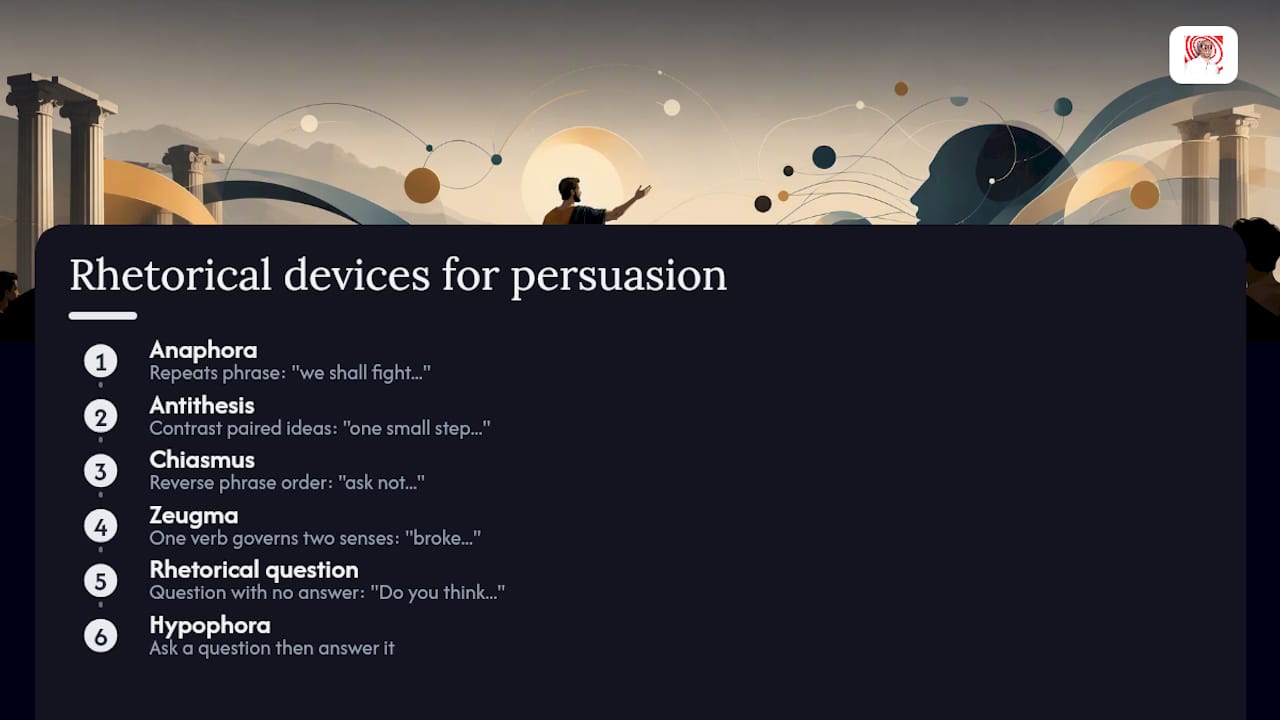
Antithesis places two contrasting ideas side by side in a balanced structure. "That's one small step for man, one giant leap for mankind" works precisely because of that contrast between small and giant.
Chiasmus reverses the structure of a phrase for effect, as in "ask not what your country can do for you, ask what you can do for your country." The mirrored structure makes the statement feel inevitable and quotable.
Zeugma uses one word to govern two or more parts of a sentence in different ways, often for wit. "She broke his car and his heart" uses "broke" both literally and figuratively in the same breath.
Rhetorical question asks a question without expecting an answer, because the answer is obvious. "Do you think I enjoy this?" persuades by forcing the listener to silently agree.
Hypophora goes one step further than a rhetorical question by asking it and then answering it directly, a common move in persuasive essays and TED-style speeches when a writer wants to control the direction of the reader's thinking.
You'll see these devices most in political speeches, courtroom dialogue in novels, and any scene where a character is trying to win an argument rather than just describe one. Recognizing rhetorical devices is often the fastest way to identify which character in a scene holds the persuasive power, even before the plot tells you outright.
How to Spot and Analyze Techniques in a Passage
Facing an unfamiliar passage on an exam or in class doesn't have to feel like guesswork. A short, repeatable method gets you through it every time.
- Read for surface meaning first. Don't hunt for devices on your first pass. Understand what's literally happening.
- Look for unusual comparisons and sound patterns. Anything that feels like it's asking you to picture two things at once, or that sounds rhythmic when read aloud, is worth flagging.
- Note structural signals. Does the timeline jump? Does a phrase repeat? Mark those separately from figurative language.
- Ask what effect it creates. This is the step most students skip, and it's the one that actually earns marks. Naming a device is worth little without saying why the writer chose it.
Here's what that looks like on a real sentence: "The old house groaned and creaked, its windows watching us like tired, hollow eyes." First, identify: personification ("groaned," "watching") and simile ("like tired, hollow eyes"). Then name it directly: the writer personifies the house and compares its windows to eyes. Then state the effect: this combination makes the setting feel alive and threatening before anything actually happens, priming the reader for danger.
Quick practice: Take this line: "Fear crept through the room like smoke, filling every corner, choking every breath." Identify three things: (1) the technique being used, (2) whether it's figurative, sound-based, or structural, and (3) the specific effect it creates on the reader's sense of dread.
Pro Tip: If you can't decide whether something counts as one device or another, describe what it does before you try to name it. Examiners give more credit for a sharp explanation of effect than for a technically perfect label.
How Writers Actually Use These Techniques
Writers don't pick a device and force it into a sentence. They start with a mood, pace, or theme they want the reader to feel, and the technique follows from that goal.
A few practical habits worth borrowing from working fiction writers:
- Choose one strong image and repeat it. A single recurring image, a locked door, a specific color, does more work across a chapter than five unrelated metaphors.
- Use sound devices to control pacing, not just decoration. Short, hard consonant sounds speed a scene up; soft, long vowel sounds slow it down.
- Save rhetorical devices for moments that need weight. A rhetorical question in the middle of a quiet scene falls flat. Save it for a confrontation.
- Let structure do quiet work. Foreshadowing works best when it's easy to miss the first time and obvious the second.
Try these two short exercises: First, write a five-sentence paragraph describing a room using only personification and one sound device, no similes allowed. Second, rewrite a plain sentence like "he was scared" three different ways: once with a metaphor, once with hyperbole, once with structural pacing (short, clipped sentences). Notice which version actually makes you feel something.
If you want to see these techniques doing real work in a genre built entirely on dread and pacing, this breakdown of literary devices in horror fiction walks through exactly how foreshadowing and sound devices combine to keep fear alive across an entire story.
Why These Techniques Change How You Read and Write
These techniques change what a reader feels and remembers, and that's the entire reason they're worth learning beyond a test.
I think about technique the way a lot of writers do: as a set of decisions, not decorations. When I'm building dread in a horror scene, I'm not reaching for a random simile. I'm choosing the exact comparison that makes a reader's skin crawl a half-second before they consciously understand why. That's the gap between knowing the vocabulary and knowing how to use it. Reading with an eye for technique doesn't ruin the magic of a good book. It shows you the gears turning, and honestly, it makes the good scenes hit harder once you can see how they were built. If you want to see these devices working inside finished horror and thriller fiction rather than isolated examples, that's exactly what you'll find across the full catalog of Mark Watson's books.
Where to Find These Techniques in Full Stories
Spotting a metaphor in a single sentence is one thing. Watching foreshadowing, pacing, and symbolism work together across an entire book is a different kind of learning, and it's often the fastest way to make these techniques stick.

If you're a teacher or parent looking for approachable examples in shorter, character-driven stories, the children's book collection uses personification, repetition, and rhythm in ways that are easy to point out to younger readers without overwhelming them. If you're a student who wants to see structural techniques like foreshadowing and pacing doing serious work in tense, fast-moving fiction, the Creepypasta anthology collection leans hard on sound devices and dread-building structure across dozens of short, self-contained stories, which makes it easy to study one technique at a time without committing to a full novel. For readers who want a broader sense of literary fiction beyond horror, Maroon House Press's literary fiction catalog is worth a look too. Start with the children's collection or the Creepypasta anthology, whichever matches what you're studying, and read one story with a pencil in hand.
Frequently Asked Questions
What are examples of literary techniques used most often in fiction? Metaphor, simile, personification, foreshadowing, and alliteration appear most frequently across novels, short stories, and exam passages, because they're versatile enough to build mood, meaning, and tension in almost any genre.
What's the difference between a literary technique and a literary device? In most classrooms, the two terms are used interchangeably. Some teachers reserve "device" for structural or narrative choices and "technique" for the broader category, but the distinction rarely affects how you'd analyze a passage.
Is a figure of speech the same as a literary device? No. A figure of speech refers specifically to figurative comparisons like metaphor and simile. A literary device is the broader category that also includes sound devices, structural choices, and rhetorical strategies.
What's the most common mistake students make when identifying techniques? Naming a device without explaining its effect. Spotting a metaphor earns partial credit at best; explaining why the writer chose that specific comparison, and what it does to the reader, is what actually demonstrates understanding.
How can I practice spotting literary techniques on my own? Pick a paragraph from any book, read it aloud once for sound devices, then reread it silently to hunt for figurative language and structural signals like repetition or foreshadowing. Annotating short passages regularly builds recognition far faster than memorizing a list.
Sources
A handful of resources are worth bookmarking for ongoing study. BBC Bitesize's fiction unit offers a clear, exam-focused breakdown of techniques with short examples. Purdue OWL's literary terms glossary gives you academic-grade definitions for citations and essays. Grammarly's device list covers over a hundred terms with quick examples, useful when you need a device you can't quite name. Reedsy's guide to figurative language connects technique to the "show, don't tell" principle for writers. QuillBot's literary devices list uses a compact format ideal for last-minute revision, and the Wikipedia entry on literary devices is a solid jumping-off point for rarer terms like zeugma or antanaclasis.
- Understanding language and structure in fiction, for CCEA GCSE English Language Unit 4 - BBC Bitesize
- Purdue OWL: Literary Terms
- 105 Literary Devices: Definitions and Examples
- Figurative Language: Types, Examples, and How to Use It
Recommended
- Literary Devices in Horror: What Makes Fear Last
- Build Suspense Like a Pro: Practical Techniques for Writers
- The Best Examples of Gothic Literature for Readers and Students
- The Art of Storytelling: What Makes a Book Impossible to Put Down | Mark Watson books: Crybaby, a gripping horror thriller of survival and vengeance about a rogue elephant in rural India. Buy now or learn more.