
Choosing a horror book comes down to one question: what kind of fear are you chasing? Dread that creeps in slowly, gore that hits fast, a folk tale with teeth, or a scare you can finish in one sitting? Match that answer to a subgenre, then pick from the shortlist below.
TL;DR:
- Most horror lists focus on rankings rather than personal taste, making filtering by subgenre and intensity the best way to find a suitable book.
- Psychological, gothic, folk, cosmic, body, and horror-romance each evoke different fears, so matching subgenre to your preferred fear type improves your experience.
- Shorter formats like novellas or anthologies offer full scares within a weekend or even a few minutes, ideal for quick, varied thrills.
- Checking content warnings on review pages helps avoid scenes that could be traumatic or unwelcome during your reading.
- Mark Watson's horror collections provide diverse, quick-to-sample stories, making them perfect for testing different horror styles before committing to a full novel.
Table of Contents
- Quick Shortlist: Recommendations by Reader Preference and Intensity
- How to Choose a Horror Book: Quick Checklist and Questions to Ask Yourself
- Subgenre Guide: What Each Kind of Horror Feels Like
- Short Reads and Formats: Novellas, Short Novels, and Audiobooks for Quick Scares
- An Author's Take on Reading Method and Taste Signals
- What Most Horror Recommendations Get Wrong
- Why Consider Mark Watson's Horror Collection as Your Next Pick
- Sources
Quick Shortlist: Recommendations by Reader Preference and Intensity
You don't need a "best horror novels of all time" list. You need three or four books that fit the specific fear you're in the mood for tonight. Here's a shortlist broken down by what you're actually craving.
Atmospheric and gothic dread — for readers who want a slow burn and a house that feels alive.
- The Haunting of Hill House by Shirley Jackson: psychological unease baked into the architecture itself. Medium pace, medium length.
- Mexican Gothic by Silvia Moreno-Garcia: colonial rot, mold, and a family secret that unfolds like a fever dream.
- The Turn of the Screw by Henry James: short, ambiguous, and built entirely on what you can't confirm is real.
Psychological horror — for readers who want the scare to happen inside the narrator's head.
- We Need to Talk About Kevin by Lionel Shriver: dread built through a mother's unreliable, guilt soaked memory.
- The Silent Patient by Alex Michaelides: a twist engine disguised as a character study.
- Behind Her Eyes by Sarah Pinborough: a slow reveal that rewrites everything you thought you understood.
Splatterpunk and body horror — for readers who want gore on the page, not implied off it.
- The Girl Next Door by Jack Ketchum: brutal, grounded, and genuinely upsetting rather than gratuitous.
- Tender Is the Flesh by Agustina Bazterrica: dystopian body horror with a premise that lingers for days.
- Bunny by Mona Awad: campus horror with a surreal, visceral edge for readers who want their gore stylized.
Folk horror — for readers drawn to rural isolation, old rituals, and communities that keep secrets.
- The Ritual by Adam Nevill: four friends, a Scandinavian forest, and something older than any of them.
- Starve Acre by Andrew Michael Hurley: grief and folklore tangled together on an English farm.
- Ring Shout by P. Djèlí Clark: folk horror reimagined through a Black American lens, fast paced and inventive.
Short reads and one-sitting scares — for readers who want a complete fright without a 400-page commitment.
- Creepypasta Omnibus One from Mark Watson's horror collection packs 150 internet-horror tales built for exactly this kind of quick, varied scare.
- We Have Always Lived in the Castle by Shirley Jackson: unsettling, compact, and finished in an afternoon.
- The Elementals by Michael McDowell: a lean Southern gothic that doesn't waste a page.
Buzzy modern picks — for readers who want to know what other horror fans are voting for right now. The Goodreads Choice Awards reader-favorite horror list is a live snapshot of what's resonating with the community this year, and it's worth a scroll if you want proof a title has real staying power beyond marketing copy.
How to Choose a Horror Book: Quick Checklist and Questions to Ask Yourself
Taste in horror is specific. Answer these questions honestly before you buy, and you'll land on the right shelf every time.
- Do you want dread or a jump scare? Dread points you to psychological or gothic horror. Jump scares point to supernatural or splatterpunk.
- How much gore can you handle on the page? Low tolerance means atmosphere-driven books. High tolerance opens up body horror and splatterpunk.
- Do you need a sympathetic narrator, or does an unreliable one intrigue you? An unreliable narrator is the engine of most psychological horror.
- How much time do you have? A weekend calls for a novella. A month calls for a doorstop like It.
- Do you want isolation (folk, cosmic) or a crowded, social kind of dread (horror-romance, campus horror)?
- Are you reading to be unsettled, or reading to be entertained by scares? These are different experiences and different books.
- Do you have any hard limits? Animal harm, child endangerment, and sexual violence show up more in splatterpunk than in gothic or folk horror.
- Would a favorite horror movie help you find a book? If you loved a specific film's tone, that's a faster shortcut than any list.
Once you've answered these, map them: dread and ambiguity mean psychological or gothic; ritual and isolation mean folk; visceral fear means splatterpunk; low time investment means a novella or anthology.
Pro Tip: Scan the first review page on Goodreads or StoryGraph for the words "content warning" or "trigger." If three or more reviewers flag the same scene independently, treat it as a pattern, not an outlier, and decide before you buy whether that scene is a dealbreaker.
If you already know your movie tastes, a horror movie to book pairing can shortcut the guesswork, since the tone of a film usually translates directly to the tone of a novel.
Subgenre Guide: What Each Kind of Horror Feels Like
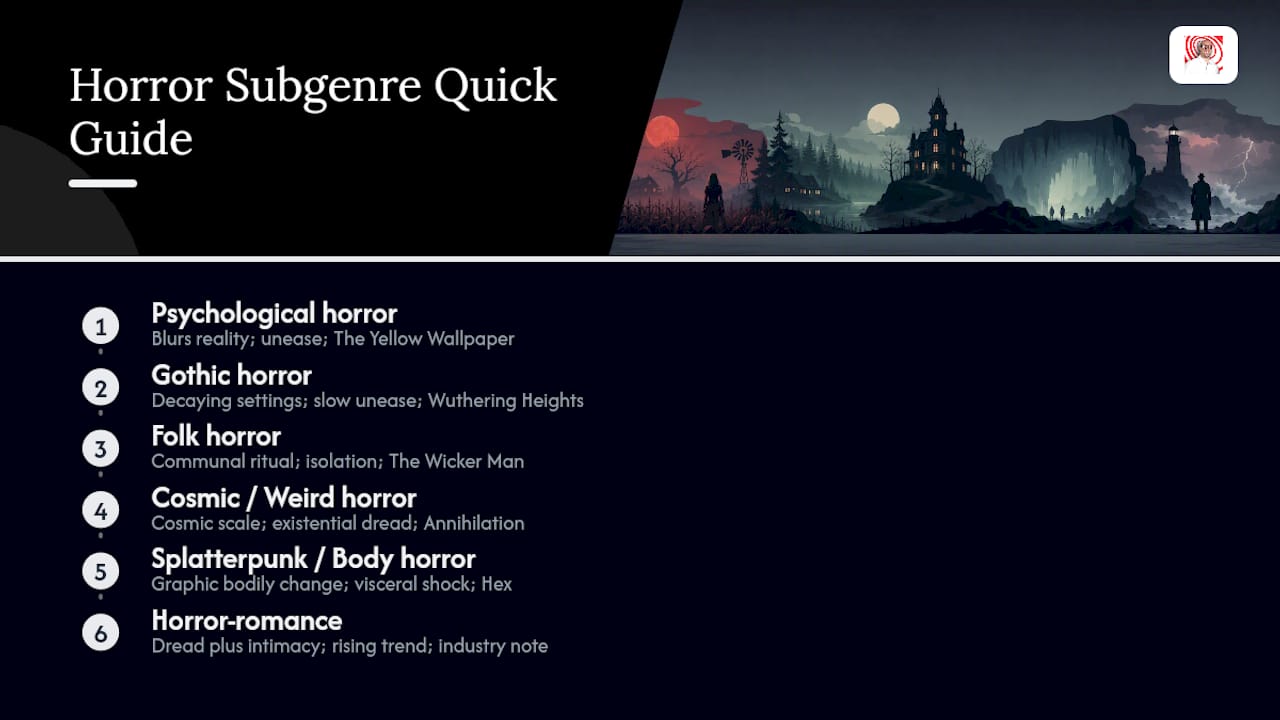
Horror isn't one genre. It's six or seven distinct experiences wearing the same marketing label, and knowing the difference is the fastest way to stop buying books that don't fit.
Psychological horror works by blurring the line between what's real and what's imagined, which is exactly why it gets under readers' skin more than monster fiction does, according to critic Tabitha Potts's FiveBooks interview on the subgenre. Start with The Yellow Wallpaper by Charlotte Perkins Gilman for the short version, or Rebecca by Daphne du Maurier for a full novel built on jealousy and doubt.
Gothic horror leans on decaying settings, family curses, and a slow accumulation of unease rather than sudden violence. Wuthering Heights and The Fall of the House of Usher remain the templates; modern gothic like Mexican Gothic keeps the mood but updates the politics.
Folk horror draws its fear from communities, land, and ritual, usually somewhere isolated enough that help isn't coming. The Wicker Man novelization and Starve Acre both hinge on the horror of belief systems older than the protagonist.
Cosmic and weird horror deals in scale. The fear isn't a killer, it's the idea that the universe doesn't care about you at all. H.P. Lovecraft popularized it; Annihilation by Jeff VanderMeer modernizes it without the baggage.
Splatterpunk and body horror put physical transformation and graphic violence on the page rather than behind a door. Hex by Thomas Olde Heuvelt and The Troop by Nick Cutter both commit fully to that discomfort.
Horror-romance is the fastest-growing blend right now, pairing dread with intimacy rather than avoiding it. Industry trend coverage from EBSCO's Novelist blog points to this crossover, along with mental-health-focused horror and cursed-object stories, as a real shift in what publishers are putting out and what readers are buying.
For a broader survey of where these subgenres show up in contemporary fiction, this roundup of adult horror picks covers titles across most of these categories in one place.
Short Reads and Formats: Novellas, Short Novels, and Audiobooks for Quick Scares
Not every scare needs a 350-page commitment. Novellas like The Ballad of Black Tom by Victor LaValle or Rosemary's Baby by Ira Levin deliver a full arc in under 200 pages, which makes them ideal when you want dread without the marathon.
- Choose an audiobook when pacing and voice acting matter as much as plot, since a strong narrator can carry gothic atmosphere better than silent reading does.
- Choose an anthology or creepypasta collection when you want variety instead of commitment. Mark Watson's Creepypasta Volume 3 delivers fifty standalone stories, so a bad fit costs you five minutes, not five hours.
- Choose a short novel over a novella when you want a real character arc but still want to finish in a weekend.
An Author's Take on Reading Method and Taste Signals
Writing horror for years taught me to judge a book on three things before plot even matters: voice, emotional core, and narrator reliability. Voice tells you in one page whether the author trusts atmosphere or leans on shock. Emotional core is the real subject hiding under the monster, usually grief, guilt, or isolation. Narrator reliability decides whether you're reading a mystery or a confession. When I'm building anthologies, I test every story against those three signals before length or gore level even enters the conversation. That editing process shaped the Creepypasta collection more than any trend list did.
What Most Horror Recommendations Get Wrong
Most "best horror novels" lists rank by consensus, not by fit. A book can dominate a reader-voted award and still be the wrong pick for someone who wants quiet dread instead of gore, or a fifty-page scare instead of a 400-page slow burn. The Booker Library's reader-chosen scariest books makes that obvious. Its list barely overlaps with genre-specific horror rankings, because "scary" means something different to every reader who votes.
The advice readers actually need isn't a ranking. It's a filter: subgenre first, intensity second, length third. Skip the "essential" label entirely and start with the tolerance question, gore or dread, isolation or intimacy, because that answer eliminates half the shelf immediately. Readers who chase prestige lists instead of personal fit end up abandoning good books that simply weren't written for their taste.
— Mark
Why Consider Mark Watson's Horror Collection as Your Next Pick
If the shortlist above pointed you toward short, varied scares, Mark Watson's horror catalog is built for exactly that reader. The Creepypasta anthologies give internet-horror fans and anthology lovers a full shelf of standalone stories, so you can sample a tone in five minutes instead of committing to a full novel on a guess.

Start with a free excerpt through the mailing list signup, or go straight to the full book catalog to browse titles by length and subgenre. If body horror and internet-horror folklore are your speed, Creepypasta Omnibus One is the single fastest way to test a hundred and fifty different scares before deciding which one to read cover to cover.
Sources
- Readers' Favorite Horror 2025 — Goodreads Choice Awards
- 4 horror trends and 16 must-read horror books — EBSCO Novelist
- The best psychological horror books - FiveBooks (Tabitha Potts)
- 11 of the scariest books from the Booker Library, chosen by our readers