

Yes, children's stories that pair a Bull Terrier with separation anxiety themes exist, and Mark Watson's Milo & Ze: A Bull Terrier Puppy Adventure is the best place to start. It's built for early readers suitable for young children, using a Bull Terrier's loyalty and big personality to make emotional lessons stick. Below you'll find more recommended titles, how to pick the right one, and discussion prompts that turn story time into real coping practice.
TL;DR:
- The story of Milo and Ze specifically models loyalty and reunion, helping children understand the emotional importance of routine and connection.
- The breed's physical toughness balances vulnerability, making the puppy's anxiety feel relatable without overwhelming young readers.
- Matching books to a child's age and emotional response is crucial, focusing on story resolution style and trigger safety to ensure reassurance.
- Using these stories in therapeutic or classroom settings benefits from brief discussions and concrete activities that reinforce coping strategies.
- Mark Watson's background in horror storytelling informs his ability to craft emotionally effective, resolution-focused books for young children about anxiety.
Table of Contents
- Which Books Cover Bull Terrier Separation Anxiety Themes?
- How Do You Pick the Right Anxiety Story for Your Child?
- How Do You Discuss These Stories With a Child?
- About the Author Behind These Bull Terrier Stories
- Why Bull Terriers Work So Well in Anxiety Stories
- Using These Stories in Classrooms and Counseling Settings
- Get Milo & Ze and Explore More From Mark Watson
- Why I Write Bull Terrier Stories About Big Feelings
- Sources
- FAQ
Which Books Cover Bull Terrier Separation Anxiety Themes?
Milo & Ze: A Bull Terrier Puppy Adventure is a notable option for readers hunting bull terrier separation anxiety stories. A handful of animal-led picture books tackle the same emotional territory from different angles, so pairing the client's title with a couple of adjacent examples gives parents and librarians real range.
- Milo & Ze: A Bull Terrier Puppy Adventure follows a Bull Terrier puppy through a friendship-driven emotional journey, with plot beats built around loyalty and reunion that speak directly to a child's fear of being left behind. Listings describe it as a story of friendship and emotional growth, and its illustrated format suits early readers for young children for a bedtime or classroom read.
- Browse the rest of Mark's children's books collection if Milo & Ze resonates. Several titles share the same warm, resolution-focused approach to big feelings in small readers.
- Anxious Charlie to the Rescue gives young readers a small dog facing a big challenge, and Kirkus Reviews notes the book works almost like accidental exposure therapy, reassuring kids that a disrupted routine doesn't have to end badly.
- Bridget's Book centers on a rescue pup afraid of being left alone. Goodreads reviewers highlight it as a conversation starter about anxiety, with family and friends stepping in to help Bridget cope.
Each of these books does the same narrative job in a slightly different way. Milo & Ze uses a Bull Terrier's unmistakable devotion to model what loyalty and reunion feel like from a child's point of view. Anxious Charlie leans on humor and a small scale to make the anxious moment feel survivable. Bridget's Book leans on community, showing that other people (and pets) notice when someone is struggling and step in.
If you're building a home or classroom shelf around separation and anxiety themes, start with Milo & Ze for the Bull Terrier angle, then round it out with Anxious Charlie or Bridget's Book for variety. All three are available through standard retail listings, and Milo & Ze can be found through various retail listings, including some author's sites.
How Do You Pick the Right Anxiety Story for Your Child?
Not every anxiety story fits every reader, and matching the book to the child matters more than the topic on the cover. A few practical filters make the choice faster.
- Check the age signals first. Shorter page counts, big simple illustrations, and short sentences suit ages 3 to 5. Denser text and more nuanced plots fit 6 to 9 year olds who can sit with a longer story arc.
- Look at how the anxiety resolves. Some stories lean on adult reassurance, others on peer support, others on a touch of fantasy or humor. A child who responds better to a calm parent figure in real life may connect faster with a story that resolves the same way.
- Preview for trigger safety. Flip through a sample first. Watch for scenes that dwell too long on fear without payoff, and skip anything that treats the separation as punishment rather than a normal, survivable event.
- Read the reviews before you buy. Reviews that specifically mention separation anxiety or emotional coping (like the Kirkus notes on Anxious Charlie) tell you more than a generic star rating ever will.
- Test read-aloud suitability. A story with rhythm and repeatable phrases holds a young child's attention longer, especially during a tense scene.
Pro Tip: Read the last two pages before you buy the book. If the ending doesn't show the character calm and reconnected, it probably won't leave your child feeling reassured either.
How Do You Discuss These Stories With a Child?
The book does half the work. What you say before, during, and after the reading does the rest.
Open with a short script: "This story is about a dog who feels worried when someone leaves. Have you ever felt like that?" That single question normalizes the feeling before the plot even starts, and it tells the child this is a safe topic, not a test.
Discussion prompts work best when tailored by age:
- Ages 3 to 5: "Where did the puppy feel scared in his tummy?" Point to the illustration. Simple, physical language works better than abstract questions at this age.
- children in early elementary years: "What did the puppy do to feel better? Would that work for you?" Kids this age can start connecting a character's coping strategy to their own routine.
- older children: "Why do you think the story ended the way it did?" Older readers can handle a bit of literary distance and enjoy unpacking the author's choices.
A few simple activities extend the lesson past the last page. Have the child draw the puppy's feelings as colors or shapes. Build a small "safe box" with a photo or comfort object, echoing whatever comfort the story's animal character relied on. Practice a short separation ritual at home, like a wave-and-wait-by-the-window routine, borrowed straight from the book's own resolution scene.
Pro Tip: Pause right before the story's turning point and ask, "What do you think happens next?" That one pause does more for anxiety processing than finishing the book in one sitting.
About the Author Behind These Bull Terrier Stories
Mark Watson writes across horror thrillers, children's literature, and Creepypasta internet horror anthologies, and his official site, Markwatsonbooks, functions as the hub for all three. That range matters here: an author who understands how to build tension and resolution for adult horror readers brings the same instinct for pacing to a picture book about a worried puppy.
A few resources back up why his Bull Terrier titles fit this niche specifically:
- The children's books collection houses Milo & Ze alongside other illustrated, emotionally grounded titles.
- Blog posts like why scary stories help develop courage in children and the educational value of scary stories for kids show ongoing engagement with how fiction shapes a child's emotional resilience.
- A dedicated post, Milo & Ze for early readers suitable for young children, connects the book directly to its intended reading audience.
Why Bull Terriers Work So Well in Anxiety Stories
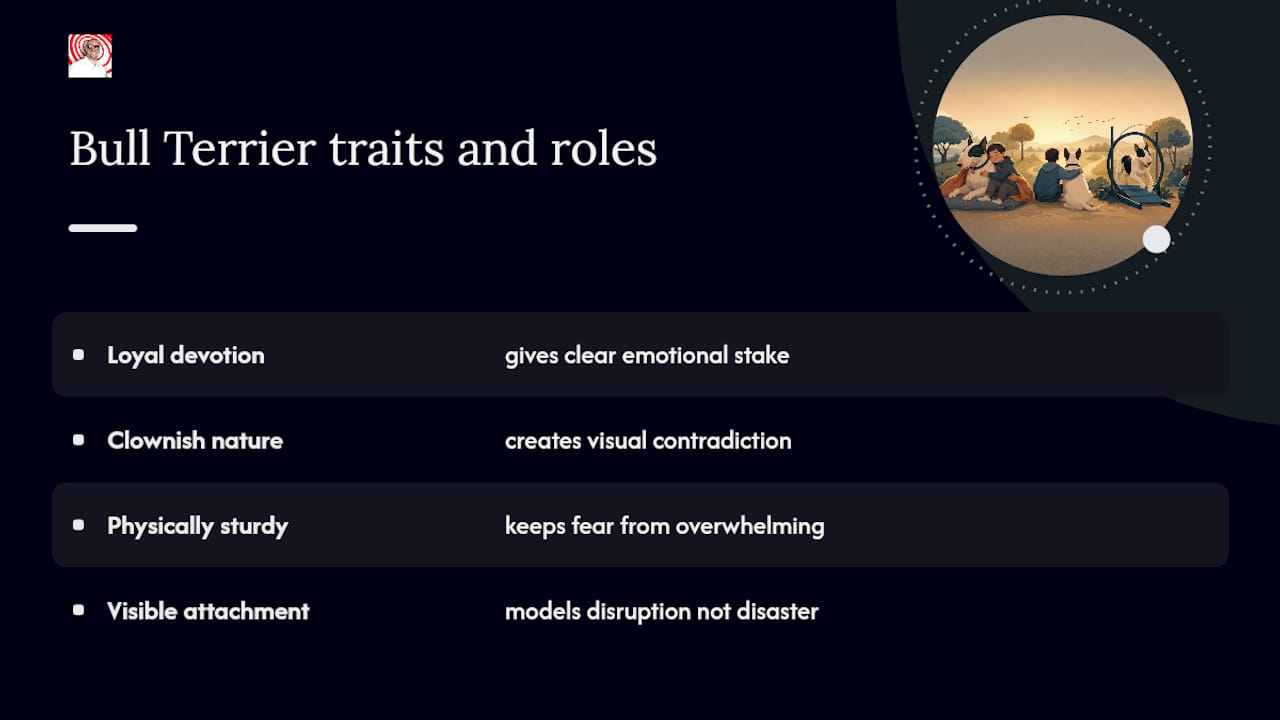
Bull Terriers bring a specific personality to the page that other breeds don't quite replicate. They're famously loyal, physically sturdy, and often described as clownish and stubborn in equal measure, a combination that makes for a character who feels vulnerable and resilient at the same time. A dog that looks tough but acts like a big goofy shadow to its owner gives kids a visual contradiction worth exploring: something can look strong on the outside and still feel scared underneath.
That contrast maps naturally onto separation anxiety. A Bull Terrier's intense devotion to its family gives a story an obvious emotional stake. Readers understand instantly why the character would panic at being left, because the bond was established as central to who that dog is. Scholarly commentary on animal characters and anxiety notes that this kind of modeling helps children see that a disrupted routine doesn't have to end in disaster, and a breed with this much visible attachment sells that lesson faster than a more neutral animal might.
The breed's reputation for physical toughness also does quiet narrative work. A Bull Terrier character can face a scary moment and still come across as capable, which keeps the story from tipping into pure distress. That balance, vulnerable feelings paired with a sturdy, even comic exterior, is exactly what makes Milo & Ze land with young readers instead of overwhelming them.
Using These Stories in Classrooms and Counseling Settings
Picture books about anxious animal characters have a place well beyond bedtime. Teachers, school counselors, and child therapists increasingly use narrative-based tools to open conversations that direct questions can't. A story creates emotional distance. A child can talk about "the puppy's" fear more comfortably than naming their own.
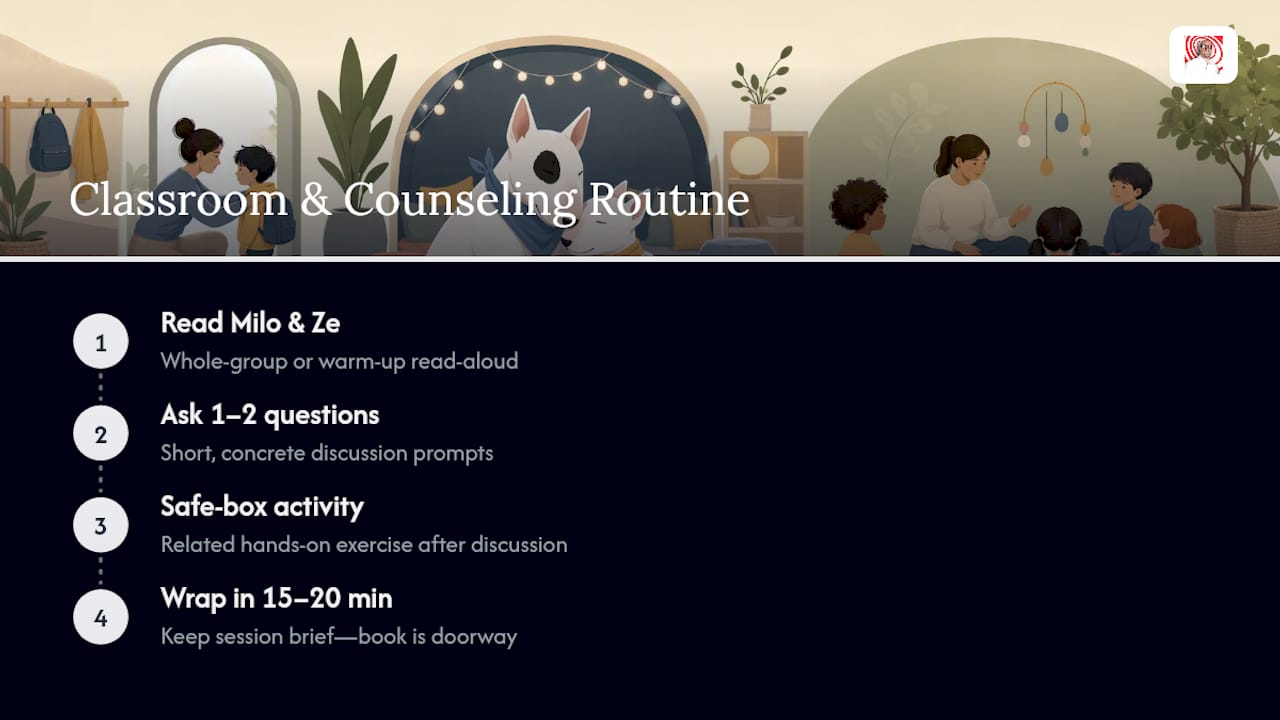
A classroom read-aloud works well as a whole-group entry point before a lesson on feelings or transitions, especially at the start of a school year when separation from parents is fresh. In a counseling setting, a book like Milo & Ze can serve as a warm-up before a harder conversation, giving a child language and imagery to borrow when their own words run short. A scholarly review of animal-led anxiety narratives backs this approach, noting that modeling coping through a character gives kids a low-stakes way to process routine disruption before facing it directly.
For either setting, keep the follow-up short and concrete. Ask one or two of the discussion questions covered earlier, then move into a related activity, like the "safe box" exercise, rather than turning the whole session into a talk therapy moment. The book is a doorway, not the destination. Used that way, it fits comfortably into a 15 to 20 minute block, whether that's a morning circle time or the first few minutes of a counseling appointment.
Get Milo & Ze and Explore More From Mark Watson
Markwatsonbooks.com is where you go to find Bull Terrier stories your family will actually want to reread, not just a random pull off a shelf. Every title here comes from one author who treats emotional storytelling with the same care he brings to his horror and Creepypasta work, so you're browsing a catalog with a consistent voice instead of guessing which imprint got it right.

Start with the Milo & Ze product page for the full synopsis, cover art, and buying links, or browse the wider children's books collection if you want a few backup titles on hand for different moods and ages. Sign up for the mailing list while you're there. Mark occasionally runs free book offers for subscribers, and it's the fastest way to hear about new Bull Terrier stories or related releases before they go wide. If horror or Creepypasta anthologies are more your speed for older readers in the house, the full books catalog covers that ground too. Pick Milo & Ze up today and see how far one loyal, worried puppy can go toward opening a real conversation.
Why I Write Bull Terrier Stories About Big Feelings
I write about Bull Terriers because they're contradictions on four legs: tough looking, soft hearted, loyal to a fault. That makes them perfect stand ins for a kid working through the fear of being left, even briefly. Milo & Ze started as a story about a puppy, but it became a story about reunion, and I think that's the part readers actually remember. If it helps your family start a conversation you've been putting off, that's the whole point. Explore the rest of the catalog and the blog when you're ready for more.
— Mark
Sources
- ANXIOUS CHARLIE TO THE RESCUE | Kirkus Reviews
- Scholarly commentary on animal characters and anxiety (BYU scholars archive)
- Milo & Ze: A Tale of Friendship (Mark Watson Children's Books) - AbeBooks
- Bridget's Book — Goodreads
FAQ
What Age Group Is Milo & Ze Best Suited For?
Milo & Ze works best for early readers suitable for young children, based on its illustrated format and story length. Younger children respond to the pictures and simple language, while older kids in that range can follow the fuller emotional arc.
Can a Book Alone Fix a Child's Separation Anxiety?
No single book resolves separation anxiety on its own, and these stories work best as a conversation starter rather than a cure. Scholarly commentary on animal characters and anxiety supports using them alongside adult-guided discussion, not in place of it.
Where Can I Buy Milo & Ze?
Milo & Ze is available directly through its Markwatsonbooks, with pricing listed on the site. You can also browse the full children's books collection for related titles.
Are There Other Bull Terrier Books Besides Milo & Ze?
Milo & Ze is the primary Bull Terrier title in Mark Watson's catalog, and it remains the strongest fit for readers searching specifically for this breed. For broader anxiety themes with different animal characters, Anxious Charlie to the Rescue and Bridget's Book offer comparable narrative approaches.
How Do I Use This Book in a Classroom or Counseling Session?
Use the book as a short warm-up activity rather than the entire session, pairing a read-aloud with one or two discussion questions about the character's feelings. Follow up with a simple activity, like drawing the character's emotions, to reinforce the lesson without overextending a young attention span.