
The best illustrated horror books don't just tell a terrifying story. They pull you into one. Whether you're drawn to gothic classics, pulse-pounding graphic novels, or collector-quality special editions, this curated list covers the top picks available in the US market right now.
| Title & Creator | Format | Artistic Style | Notability | Best For |
|---|---|---|---|---|
| Dracula by Bram Stoker | Illustrated novel / special editions | Gothic, cinematic | Timeless classic with multiple celebrated editions | Fans of classic gothic horror |
| Frankenstein by Mary Shelley | Illustrated novel | Gritty gothic (Wrightson); ornate (Coulthart); vivid color (Ekdahl) | Wrightson edition praised by Stephen King; Coulthart won World Fantasy Award | Readers who want classic lit with striking visuals |
| Locke & Key by Joe Hill | Graphic novel series | Dynamic, expressive | Multiple Eisner and Bram Stoker Award nominations | Serialized supernatural horror fans |
| Locke & Key, Vol. 1: Welcome to Lovecraft | Graphic novel | Dynamic, expressive | Award-nominated series opener | Newcomers to horror graphic novels |
| The Walking Dead by Robert Kirkman | Graphic novel series | Grim, realistic noir | Cultural phenomenon; adapted for TV | Zombie apocalypse and long-form horror fans |
| The Walking Dead, Vol. 1: Days Gone Bye | Graphic novel | Stark black-and-white noir | Defining opener of an iconic series | Readers starting the saga |
| Through the Woods by Emily Carroll | Horror anthology | Bold color on black; surreal | Critically acclaimed; praised by Publishers Weekly | Short eerie stories with striking art |
| The Night Eaters trilogy by Marjorie Liu and Sana Takeda | Graphic novel trilogy | Painted, luminous watercolor | Eisner Award winner; NPR and Washington Post Best of Year | Layered narratives with lush visuals |
| Dracula: A Storybook Portfolio by J.H. Williams III | Illustrated art book | Painterly, silent-film cinematic | New York Times bestseller; multi-award winner | Collectors and immersive visual storytelling |
| The Sandman, Vol. 1: Preludes & Nocturnes | Graphic novel | Atmospheric, genre-crossing | Foundational Neil Gaiman series; Hugo and Eisner wins | Literary horror with mythic depth |
Content warnings apply across this list: graphic violence, body horror, and mature themes are present in most titles. The Walking Dead and The Night Eaters trilogy are strictly adult reads. Through the Woods suits older teens and adults.
What makes classic illustrated horror still essential reading?
Gothic illustration and classic horror were practically born together. Dracula by Bram Stoker and Frankenstein by Mary Shelley remain the twin pillars of the genre, and the illustrated editions produced over the decades show just how much a single artist can reshape a reader's experience of a familiar story.
The most celebrated version of Frankenstein pairs Mary Shelley's original 1818 text with numerous full-page illustrations by Bernie Wrightson, created over several years. Wrightson's intricate inking delivers a gritty, almost grotesque gothic style that Stephen King described in his introduction to the edition as one of the greatest achievements by any artist in the field. That's not a small claim. John Coulthart's illustrated deluxe edition from Hachette takes a different path entirely, with 25 ornate full-page illustrations and bonus material including John Polidori's "The Vampyre." Coulthart won the World Fantasy Award's Artist of the Year, and his work on Frankenstein shows why. Kim Ekdahl's full-color Arcturus Illustrated Classics edition offers a third interpretation, vivid and accessible, with patterned endpapers that signal collector quality from the moment you open the cover.
What separates a great classic illustrated edition from a merely pretty one is whether the visual design reinforces the narrative's dread rather than just decorating it. The Folio Society's horror and gothic editions are the benchmark here, using font choice, endpaper art, and binding materials to deepen the reader's psychological immersion.
- Wrightson's Frankenstein (Simon & Schuster): gritty gothic inking, introduction by Stephen King, approximately fifty full-page illustrations
- Coulthart's Frankenstein (Hachette): 25 ornate full-page illustrations, World Fantasy Award-winning artist, includes bonus Polidori and Byron texts
- Ekdahl's Frankenstein (Arcturus Illustrated Classics): full-color illustrations, patterned endpapers, unabridged text
- Dracula illustrated editions: multiple versions available, from cinematic painted styles to gothic line art
Pro Tip: When buying a classic illustrated edition, check whether the illustrator's style matches the tone you want. Wrightson's Frankenstein is visceral and dark. Coulthart's is ornate and surreal. Same text, completely different emotional experience.
Which contemporary horror graphic novels are worth your time?
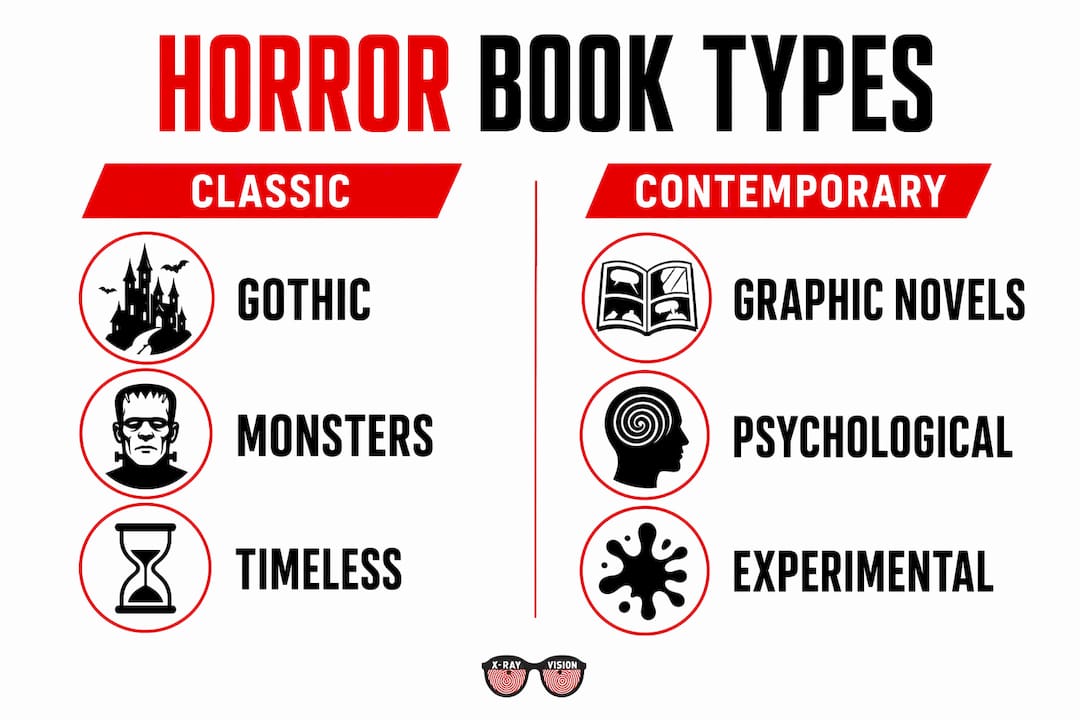
Modern horror graphic novels have pushed the format into territory prose alone can't reach. The best ones use negative space and pacing to build psychological tension, letting silence and shadow carry weight that dialogue never could.
Through the Woods by Emily Carroll is the clearest proof of that principle. Five short stories, each built around a different shade of dread, with Carroll's bold color-on-black illustration style creating a keep-the-lights-on atmosphere that reviewers at Publishers Weekly called "masterfully" tension-building. The horror graphic novel spectrum Carroll helped define now includes everything from atmospheric anthologies to cinematic intercutting narratives.
The Night Eaters trilogy by Marjorie Liu and Sana Takeda operates on a different scale entirely. Sana Takeda's watercolor and ink work shifts from sunny domestic warmth to submerged supernatural dread within a single page turn, a technique that earned the series an Eisner Award for Best Graphic Album and recognition from NPR and the Washington Post. The narrative structure intercutting present-day action with Hong Kong flashbacks gives the trilogy a cinematic depth that rewards patient readers.
- Locke & Key, Vol. 1: Welcome to Lovecraft: strong entry point for the series, vivid artwork, supernatural family drama
- The Walking Dead, Vol. 1: Days Gone Bye: stark black-and-white art, immediate tension, defines the series' grim tone
- The Sandman, Vol. 1: Preludes & Nocturnes: Neil Gaiman's genre-crossing mythology, atmospheric visuals, Hugo and Eisner Award-winning series
- Through the Woods: short-form anthology, surreal color work, ideal for readers new to horror comics
Pro Tip: If you're new to horror graphic novels, start with Through the Woods or The Sandman, Vol. 1. Both are self-contained enough to read without committing to a long series, and both show the format at its most artistically ambitious.
How do special illustrated editions change the horror experience?
A special edition isn't just a prettier version of a book. The best ones use physical design as a storytelling tool, and the difference is visceral the moment you hold one.
Dracula: A Storybook Portfolio by J.H. Williams III is the most striking recent example. Over 150 pages of painted illustrations accompany prose passages written in the spare, evocative style of 1920s silent films like Nosferatu. Williams, a multi-award-winning New York Times bestseller known for The Sandman Overture and Batwoman, treats every spread as a cinematic frame. The result sits somewhere between an art book and a novel, and it works precisely because the visual and textual registers match.
The Folio Society's approach to horror classics demonstrates the same philosophy at a different price point. Their special editions use archival-quality paper, foil-blocked bindings, ribbon markers, and custom typography to extend the narrative's atmosphere into the physical object. The Pet Sematary 40th anniversary edition illustrates this perfectly: Edward Kinsella's 11 illustrations and spiral epitaph endpapers earned a Gold Cube Award from the Art Directors Club of New York and a Gold Award from the 3x3 International Illustration Awards 2023.
Pro Tip: When evaluating a special edition for collector value, look for archival paper, foil or gold-blocked bindings, and named illustrators with award credentials. Those design details signal longevity and genuine production investment, not just a premium price tag.
Standout fact: J.H. Williams III's Dracula: A Storybook Portfolio runs over 150 pages of original painted art, making it one of the most visually immersive single-volume horror releases in recent years.
How do you choose the right illustrated horror book for your taste?
The format question comes first. Graphic novels like The Walking Dead or Locke & Key deliver continuous narrative momentum, where art and story build across hundreds of pages. Anthologies like Through the Woods offer complete, self-contained dread in short bursts. Illustrated text editions like the Wrightson Frankenstein or Williams' Dracula portfolio sit closer to art books, where you set your own pace.
After format, consider artistic style. Gothic illustration (Wrightson's Frankenstein) uses dense, intricate inking to create weight and shadow. Surreal styles (Carroll's Through the Woods, Takeda's Night Eaters) use color and distortion to unsettle. Noir approaches (The Walking Dead's stark black-and-white) strip everything back to raw contrast. Knowing which visual register pulls you in makes the choice much easier.
- Prefer long-form narrative? Start with Locke & Key, Vol. 1 or The Walking Dead, Vol. 1.
- Want literary depth with horror? The Sandman, Vol. 1 or the Wrightson Frankenstein.
- Drawn to painted, cinematic art? Dracula: A Storybook Portfolio or The Night Eaters trilogy.
- New to the genre? Through the Woods is the most accessible entry point.
- Collecting? Prioritize editions with named illustrators, archival paper, and award credentials.
Content warnings matter too, especially if you're buying for someone else. The Walking Dead and The Night Eaters trilogy contain graphic violence and mature themes. Through the Woods suits older teens. The Sandman Vol. 1 carries mature content throughout. Check age suitability before gifting.
Pro Tip: Research the illustrator before you buy, not just the author. The illustrator's style shapes the entire emotional tone of an illustrated edition. Two editions of the same classic can feel like completely different books.
Markwatsonbooks brings a different kind of horror to the shelf
If the titles above have you hungry for more dark fiction, Markwatsonbooks offers something the mainstream publishers don't: original horror written for readers who grew up on internet horror, Creepypasta, and the kind of unsettling tension that keeps you scrolling at 2 AM.

The horror collection at Markwatsonbooks spans horror thrillers and illustrated internet horror anthologies, including Creepypasta collections that pull from the same tradition of short, atmospheric dread that makes Through the Woods so effective. Where the titles in this list come from major publishers with decades of distribution, Markwatsonbooks is an independent author's platform built around direct reader engagement. You get the books, the backstory, and the community in one place. Browse the full book catalog to see what fits your shelf next.
Key Takeaways
The strongest illustrated horror books pair a skilled illustrator with source material that demands visual interpretation, and the format (graphic novel, anthology, or special edition) shapes the reading experience as much as the story itself.
| Point | Details |
|---|---|
| Format determines pacing | Graphic novels build sustained tension; anthologies deliver concentrated dread in short bursts. |
| Illustrator style defines tone | Wrightson's gothic inking, Takeda's luminous watercolor, and Carroll's surreal color-on-black each create a distinct emotional register. |
| Special editions add physical storytelling | Folio Society editions use archival paper, foil bindings, and custom typography to extend horror atmosphere into the object itself. |
| Dracula: A Storybook Portfolio stands out | J.H. Williams III's over 150 pages of painted art make it one of the most immersive single-volume horror releases available. |
| Markwatsonbooks for internet horror fans | The Markwatsonbooks horror collection offers original horror thrillers and Creepypasta anthologies for readers who want dark fiction beyond the mainstream. |