
Use a dedicated tracking app plus an author newsletter, and you will never miss a release date again. BookNotification and Bound cover the tracking side with human-audited data; Substack-style author lists cover the delivery side, since email consistently outperforms social algorithms for reaching readers directly. What follows is a quick tool comparison, then a fifteen-minute setup you can run today. Author Mark Watson uses this exact combination, plus BookFunnel, to get new titles in front of readers before anyone else hears about them.
TL;DR:
- Tracking apps like BookNotification and Bound provide accurate, human-verified release dates, reducing errors common with retailer feeds.
- Subscribing to author newsletters offers the most reliable and direct way to receive timely release alerts, outperforming social media algorithms.
- Setting calendar reminders for verified release dates helps prevent missing upcoming titles, especially when you follow multiple series or authors.
- Exporting data from platforms like Goodreads and maintaining a backup spreadsheet ensures you can quickly re-follow authors if a third-party service shuts down.
- Combining tracking tools, newsletters, social media posts, and calendar alerts creates a robust system to stay updated without overwhelming your inbox.
Table of Contents
- Which tools help you follow book releases best?
- How do you set up book release alerts in fifteen minutes?
- Why newsletters beat algorithms for release alerts
- What happens if a tracking app disappears tomorrow?
- Managing and prioritizing notifications to avoid overload
- Using social media effectively to follow authors and book release announcements
- Integrating book release tracking with calendar apps or reminders for timely alerts
- How I follow releases and why I invite readers to subscribe
- Get Mark Watson's releases straight to your inbox
- Sources
Which tools help you follow book releases best?
Six options dominate how UK readers actually track new titles, and each one solves a slightly different problem. Some specialize in author-level tracking with clean, human-checked data. Others lean on your inbox, which turns out to be the most dependable channel of all.
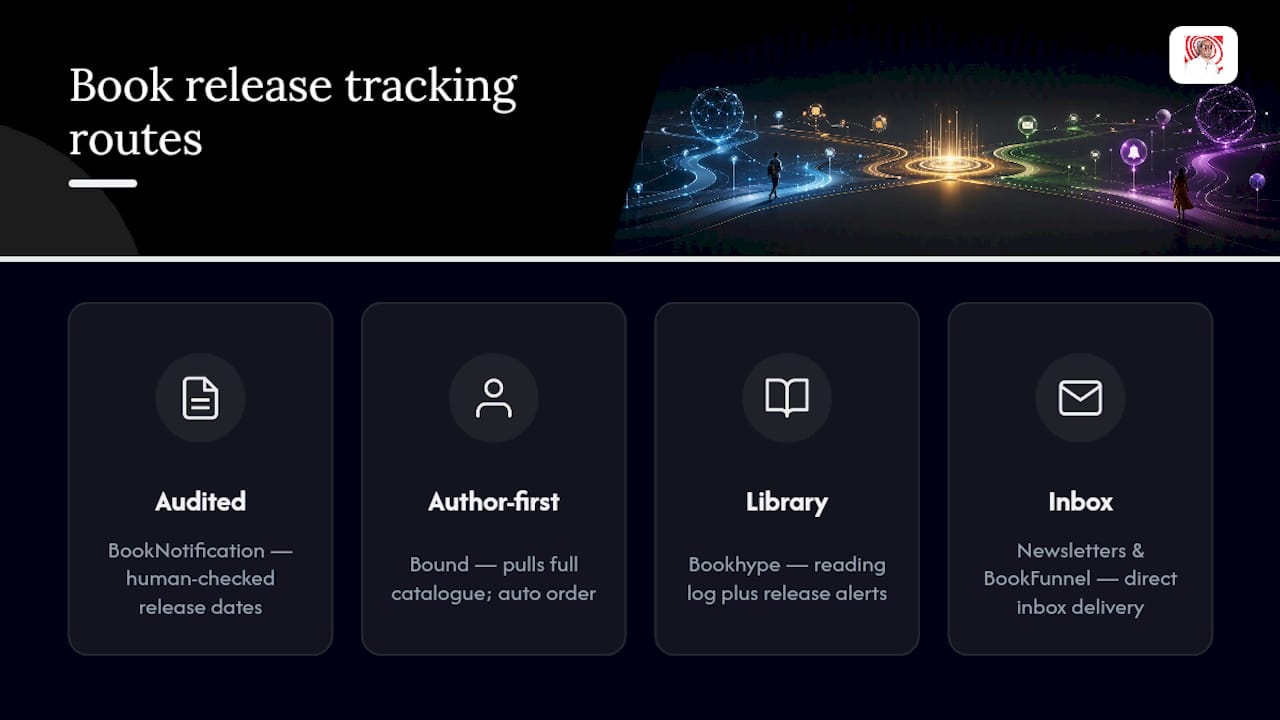
BookNotification builds human-audited author and series pages and actively monitors upcoming release dates rather than scraping them from retailer feeds. That matters more than it sounds. Retailer metadata gets release dates wrong constantly, especially for reprints, box sets, and books that get pushed back by six months without warning.
Bound, developed in the UK, takes an author-first approach: favorite a writer once, and the app pulls in their entire catalogue and sorts it into reading order automatically, flagging anything upcoming. It is close to zero-maintenance once set up.
Bookhype suits readers who want more than alerts. It tracks reading progress and builds a personal library alongside its release notifications, so it doubles as a reading log.
Substack and similar newsletter platforms are less an app and more a category. Search an author's name plus "newsletter" and you will often find a direct feed straight to your inbox, no algorithm involved.
Goodreads and Amazon Author Follow remain the defaults for most casual readers, since both are already baked into accounts people use anyway, even though neither audits release dates by hand.
BookFunnel is not a tracking tool at all. Authors use it to deliver free ebooks and reader magnets the moment you join their list, which is why it shows up so often in signup flows.
Best for quick decisions: pick BookNotification or Bound if accuracy matters most, Bookhype if you want library features too, and a Substack-style list for any author whose new work you never want to miss.
How do you set up book release alerts in fifteen minutes?
Start with the app, then layer email and automation on top. Each step below takes a few minutes.
- Pick a tracking app and follow an author. Open BookNotification or Bound, search the author's name, and hit follow or favorite. Bound will pull their full catalogue immediately; BookNotification adds them to your alert list and starts monitoring release dates.
- Join the author's newsletter. Check the back matter of any book you own, or the author's website footer, for a signup link. Look for phrasing like "get notified of new releases" rather than a generic contact form, since that usually signals an actual release-alert list rather than a general mailing list.
- Wire up RSS or automation for anything without a native alert. If a publisher's "coming soon" page has no signup option, grab its RSS feed and pipe it into an email digest through Zapier or IFTTT, so blog updates land in your inbox automatically.
- Check publisher catalog pages directly for series you follow closely. Search "[publisher name] upcoming 2026" a few times a year to catch announcements before they hit tracking sites.
Pro Tip: Scan the QR code printed in the back of a physical book before you shelve it. Most authors link straight to a newsletter signup there, which is the fastest way to lock in alerts for a series you already love.
Why newsletters beat algorithms for release alerts
Social platforms decide who sees your favorite author's posts. Email does not work that way. Industry analysis on author email lists shows they convert better on launch day than social reach ever does, largely because a subscriber list is not subject to a feed algorithm's mood swings.
An email lands in your inbox regardless of engagement history. A social post competes with thousands of other signals before it ever reaches you.
Newsletters also tend to arrive on a predictable rhythm, with open rates commonly in the 25 to 45 percent range when authors send consistently rather than sporadically. That consistency is what makes email the more reliable channel, not just a marginally better one.
Mark Watson runs this exact setup, pairing his own newsletter with BookFunnel to deliver free stories the moment someone joins his list. Readers get direct launch links and early access to titles across horror, children's books, and the Creepypasta anthologies well before general announcements go out.
What happens if a tracking app disappears tomorrow?
Third-party services shut down. Goodreads has changed hands before, and smaller trackers fold without warning. Protecting your reading history takes a few minutes every few months.
- Export your data from Goodreads or similar platforms as CSV, since that format transfers cleanly between services.
- Set a recurring reminder, quarterly is plenty, to re-export and save a fresh copy locally.
- Keep a simple spreadsheet of followed authors and active newsletter subscriptions as your master backup.
- If a service disappears, use that spreadsheet to re-follow authors and rejoin newsletters within a day, rather than trying to rebuild your list from memory.
Managing and prioritizing notifications to avoid overload
Follow enough authors and your inbox turns into noise fast. The fix is not fewer follows, it is smarter filtering.
Create a separate email folder or label just for author newsletters, so release alerts never get buried under everything else. Most email clients let you build a filter rule off sender domain in under a minute, and it is worth doing before you subscribe to a fifth or sixth list.
Inside your tracking app, use tiers if the app supports them. Mark your must-read authors as top priority so their alerts surface first, and let everyone else sit in a general "watching" category you check monthly rather than daily.
Batch your checking, too. Rather than reacting to every notification as it lands, set aside ten minutes on a Sunday to review what came in during the week. This works especially well with weekly newsletter digests, since most authors are not sending daily updates anyway.
Finally, unfollow ruthlessly. If you have not read an author's last three releases, the alert is just clutter. Tracking apps make it easy to add someone; they should make it just as easy to walk away when your reading taste shifts.
Using social media effectively to follow authors and book release announcements
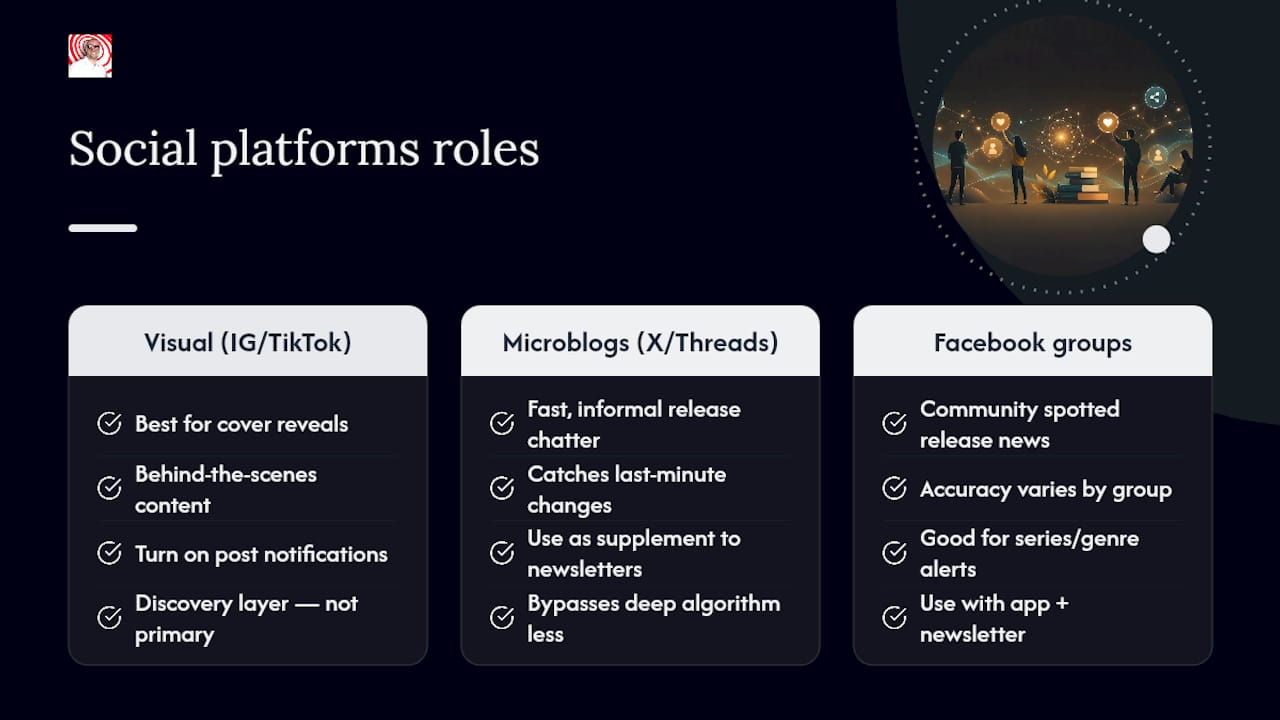
Social platforms still have a role, just a narrower one than most readers assume. Treat them as a discovery layer, not your primary alert system, since a feed algorithm decides what you see rather than the author.
Instagram and TikTok work best for cover reveals and behind-the-scenes content, the kind of material that rarely makes it into a newsletter. Turn on post notifications for a handful of favorite authors rather than relying on the main feed to surface their content, since that is the one setting that bypasses the algorithm entirely.
Twitter/X and Threads tend to carry faster, more informal release-date chatter, useful for catching last-minute schedule changes a newsletter has not sent yet.
Facebook groups built around specific series or genres often share release news community members spot before official channels catch up, though accuracy varies group to group.
The practical rule: use social platforms to catch what a newsletter or tracking app missed, not as your only method. Pairing an app with an author-owned list protects you from algorithm changes that can bury an author's posts overnight, something that has happened to nearly every platform at some point.
Integrating book release tracking with calendar apps or reminders for timely alerts
A release date sitting in an app is easy to forget. A release date sitting in your calendar is not.
Most tracking apps and author pages list a specific release date once it is confirmed, which is your cue to add a calendar event immediately rather than trusting you will remember later. Google Calendar and Apple Calendar both support quick manual entry, and setting the reminder for the morning of release, rather than weeks ahead, keeps it from getting lost among unrelated events.
For readers tracking several series, a recurring monthly calendar check works well: block fifteen minutes to scan your tracking app or newsletter folder and transfer any newly confirmed dates. This catches the releases that get announced with only a month or two of lead time, which happens more often than publishers would like to admit.
If your tracking app offers an export or calendar sync, feed it into an existing calendar rather than maintaining a separate one. One calendar you actually check beats three you forget about.
How I follow releases and why I invite readers to subscribe
I run my own release alerts the same way I recommend here: a newsletter tied directly to my books page, paired with BookFunnel for instant delivery the moment someone signs up. Subscribers get release alerts, early reveals, and extras I do not post anywhere else. If you want Mark Watson updates specifically, rather than a general tracking feed, joining that list is the most direct route.
— Mark
Get Mark Watson's releases straight to your inbox
Tracking apps are great for casting a wide net across dozens of authors, but if you want to follow one author closely, going straight to the source beats any third-party tool. Subscribing through Markwatsonbooks means release alerts come from Mark directly, not filtered through an algorithm or a database that might list the wrong date.

Browse the full books page to see what is out now and what is coming next, or head straight to the Creepypasta collection if horror anthologies are what you are after. Parents tracking the children's titles can bookmark the children's books collection for the same treatment. Every one of these pages links to the newsletter signup, so subscribing takes under a minute and puts every future release directly in your inbox, no app required.
Sources
For deeper background on the tools and research mentioned above, these are worth a look: BookNotification for human-audited author tracking, Bound for catalogue-based following, author email list research on why newsletters convert better than social reach, and Bookaholic for curated author interviews and book news.
- Book Notification - Track Your Books, Get Notified on New Books!
- Bound — The book tracking app built around authors
- Author Email Lists: Your Most Reliable Sales Channel