
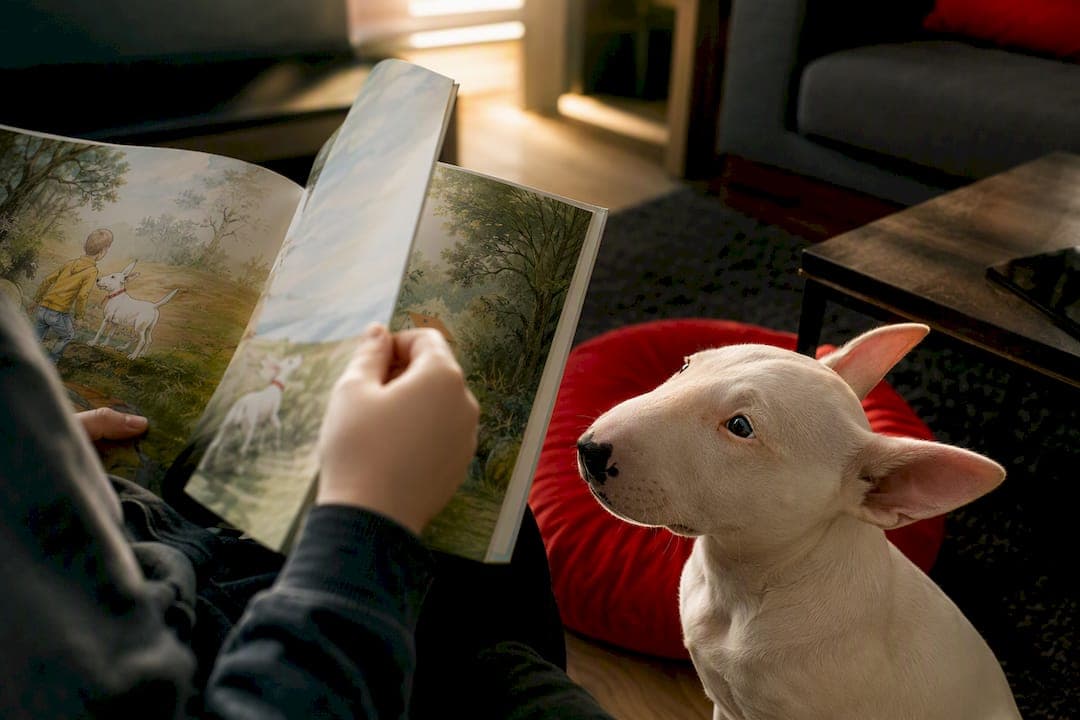
Milo & Ze: A Bull Terrier Puppy Adventure is the strongest first Bull Terrier story for children because it pairs bright, expressive illustration with a read-aloud rhythm kids ask to hear again. It fits ages 3 to 7, works equally well at bedtime or in a classroom circle, and threads a gentle boundaries theme through a puppy's messy, funny energy. Check the full book details before you buy or preview it.
TL;DR:
- For ages 3 to 7, the story's rhythm and comedic puppy mischief make it ideal for both bedtime and classroom reading, encouraging positive boundaries.
- The picture book's appeal relies on expressive illustrations and a clear emotional arc that resonates on repeated readings, not just breed accuracy.
- Choosing the right book involves assessing the child's interest, reading level, and the story's rhythm, with preference given to those kids request to hear again.
- Supplementing the story with prediction, feeling charts, and role-play activities deepens comprehension and fosters a shared, routine reading experience.
- The story's strength comes from behavior-driven plots, making it engaging and memorable, regardless of the child's independent reading skills.
Table of Contents
- The best Bull Terrier stories for children right now
- How to choose the right Bull Terrier book for your reader
- Turning a Bull Terrier story into a classroom or bedtime routine
- Why an author's own experience with the breed shapes better stories
- What actually makes a Bull Terrier story work for kids
- Preview Milo & Ze before you buy
- Where to learn more about picking children's books
- Sources
- FAQ
The best Bull Terrier stories for children right now
Parents searching for Bull Terrier tales for kids usually want one of two things: a bedtime book that holds a squirmy three-year-old's attention, or a classroom pick sturdy enough to survive a fourth read-aloud without losing the room. Milo & Ze was built with both in mind.
Milo & Ze: A Bull Terrier Puppy Adventure (Mark Watson) leads this list for a reason. The story follows a Bull Terrier puppy through the chaos of learning house rules, chewing the wrong things, and figuring out where his energy belongs. It's written for ages 3 to 7, and it earns its spot on repeat-read shelves because the puppy's mistakes feel real rather than moralized. Kids laugh at Milo's antics first, then absorb the boundaries lesson almost by accident. Teachers can use it as a single sitting story for kindergarten circle time; parents get a bedtime book durable enough for the fortieth request.
For families who want a second breed-focused picture book to round out story time, Pija Lindenbaum's Boodil My Dog is worth knowing about. Kirkus Reviews describes it as an illustrated tale that leans into a stout, expressive dog's quirks and antics, and it reads well alongside puppy-adventure stories for the same age band. It isn't part of the Markwatsonbooks catalog, but it's a fair example of what "good" looks like in this niche: strong character work, visual humor, and a dog who feels like a specific personality rather than a generic pet.
If neither of those two options quite matches what you're after, here's what to look for instead:
- Picture books with expressive illustration and gentle humor rather than flat, static art that doesn't reward a second look.
- A clear emotional arc for the dog character (confusion, mischief, resolution) instead of a string of unconnected cute moments.
- Read-aloud rhythm — sentences that sound good spoken, not just read silently.
- A behavior or boundaries thread, since Bull Terrier stories aimed at kids often double as a soft introduction to supervised play and pet responsibility.
For the client's own title, the fastest path is the Milo & Ze book page, where you can see the age guidance and preview details before buying.
How to choose the right Bull Terrier book for your reader
Picking well starts with separating two different questions: what your child can read alone, and what they'll sit still for when you read to them. Those are not the same number. Oxford Owl recommends matching books to a child's actual interests and favoring rhythmic text and strong illustration for ages 3 to 7, and a read-aloud book can comfortably run above a child's independent reading level because you're carrying the harder vocabulary for them.
The five-finger rule helps here: open to a page and count the words your child would stumble on. Five or more stumbles means the book is likely too hard for solo reading, though it may still be a fine read-aloud choice. Beyond difficulty, judge a Bull Terrier story the way Reading Rockets judges any children's book: character development, illustration quality, and whether it holds up on a third or fourth read.
Run through this checklist before you buy or borrow:
- Does the illustration style hold a young child's attention on its own, without the text?
- Is the dog character's personality distinct, not just "a dog does dog things"?
- Does the story have a rhythm that sounds natural read aloud, not just on the page?
- Is there a boundaries or empathy theme that opens a conversation, rather than lecturing?
- Would you want to read this again tomorrow night?
Pro Tip: Read the first two pages out loud in the store or library before deciding. If the sentences feel clunky in your mouth, they'll feel clunky at bedtime too.
Turning a Bull Terrier story into a classroom or bedtime routine
A good story earns its keep when it becomes a routine, not a one-off. For a 10 to 15 minute session with Milo & Ze or a similar puppy-adventure book, pause every two to three pages and ask a simple question: "What do you think Milo does next?" That single habit, prediction pausing, is one of the shared-reading techniques the UKLA's early reading framework recommends for building comprehension in young readers.
A few activities extend the story well past the last page:
- Feeling chart: after each spread, have kids point to a face (happy, confused, sorry) that matches the puppy's expression.
- Puppet role-play: a sock puppet Bull Terrier acting out "asking before petting" reinforces the boundaries theme physically.
- Draw-the-scene: kids sketch their favorite moment, then explain why they picked it.
- Supervised play discussion: a short, age-appropriate chat about why puppies (and real dogs) need calm hands and quiet voices.
For ages 3 to 5, keep the discussion to feelings and faces. For ages 6 to 7, add a short "why" question, why does the puppy need rules, why does calm work better than chasing, since older kids can hold a cause-and-effect conversation.
Reading Rockets notes that reading for pleasure supports literacy development, and books that invite repeat reads, the kind kids ask for again without being told to, do more of that work than books that get opened once and shelved.
Why an author's own experience with the breed shapes better stories
Writing a convincing Bull Terrier story for kids takes more than picking a fun-looking dog. Mark Watson's catalog spans horror thrillers, Creepypasta anthologies, and children's books, and that range shows up in how Milo & Ze is paced. It borrows a horror writer's instinct for tension and release, a puppy's mischief builds, then resolves, without ever losing its warmth for young readers.
The puppy's boundary-testing moments in Milo & Ze echo the same real-world adjustment period covered in the Bull Terrier puppy care guide on the Markwatsonbooks blog, where the first 72 hours of a new puppy's energy and limits get the practical treatment. Story and guidance were built to reinforce each other.
That connection between blog and book, fiction that mirrors real supervised-play advice, is part of why teachers and parents can trust the story's themes as more than decoration.
What actually makes a Bull Terrier story work for kids
Most advice on choosing dog-themed picture books focuses on the dog: is the breed cute, is it accurate, does it look right in the pictures. That's the wrong starting point. The stories that hold up on a tenth read are the ones where the puppy's behavior carries the plot, not its breed label. Kids don't remember "Bull Terrier." They remember "the puppy who chewed the shoe and felt bad about it."

The conventional wisdom also oversells independent reading level and undersells read-aloud rhythm. A book a five-year-old can't decode alone might still be the best bedtime book in the house, because you're the one reading it. Prioritize how a story sounds out loud before you worry about vocabulary difficulty.
If you take one thing from this: pick the book your child asks to hear again. Repeat requests are the real signal of a good match, better than any age label on the cover.
— Mark
Preview Milo & Ze before you buy
Markwatsonbooks gives you a straightforward alternative to guessing at a bookstore shelf: every title, including Milo & Ze: A Bull Terrier Puppy Adventure, comes with a summary and age guidance right on the page, so you know before you buy whether it fits your reader.

If Milo & Ze sounds like the right fit, preview or buy it directly on the book's page. Want more options for story time? Browse the full children's books collection for other illustrated titles from the same catalog, and sign up on the site for updates on new releases and free preview offers.
Where to learn more about picking children's books

For deeper guidance beyond this list, Oxford Owl covers age-specific selection for ages 3 to 7, Reading Rockets explains why illustration and character quality drive repeat reads, and BookTrust's Great Books Guide curates age-based lists for ages 4 to 11.
Sources
- How to choose a book for ages 3–7 | Oxford Owl
- Choosing and using kids' books | Reading Rockets
- Great Books Guide | BookTrust
- Boodil My Dog review | Kirkus Reviews
FAQ
What age group is Milo & Ze best suited for?
Milo & Ze: A Bull Terrier Puppy Adventure is written for ages 3 to 7, spanning both bedtime read-alouds for younger kids and classroom read-alouds for early elementary. Full details are on the book's page.
How do I know if a book is too hard for my child to read alone?
Use the five-finger rule: open a page and count words your child struggles with. Five or more stumbles usually means it's better as a read-aloud than an independent read, a guideline Oxford Owl recommends for ages 3 to 7.
What makes a Bull Terrier children's story worth reading more than once?
Strong illustration, a distinct character personality, and rhythm that sounds good spoken aloud all drive repeat requests, according to Reading Rockets. Stories that use the puppy's behavior as the plot, rather than the breed as a novelty, tend to hold up best.
Are there classroom activities that pair well with a Bull Terrier story?
Yes. Prediction pauses, feeling charts, and short puppet role-play all extend a puppy-adventure story into a 10 to 15 minute lesson, following shared-reading approaches from the UKLA early reading framework.
Where can I buy Milo & Ze or browse similar titles?
Milo & Ze is available on its book page, and the full children's books collection lists other titles from the same catalog. Current pricing is available on the site.